
August 20, 2014
Bulgaria!
I got this information from Cultures of the World: Bulgaria by Kirika Stavreva and Lynette Quek.
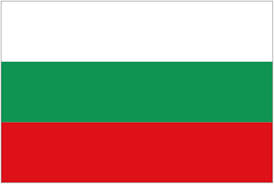
-The white stripe in the Bulgarian flag means peace, the red band symbolizes strength and valor, and the green represents hope and joy.
-There is legend about how Bulgaria was created so beautiful. On the day that God was giving out land to the various nations, he parceled it all out and forgot the Bulgarians. When a Bulgarian man complained, God thought for a moment, and then smiled broadly, “I have the solution for you. Since all the world has been already divided up, I will give your people a piece of paradise.”
-Yogurt is a staple of the Bulgarian diet. It can be eaten plain or made into a drink, salad dressing, or cold soup. Bulgarian yogurt is usually made from cow’s milk, but sheep’s or goat’s milk are also used. Yogurt from sheep’s milk is considered a delicacy.
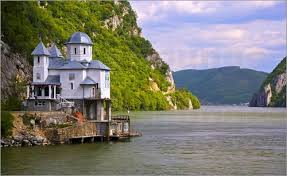
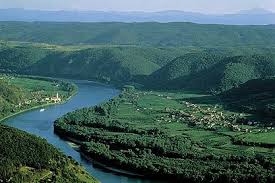
-The Danube river runs through or touches the borders of ten countries, including Bulgaria. The Danube is mentioned in the title of a famous waltz by Austrian composer Johann Strauss, An der schonen blauen Donau (On the Beautiful Blue Danube). I love this song primarily because of growing up watching the live action The Jungle Book, in which there are several scenes where the meant-to-be couple practices the waltz in the jungle, and then dances to it romantically at a ball. J Anyone who hasn’t watched the movie should do it now! It has Wesley from The Princess Bride in it and everything! 
-Before Bulgaria fully grown into their independence, they had to fight to keep their land. They were involved in the First and second Balkin Wars that took place right before World War I–and then they fought in both World Wars. Bulgaria was a reluctant all of Germany, but they did not send troops into combat and declined to deport Bulgarian Jews to the death camps of Poland.
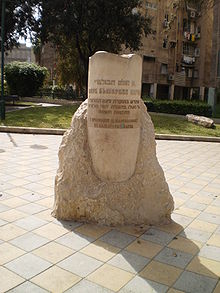
-“Few people are aware that the Bulgarian people saved the lives of 48,000 Jews during World War II. Under German pressure, the government of the day introduced some halfhearted anti-Semitic measures. The Bulgarian population, however, responded with sympathy and support for the Jews. Once, when the Jews of Sofia were to be expelled to the rural death camps, the citizens of the capital stopped the Nazis by preventing the Jews from reaching the railway station, and the Jews were sent home.
In 1943 the Nazis finally exacted an agreement from the Bulgarian commissar for Jewish affairs to deport 6,000 “leading Jews” to the Treblinka death camp in Poland. But leading intellectuals raised a huge outcry in the media against the plan. Church officials and ordinary farmers from north Bulgaria threatened to lie down on the railway tracks to stop the deportation trains. None of the Jews ever left the country.” (Stavreva and Quek)
-Bulgaria became a Communist state after 1944, when in the midst of peace talks with the Allies, Bulgaria was attacked and taken over by the Soviet Union. The country began to echo the Soviet Union in many spheres. But other areas, such as central control of the arts, it proved less restrictive than the former Soviet Union.
Bulgaria’s “gentle revolution” began with the forced resignation of the dictator Todor Zhivkov in November 1989. Zhivkov’s fall set off a wave of rallies. Tens of thousands of demonstrators converged on the central squares of the capital and the big cities, demanding free elections and the end of the regime. Bulgaria managed to break away from Communist rule without bloodshed and violence.
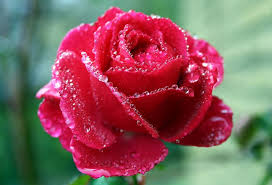
-The national flower of Bulgaria is the Oil-bearing Rose, and the capital is Sofia. Sofia lies at the foot of Mount Vitosha and was built on the site of an ancient Roman fortress, the remains of which can still be seen in the underpasses in the city center. Being an art history student, I’m restraining myself from listing out all the varied and beautiful architecture and paintings in Sofia. You’re welcome 
-Here are some Bulgarian proverbs;
-Unselfishness: Do a good deed and cast it into the sea.
-Determination: The dogs are barking, but the caravan moves on.
-Female: A woman is an Iron shirt.
-Self importance: An empty bad weighs more than a full one.
-Self-interest: The dog barks to guard itself—not the village.
-Over 90% of the adult population of Bulgaria is married. They do not approve of those who choose to remain single, and they frown upon couples who live together without getting married. Mixed marriages of people of different races are virtually unknown in this overwhelmingly white society. Even different ethnic groups, or those with different religious backgrounds, do not intermarry. But friendships among all groups are encouraged or, at least, tolerated.
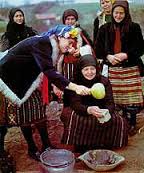
-January 21 is Grandmother’s Day, one of the most touching and heartwarming Bulgarian holidays. In the past the oldest and most experienced woman in the family would help with the birth of her grandchildren. Grandmother’s Day is a holiday for women. On this day Bulgarian women visit their grandmothers to ceremonially wash their grandmother’s hands and to present them with a fluffy new towel. The same ritual is enacted in the maternity wards of hospitals, where nurses are given a towel as an acknowledgment of the nurses’ part in taking care of the mothers and their newborn.
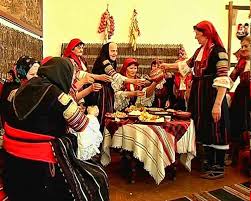
-In Bulgaria the engagement ring is on the left finger and then in the ceremony, the ring is moved to the right hand.
-It is considered a disgrace if a young adult leaves the parental home before marriage. Unless a promising career is at stake, the parents will be accused of having driven their child away. Even after marriage, it is common for young couples to live with either set of parents.
-“It is hard being a stranger in Bulgarian society. Even in a small village strangers get only a hesitant ‘hello,’ and then only after the elderly people, seated on the benches in front of their homes, have looked them up and down. In the cities people ignore each other. Office workers and store clerks appear to wear stone masks.” (However, there is a Christmas tradition, where the women of the family will leave out a piece of pie outside their home for the stranger who has not managed to make it home though the now-covered country roads. (Stavreva and Quek) Also, the proper etiquette when riding a train in Bulgaria is not averted eyes and silence, but sharing of food, wine, stories, and sometimes dancing!
-Body language is used a lot for conversation. Perhaps the most confusing to outsiders is the Bulgarians habit of shaking the head to the left to express agreement or compliance. What is more, a Bulgarian gently nods his head up and down to signify “no.” though it is usually accompanied by clicking sounds of the tongue. It’s like that scene from Sing’n in the Rain. 
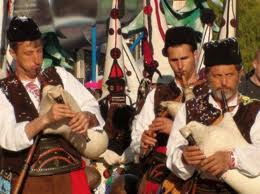
-The main instruments used in Bulgaria are the gaida (bagpipe) and the kaval (wooden flute). And I only thought bagpipes were primarily used in Scotland!
-Bulgarians drink coffee for every meal of the day.
-May 24 is the holiday known as the Day of Letters, which celebrates the written word and education. This holiday is very important to children who have just learned to read and write and pays respect to teachers, educators, writers, journalists, actors, musicians, and artists of Modern Bulgaria.
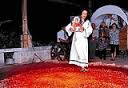
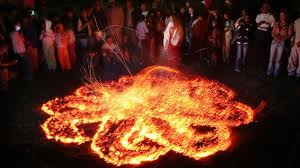
-On May 21, the day of Saints Constantine and Helena, the local people light bonfires. At sunset, when the fires have turned to red-hot embers, the dancing begins to the beat of drums and the drone of bagpipes. Barefoot men and women, carrying priceless old icons in their hands (pictures of saints, rosaries, etc.), start to circle around the embers, picking up the fast rhythms. Then, raising the icons above their heads, the step into the hot coals. At the end, dancers shake the ashes and the embers from their feet and step out—unharmed. These dancers are called the Nestinari, and the secret to this dance is passed down from generation to generation.
That is it for random information on Bulgaria. Next time I’ll write about the more serious aspects of Bulgaria and what I’m praying about this week! If any of you want to add anything else, feel free!!!
God Bless!
~Tori







