


Kyrgyzstan (pronounced kur-guh-STAHN) is in Central Asia, right below Kazakhstan (see my previous blog) and next to China. Mountains cover 80% of the country, and it is sparsely populated. “Kyrgyz” means “forty”, referring to the original 40 clans that made up the Kyrgyz culture. The Kyrgyzstan flag features a sun with 40 rays, with lines on the inside of the sun resembling the design of the top of a yurt.

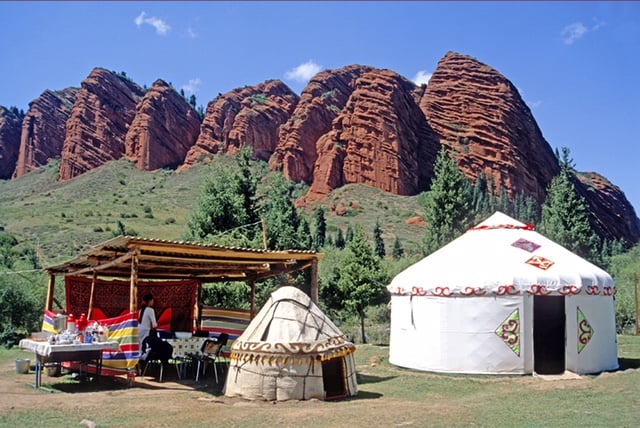
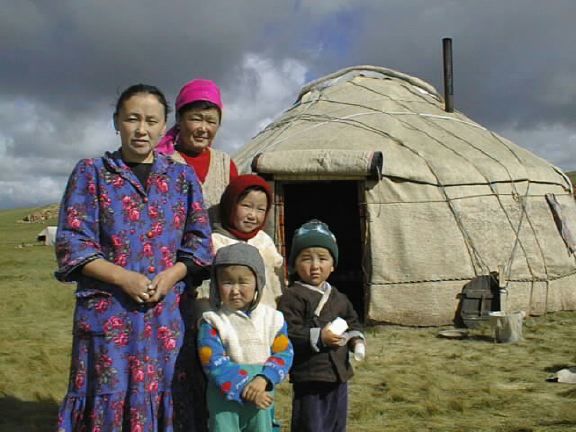
The majority of the population still lives in rural areas, with only 36% living in cities. Kyrgyz (the people of Kyrgyzstan) are traditionally semi-nomadic, meaning they live in permanent homes in the winter, and take their livestock to the mountains and live in yurts for about 3 months in the summer. In some mountainous regions, there are only about 60 days when there is no snow on the ground.

Their lives are dependent on livestock, especially horses and sheep. Horses are used as a mode of transportation and herding sheep. Fermented mare’s milk is very popular, and horse meat is occasionally eaten. Mutton is the favorite meat, and yurts are made of felted sheep’s wool.

The second largest city, Osh, is 3,000 years old, and was a key trading point on the Silk Road for caravans going between Europe and Asia.
Kyrgyzstan is a secular state, but struggles with corruption. It was the first country to form its own government after the fall of the USSR in 1991. Eighty-eight percent of the population is Muslim, 5% non-religious, and 5% Christian. In 2005, an anti-extremism law was passed, causing some restrictions to Christians and evangelism. However, there is still more religious freedom than in most of their neighboring countries. During Communism, Christianity was only allowed within immigrant communities—the Orthodox faith to Slavic people, and the Protestant faith to German people.
Sources:







