
A few days ago, during the night of the 28th of October, a boat carrying 600 people capsized over the small stretch of the Agaean between Turkey and the Greek island of Lesvos. This boat was one of the many that make this journey everyday.
Turkey is clearly visible looking northward at any time of day and in any weather from Molyvos and Sykamineas, which is where we spend most of our time as a squad.
Standing in Lesvos, Greece looking north to see the Turkish Coastline
Nearly touching, Turkey and Greece are closest right here at this small gap, where the distance between the countries is a measly 9 Kilometers, that’s less than 6 miles for all my American readers. Easily, I can run that distance in about 45 minutes, and I know for all the refugees looking from Turkey to Greece the distance must seem so close they can taste it. At any moment I can look out across the icy, treacherous sea, and catch a glimpse of an overcrowded boat on the horizon making its way towards freedom. But here’s the reality, at least 70 people drowned that night when that boat capsized, and there’s probably more that were uncounted, swallowed by the waves.
Greece is a stark contrast to the bleak picture of refugees running from their homes.
View from a window in Molyvos
Here there are cobblestone paths, beautiful blue waters to look out over, quaint stores, awesome food, even a castle at the top of a hill with a sprawling village beneath it, and every moment here seems like a beautiful fairytale straight from the movies everyone always wanted to be a part of.
The city of Molyvos, Greece on the island of Lesvos
However, the pain of the world cannot be shut out, and the setting becomes a jarring, bizarre juxtaposition when the refugees are added to the mix.
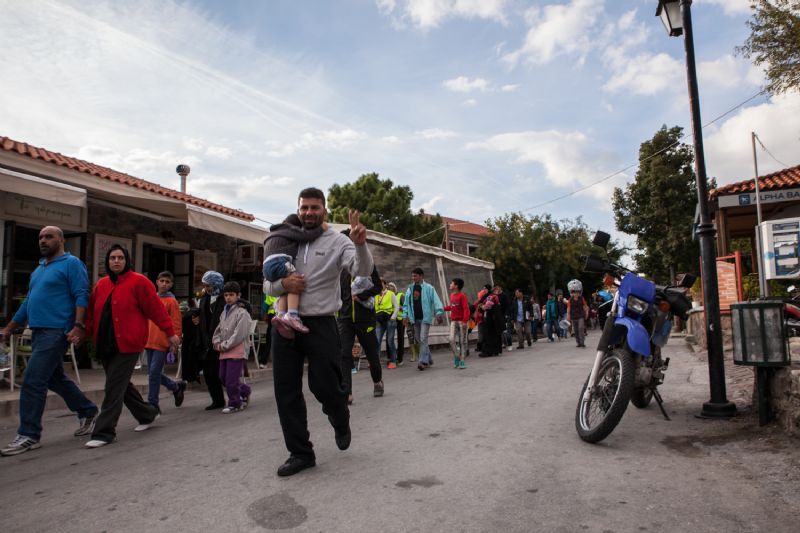 Group of families walking through Molyvos to the next refugee camp
Our team was walking down to the docks, the day after the boat capsized, and a small, old orthodox church stood with its door gaping and sounds rushing out from its echoey spaces. The beckoning revealed refugees strewn about the floor gazing up at the golden icons above them, as they themselves lay wrapped in golden, crinkly thermal blankets. Stopped, I was mesmerized by the difference, as if there was a line drawn right in front of me. One side had the sun shining down, waves glistening, and beauty all around, but inside that dimly lit church people were battling for their lives with the sounds of chaos messing against the peaceful rhythm of the waves. Crisis was spilling out of the church doors, as volunteers were sorting through materials to help those in poor health. All the same, the locals continued on with their day as usual.
Inside, a translator’s words reverberated, as she spoke to the nurse, “She’s lost her baby in the waters last night,” The mother’s body was limp, non-responsive, not dead, but hopeless.
“There appears to be a societal impulse to blame traumatized individuals for their suffering…
 Man outside of the camp in Skala Sykamineas
‘Society becomes resentful about having its illusions of safety and predictability ruffled by people who remind them of how fragile security can be. Society’s reactions [to traumatized people] seems to be…in the service of maintaining the beliefs that the world is fundamentally just, that people can be in charge of their lives, and that bad things only happen to people who deserve them.’
Single men and families waiting in line at the camp at Sykamineas
In short, we sacrifice those who suffer so we can maintain our illusions of autonomy and safety”
-Rid of my Disgrace by Justin and Lindsay Holcomb
Single men waiting in the camp at Sykamineas
Natives to the island of Lesvos didn’t want this refugee crisis, and organizations like Euro Relief, the humanitarian arm of Hellenic Ministries, battled long and hard to try to use the space and resources of the island to help refugees.
Inside the camp at Skala Sykamineas
Now, thanks to native Greek activists who have championed the cause of the refugees, we have some spots for relief. The local populous doesn’t want the refugees to think that they can stay at these locations for any extended period of time, so they have renamed the camps where they provide food, shelter, and bussing services for the refugees “Assembling Points” instead of camps. Solutions are complicated, but the current reaction of the average Greek to the giant influx of refugees is to ignore them.
Older woman and son walking the streets of Molyvos, going to the next refugee camp
However, as much as the Greeks may wish this problem would simply “ease-up” or “go away” the numbers of refugees seem to show no indication of dwindling. A year ago, the number of refugees that passed through Lesvos totaled around 44,000 people for the entire year. This year, August alone tallied 45,000 refugees for that one month, and there doesn’t seem to be any indication that the refugees will stop coming in as massive numbers as these statistics show. About every three hours another 2,000 refugees land on the coastline near Sykamineas alone.
In Molyvos, Refugees wander the streets trying to make it to the next leg of their journey.
Group of people walking through Molyvos headed to the nearest refugee camp
The same day we traveled down to the docks 150 refugees walked from one end of Molyvos to the other, and all the while congesting roads and traffic in the city. It is nothing special to see sojourners on the sides of roads or in groups, for they are a ragtag, small army of families and lonely individuals searching for shelter, water, and food. However, in a greater sense they are all looking for a new place to call home and make their own.
Woman sitting on blankets inside camp at Sykamineas, Greece
These people need a home. Giving them a home means sharing our home with them or advocating on their behalf.
Syria may be the country with the most forefront problems, but the hurt of the world is made fullscreen in the visceral reality of the camp. People come from Syria, Iraq, Afganistan, Pakistan, Somalia, Uganda, The Congo, and even the Dominican Republic. All of these ethnicities, nationalities, and people groups come seeking a new life, and not only a few are being chased, not only a few have been wrecked by war, and not only a few have lost someone special.
Afghani 14 year olds travel alone, because the Taliban killed their families.
14 year old youths from Afghanistan who had their parents killed by the Taliban now searching for a safer home
A man from Aleppo, Syria shared with me his summations of the war, “Bombs, bombs, bombs, bombs always…bombs! We don’t care who wins or loses. Any military are not welcome in Syria anymore…30-40 people were dying in my hometown everyday…Everyday!”
Another shares that he’s afraid of being kidnapped and killed by his government in Iraq.
Iraqi leaving his homeland for fear of his government.
There are people running from rebel groups in Africa.
Ugandan fleeing rebels that seek to press him into their army or kill him
People who have been kidnapped by ISIS.
Ex-Iraqi SWAT team member kidnapped by ISIS fleeing his country
So many come, and they all come for a variety of reasons.
Refugees waiting to get into the camp at Sykamineas
However, they are unified by their experience.
Each individual that comes across our eyes has risked everything, and the road is perilous, confusing, and difficult to say the least. But, this road is traveled for family, for safety, for freedom, and for a place to call home.
A family waits to get into the camp at Sykamineas
Armed, dangerous, and ruthless, smugglers care little for the refugees, and they do not hesitate to murder or exploit the orphaned people of the world. Smugglers charge 1000 Euros per person for the trip from Turkey to Greece, and if the weather is bad, those who are poorer, those who have the courage, or those who are simply desperate enough can pick up a discounted rate of 700 Euros per person along with the added danger and difficulty. Generally, the Turkish smugglers procure an old inflatable raft or wooden vessel that is perhaps barely seaworthy, and pack as many people as they can onto it. The numbers look something like 40-60 people squeezing into a boat that was meant for 20-30 people, or a boat that was made for 200 people shared amongst 600. Then they choose a refugee who cannot pay full price, and force him to man and direct the small engine on the boat. This way the smugglers risk nothing of their own safety, because they stay back in Turkey to bid farewell to the refugees. If anyone causes trouble for the smugglers in any way they may face beatings or even death. One of the leaders of the camp shared a story, which included smugglers taking a man who was becoming ill out back and killing him so as to not sully rest of their investment.
Most of these refugees have no experience on ships or boats of any kind, and are not able to navigate the waters effectively. It is by the grace of God that they make it to the other side without harm, but many do not. Over the weeks that I have spent working here, all the refugees seem to have stared death in the face as they crossed the sea. One man from Iran shared that the captain of their raft was unable to land well, and their boat was dashed up against the rocks. Afterwards, he was thrown into the sea, and he washed up on shore amidst the lifeless bodies of men, women, and children.
Iranian man who was washed up on shore at Skala Sykamineas
He added, “Sir you do not want to see that.”
All the refugees know that the trip is treacherous, and there is an incredible group empathy amongst the refugees.
Woman caring for child inside camp tent
While waiting in line to get into the camp, the crowds of hundreds of refugees began to beg and plead that we help a boat that they saw capsize on the horizon. Mournful sounds rose from the crowd, and refugee after refugee grabbed my arm as I manned the front gate, asking that I do something for the boat. Their hearts were breaking for their brothers and sisters who were in trouble.
Man outside the camp Sykamineas, Greece
They are a broken people united by their difficulties, not by their language, birth, country, ethnicity, or even religion. They are humbled by their circumstances, but we ought not look down on them. They have homes, but they are broken right now. We ought to help them in some way.
Father and Daughter inside the camp Sykamineas, Greece
“When he saw the crowds, he had compassion on them, because they were harassed and helpless, like sheep without a shepherd. Then he said to his disciples, ‘The harvest is plentiful but the workers are few. Ask the Lord of the harvest, therefore, to send out workers into his harvest field.'”
Matthew 9:36-38
Single men lined up outside the camp at Sykamineas
Thank You for reading this far along.
If you have been blessed by this post please consider supporting me financially, as I am working to share the Gospel with the nations of the world.
My next and final deadline is on December 31st. I need to have $16,256 raised by then to continue this journey.
Please, I ask that you prayerfully consider giving. My team and I are doing quite a lot. The refugee camp that we worked at for these past two weeks would have been shut down if not for our teams’ willingness, and flexibility to answer the call.
God Bless.
How to make a donation:
ONLINE GIVING:
•I will continue to blog from now until the end of the trip here:stephenzenner.theworldrace.org
-click “support me” underneath My Fundraising Status to make a donation
-Choose to donate a one time gift, a weekly gift or a monthly gift.
CHECK DONATIONS:
-CHECK PAYABLE TO: ADVENTURES IN MISSIONS
-Memo: Stephen Zenner
-Send to: P.O. Box 742570 Atlanta, GA 30374-2570
All pictures in this blog were taken and edited by Stephen Zenner, and they remain to be his property alone.
Stephen Zenner © 2015







