
Same Same but Different
In Asia, there is a solution to almost every cross cultural communication barrier; a polite and innocent shrug of the shoulders and the words “same, same”. Sometimes a question, sometimes a statement. [If you have been to Asia you know what i’m talking about and are probably laughing at your own experiences of this]. The classic (and I must say, intuitive) western response is, “…but different”, because 9 times out of 10, it just isn’t the same. For example, instant Nescafe is definitely not the same as Starbucks Via, they are completely different. But sometimes, as far as the conversation is concerned, coffee is coffee and further explanation is just not possible.
This has been true in a variety of contexts and has quickly become the easiest way for people on our squad to describe life on the race. It helps bring understanding to the indescribable experiences. Everything is the same and yet completely different; Purified bottled water versus hand squeezed filtered water, India and Nepal, Nepal and Thailand, life at home compared to life on the race, expectations versus reality, team dynamics and overall Race experiences. Same, same, but totally different.
One of the most fascinating things to me about living in community is how different people interpret “the same” moments on the Race. How is it that the same group of people, set out on the same adventure, capture completely different moments, or capture the same moment, completely differently? It’s a mystery, God’s creativity expressed at it’s finest.
For me, the ability to re-live a memory through someone else’s lens is one of the greatest gifts of sharing life in community because some moments (several, actually) are just beyond my ability to capture. Or sometimes, my enjoyment of a particular moment overrides my attempt to capture it. But for a teammate, the same moment awakens their artist eye in a way I never thought to look at it.
This blog is a collection of such moments in Nepal. Some felt so ordinary at the time that I didn’t think to conserve them, while others completely escaped me. And it wasn’t until I re-lived the moment through someone else’s filter that was I able to grab hold of its significance.
Like the rare occasion when clouds dissipated and the snow cap mountains glistened from a distance. I see snow covered Rockies everyday back home, but the Himalayans are indescribably different.
[Photo Credit: Ashley Davis]
.
Sunrises get me every time. But this masterpiece was unique because of the company I was in and the conversations that followed the 5 am wake up call and the chilly air that caught our breath.
[Photo Credit: Ashley Davis]
There is something wonderful about picking fruits and veggies that still have patches of garden dirt. I loved passing by this one vegetable cart as the woman set up shop in the early morning. She sold the best carrots, tomatoes, green beans and squash. I would tuck enough rupees into my shoe to buy some on my way back from my morning runs, costing no more than $1-$2 a day.
[Photo Credit: Julie Sliwinski]
When I look at this picture I hardly believe that walking down dusty roads with cows became a normal occurrence in Nepal. It reminds me of how much my definition of “normal” has changed since leaving home a few short months ago.
[Photo Credit: Jeremi Joel]
And yet the realization that these streets and homes in the slums are someone’s “normal” was a hard moment to process.
[Photo Credit: Julie Sliwinki]
Equally as challenging for my mind to hold were the smiles that came from the slums. One would think these should be mutually exclusive. But in the Kingdom, joy and sorrow collide.
[Photo Credit: Janet Castaneda]
Hindu festivals were celebrated with colourful dust. In October, Nepali people prepared to engage in all kinds of religious festivities by purchasing various quantities and combinations of all these colours. Decorative designs adorned the streets and burning candles led to plates of food sacrificed to gods. There is no other way I can describe this but deceivingly beautiful.
[Photo Credit: Heidi Striecher]
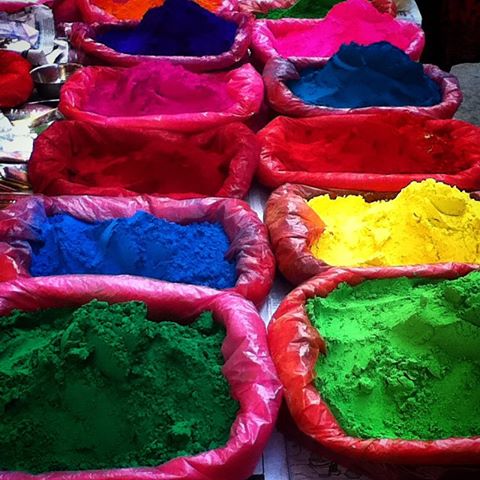
On specific days, stray dogs and wondering cows were worshiped; they freely roamed the streets covered in red dust. They wore bells around their neck and were fed prepared food. Other gods were worshipped by sprinkling this chalk-like powder on stone idols around the city. Bells were rung and prayers were whispered for another year of good luck and prosperity.
[Photo Credit: Julie Sliwinki]
Hundreds of people, of all generations, traveled large distances to bless each other by putting to this red clump of chalk and rice on their loved one’s forehead. The bigger the clump the better.
[Photo Credit: Jeremi Joel]
Colour held a lot of tension for me in Nepal. On one hand it played a significant role in appeasing unresponsive gods and on the other hand, it was a vibrant expression of Nepalese culture, like this creative display of dainty souvenirs.
[Photo Credit: Allison Ashforth]
If I could sum up Nepal in one picture, it would be this one. Open hands, open heart; learning to give and receive Love with the Father and in community. A colourful exchange full of beautiful imperfection.
[Photo Credit: Allison Ashforth]
This is my squad mate, Steff. We have the same name and we both made a video of our month in Nepal but we are quite possibly two of the most opposit people on our squad; the epitome of same, same but different. I love her! And I think you’ll love her video! [See below].







