
Fact: Every male in Central America owns a Lionel Messi
jersey.
Fact: The vast majority of Americans have never heard of
Lionel Messi.
Fact: Lionel Messi is one of the best, if not the best
soccer play today.
Fact: Lionel Messi is not American.
In case you can’t tell, this post is about soccer. I love
soccer. I grew up on it. I played all through middle and high school, and was
lucky enough to walk onto the soccer team in college. And I loved it.
I gave up soccer before my senior year of college to focus
on other things. Some call it quitting, I prefer “retiring early”. Though, I
never fully retired from soccer. After graduating, I started playing for fun. I
joined a co-ed indoor team, filled with past soccer players who just weren’t
ready to give up their passion.
I had to set aside my position on that team to come on the
race. But as of yet, I have never had to give up soccer.
You see, Central Americans love soccer. They live it. They
breathe it. If they aren’t doing anything else, they’re playing soccer. Soccer
games happen in the streets, in the house, in a field, or anywhere that there
is a ball.
In Guatemala, we didn’t have much opportunity to play soccer
at the orphanage, but once we got to El Salvador, the soccer games began. Every
Tuesday and Thursday we went to a home for people with cerebral palsy and it
didn’t take long for the men working there to find out that we could play
soccer. From then on, they rearranged their schedule so we could play whenever
we were there. By “play” I mean a full field, 3 verses 3, 45-minute game. By
“full field” I mean a flat area of gravel/dirt with goals on each side. I found
out rather quickly that gravel and dirt don’t have much traction. The scrapes
on my legs are proof.
In Honduras, soccer is just as prevalent. The boys that live
on the property here are constantly kicking a ball around. And yesterday, we
had the privilege of going to a colony about an hour away. When we show up, I
was excited to see the nicest soccer field ever. What do you ask, made this
field the nicest ever? Well, it had white lines painted on it. It was the
proper size. The goals had nets. It was relatively flat. And there was about a
square foot of grass in one corner.
While we were there, we got to watch two official games, (with
refs!) and we got to compete in two as well. The first game was gringos
(Americans-boys and girls) vs. Hondurans, and the second game was gringas
(American girls) vs. a Honduran girls team. We did pretty well for a bunch of
Americans, most of whom have never played soccer before.
Soccer games are thus far my favorite ministry on the race.
Yes, we typically pray and share our stories after the game, but it’s what
happens on the field that I appreciate the most. It’s pure fun. It doesn’t
matter what else is going on in the world. It doesn’t matter that we don’t
speak the same language. It doesn’t matter if you live in a mansion or a broken
down shack. None of this actually matters. Soccer games are a time to forget
about your problems, and just enjoy the game. Plus, it’s a way we can relate to
each other despite the language barrier.
So bring on the games. I only wish more of this happened in
America.
Sidenote: Yes, “football” would make more sense than
“soccer”. Yes, in Spanish speaking countries they call it “futbol”. However,
this DOES NOT make more sense than soccer does. The Spanish word “futbol” might
sound like “football”, but it since “fut” doesn’t mean “foot” and “bol” doesn’t
mean “ball” in Spanish the analogy doesn’t actually work. In order for it to
work, the Spanish would have to call the sport “pelota de pie”, which they
don’t. So in reality, “futbol” doesn’t make any more sense than “soccer”.
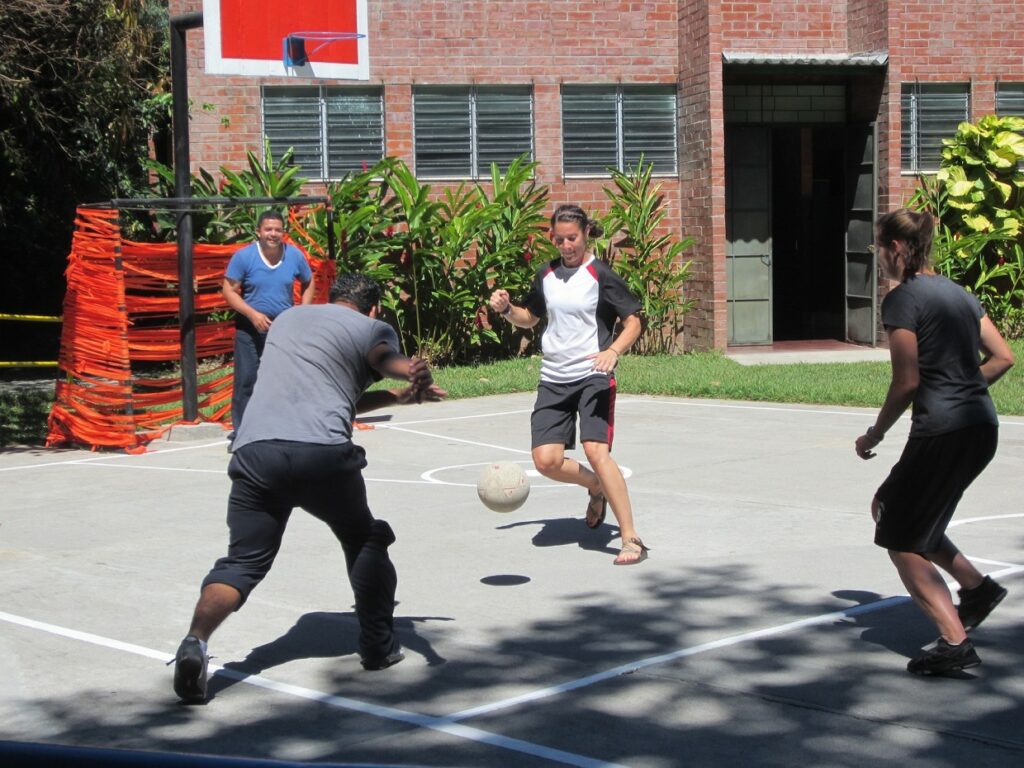
Playing soccer at the home for people with cerebral palsy in El Salvador (this wasn’t the dirt field I mentioned above).

The field at the colony in Honduras

The boys playing in a game at the field in Honduras







