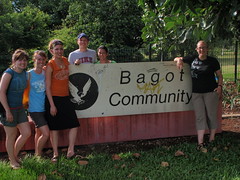
 The other day, someone asked me what I thought of Australia. After reflecting for a few moments, I realized that I had no idea how to answer that question. In reality, I don’t feel like I had more than a day or two of actually experiencing what most people would consider Australian culture. The rest of our time was spent in Bagot, a neighborhood far removed from the rest of modern society.
When I think of how it felt to walk into Bagot, I can’t help but remember Ephesians 6:12 which reads, “For our struggle is not against flesh and blood, but against the rulers, against the authorities, against the powers of this dark world and against the spiritual forces of evil in the heavenly realms.” When we began praying on our first night in Bagot, the dogs around us began fighting and growling. We could feel that someone or something didn’t want us there. As the days went by, we started to realize a pattern. Every time we were fighting the hardest to help someone in Bagot, or even on our own team, achieve a new level of freedom in Christ, bad things started to happen. People would get sick or lies would start creeping in. Any number of bad (and unlikely) things occurred to let us know that we were not unopposed in the work we were doing in Bagot. The enemy didn’t like the freedom and life that God was bringing to the people there, and he would try to prevent it at every turn. None of us had ever seen spiritual warfare as blatant as what we witnessed there, and we wondered how Satan had built such a stronghold in the Aboriginal community. What we found out is that he had been invited in. Their spiritual beliefs center around demon-worship, witchcraft, curses, and superstition. These all 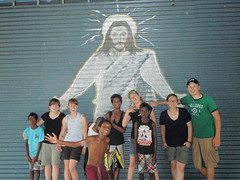 present open doors for Satan to step through, and once he’s in, he wastes no time in wreaking havoc. This was a major wakeup call to our team to stop being naïve about the war that’s going on all around us. We have to be aware, and we also have to know that God has already won this war. We can be confident in His power and trust in Him to protect us against all spiritual attacks that come our way.
This was not the only lesson we learned in Bagot. We also learned a lot about love. When we first arrived, we were prepared to love the people we ministered to. We thought they would be people who had been given an unlucky lot in life and were simply doing the best with what they had. What we found, however, was a people who have plenty of opportunity for success. They are taken care of financially by the government, and live in the midst of a modern, civilized society. Instead of taking advantage of these benefits, however, they have no motivation, preferring instead to spend their days gambling, fighting, and most of all, drinking. One day, we decided to pick up trash around the community to show our goodwill. They were literally walking past us as we picked up trash, throwing new trash on the ground. It was maddening! We wanted to badly to help these people, but they weren’t willing to do anything to help themselves. Many of them seemed indifferent to the love we showed them, not caring at all that we traveled half way around the world to help them. Through prayer, and many conversations with our ministry contacts, I came to a realization through this experience. The way these people acted toward us is exactly how we act toward God. He loves us and heaps blessings on us, and we throw them back in his face. We are as hard to love for God as the aboriginal people were hard for us to love. But God still calls us to love them. We have to love them unconditionally just as he loves us, not because of any kind of reciprocation we expect on their part. This is an easy lesson to talk about, but a much harder lesson to truly live out in our daily lives, but I feel that our time in Bagot brought us much closer to understanding the importance of unconditional love.
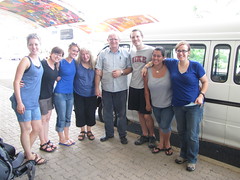 These are just a couple of the lessons we are taking away from our time in Australia. It was a month full of hardships and discouragement, but it was also a month of incredible growth both spiritually and emotionally. We learned a great deal from our ministry contacts, and I think we were able to be a blessing to them during the course of our stay as well. We were also privileged to witness some small but very important growth in the community of Bagot. At the tail end of our stay, we took part in a commissioning service for two of the Christian women in the community. They acknowledged that they haven’t been obedient to God’s call to evangelize others, and they committed themselves to this task with a new passion. In a community that is so ripe with apathy, this kind of selflessness was a major victory, and one that we believe is just one step of many more to come. We were so proud of these women! If you had asked us during week one if we would ever consider coming back to Bagot, we would have all said no without any hesitation. Now…I’m not so sure. While it was difficult, I felt like God was using that experience to break us down in order to build us back up in a new and better way. Perhaps Bagot was the refiner’s fire for our team. Whether we ever get a chance to return or not, I do know that Bagot will always hold a special place in our hearts.