
My teammate, Adam, loves movies that show the reality of the world we live in. He likes for people to see these movies, because while knowledge isn’t necessarily power, applied knowledge is. And we can’t have that knowledge if we don’t know.
So, we watched Blood Diamond yesterday. GREAT movie. Beforehand, Adam and I had been talking about the government and rebels in Sierra Leone in the late 1990s, when the movie takes place. I was pretty sure that I couldn’t forgive either side. And so when I said that maybe the rebels should just be shot, too, Adam replied, “But they’re just children.”
And it’s true. There are still, in Africa, over 200,000 child soldiers. Children, having seen their mothers raped and killed, or their fathers decapitated, or having seen their entire family shot to death, and then kidnapped to be part of this rebel army. These children, who have seen such horrors, and are then taught to inflict more of this pain and death onto others. In the movie, Dia is such a boy, ripped from his mother’s arms, his father having already been taken to work in a diamond mine.
We see what Dia goes through: the endless chants declaring hatred and supremacy, being given a new name (some included “baby killer” and “see me no more”), being injected with heroin, taught that hatred and power are the only ways to gain respect, being taught that human life is worthless, being made to slaughter people. We see Dia, the little boy who laughed and wanted to become a doctor, becoming a killing machine. His father, Solomon, does not see this. So, it’s shocking when Solomon, having come so far to find his son, finally does find him, and Dia responds, “I don’t know you! I hate you! You are not my father!”
And yet, in the end, with Dia holding a gun at another man (which turns into a beautiful story of redemption, as well), Solomon woos him back to the land of the living. (It brought tears to my eyes.) This father, on his knees, weeping for his son. “You are good,” he tells his beloved son, “Dia, What are you doing? Dia! Look at me, look at me. What are you doing? You are Dia Vendy, of the proud Mende tribe. You are a good boy who loves soccer and school. Your mother loves you so much. She waits by the fire making plantains, and red palm oil stew with your sister N’Yanda and the new baby. The cows wait for you. And Babu, the wild dog who minds no one but you. I know they made you do bad things, but you are not a bad boy. I am your father who loves you. And you will come home with me and be my son again.” And Dia, somehow, regains his humanity. He again becomes a little boy, desperately wanting love. It’s beautiful.
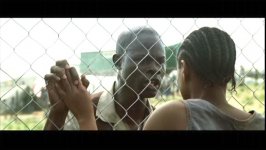
And isn’t that what God does with us? Don’t we deny Him, say that we hate His ways and love with our sinning? And doesn’t He come, on His knees, crying for His beloved, saying, “Come home. I love you. I miss you. Come home.”
I’m so glad He does. I am so thankful for the relentless pursuit of God for all of His people and for me. He desperately loves each of us, and I really think that He cries with us as we cry. The tragedies and horrors of the movie are impressed upon his heart. We have an enemy that tries constantly to steal our joy, our peace, our lives, and sometimes we listen to the chants that he is screaming into our ears. And yet God is always ready, waiting with open arms and forgiveness. “You may have done bad things, but My blood covers it all. You are mine. I will fight for you. I will search you out over the ends of the earth. You are my son and I love you.”
“The Lord our God is merciful and forgiving, even though we have rebelled against him…” (Daniel 9:9)
[The movie also does note at the end that, in 2003, forty nations signed the Kimberly Process, designed to help stop illegal diamonds from being sold together with legitimate diamonds. But it’s up to the consumer to make sure that the diamond he or she is about to purchase hasn’t also been bought at the expense of human lives and turmoil. Please check into it. And also look at Invisible Children to learn more about child soldiers.]







