
Céad míle fáilte!! On August 11, the August teams will be heading to Dublin, Ireland! (Insert wild cheering and applause here.)
Here are some facts about Ireland!
Three things I think of when I think of Ireland:

The Luck o’ the Irish! Oh, Michael Flatley. Everyone dances like this in Ireland, right?

Kiss the Blarney Stone and get the gift of gab!
So, this is Ireland. 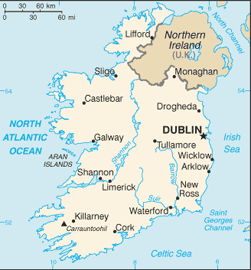
“English invasions began in the 12th century and set off more than seven centuries of Anglo-Irish struggle marked by fierce rebellions and harsh repressions. A failed 1916 Easter Monday Rebellion touched off several years of guerrilla warfare that in 1921 resulted in independence from the UK for 26 southern counties; six northern (Ulster) counties remained part of the UK. In 1949, Ireland withdrew from the British Commonwealth; it joined the European Community in 1973″ (CIA World Factbook). Just to add in a fact about the counties in Ireland, Louth is the smallest county in Ireland; Cork is the largest.
The government is a parliamentary democracy.
About 4.2 million people live in the republic. Of those, a little over 87% of the population is Irish Catholic. Both English and Irish (Gaelic) are official languages, though Gaelic is found more along the western coast.
*The Vikings founded Dublin in 988. Dublin was originally called “Dubh Linn,” which means “Black Pool.” The name refers to an ancient treacle lake in the city, which is now part of a penguin enclosure at the Dublin City Zoo. The alternative name of Dublin is Áth Cliath.
*The national symbol of Ireland is the Celtic harp, not the shamrock (or a glass of Guiness!!).
*The Irish tricolor flag, created in 1848, was designed to reflect the country’s political realities. Orange stands for Irish Protestants, green for Irish Catholics and the white stripe for the hope that peace might eventually be reached between them.
*Medieval laws in Ireland allowed a man to divorce his wife if she damaged his honor through infidelity, thieving or “making a mess of everything.”
But it’s not all rainbows and leprechauns in Ireland. As James Clarity reported, “Though long stereotyped as a happy land of pious churchgoers and bibulous dancers of jigs, Ireland is suffering a sharply rising increase in suicides, particularly among young men.”
And don’t forget about Ireland’s potato famine. The famine proved to be a watershed in the demographic history of Ireland. As a direct consequence of the famine, Ireland’s population of almost 8,400,000 in 1844 had fallen to 6,600,000 by 1851. The number of agricultural labourers and smallholders in the western and southwestern counties underwent an especially drastic decline. About 1,100,000 people died from starvation or from typhus and other famine-related diseases. The number of Irish who emigrated to North America and Britain during the famine may have reached 1.5 million. Ireland’s population continued to decline in the following decades owing to overseas emigration and lower birth rates. By the time Ireland achieved independence in 1921, its population was barely half of what it had been in the early 1840s.
To end, a few Gaelic words: (best of luck in trying to pronounce them!)
Is tú mo ghrá (I love you)
Ni ceart go cur le cheile (There is no strength without unity)
Gle mhaith! (Very good!)
céad míle fáilte [kad meel-a fall-sha] (a hundred thousand welcomes)
Fir/Mná (man/woman.) [World Racers take note! Remember these when restrooms are needed..]
Slán (used to wish a safe journey and a healthy return)







