
This is actually a blog I wrote in January, while we were in Nairobi. Hopefully the motto “Better late than never” applies, especially in Africa, where the internet is often sketchy at best.
Two days ago, Pastor Joseph took us to the park across the street. This is where the Kenya flag first flew after the British wazungu (white people) took down theirs.
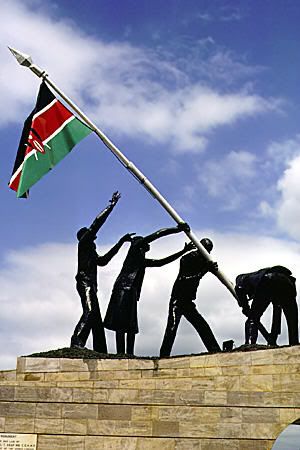
What I loved most about the park, other than the statue and several acres of fields, were the people sitting by the memorial. We met three men, who introduced themselves. As we talked, they told us that they were from Southern Sudan. “We are the blackest men in Kenya!” they proclaimed. It was also noted that I was probably the whitest person in Kenya. When Marissa walked up to us, the youngest one (who will graduate from high school at the end of this term) noted, “We grow towards the sky; you grow towards the grass!” They were very friendly and had great senses of humor. They told us about their goals for education, the youngest wanting to go to school in Canada. It was about 75 degrees and he was wearing a sweater. Colin told him that it gets very cold in Canada. “Okay,” he said, ” maybe I will wear two layers, then.” I’m not sure how to explain something like bitter, freezing snow to someone who is wearing a sweater while I’m sweating.
And then one of the men we’ve met here, who is helping us at the church, asked, “Are you here with your families?” The sudden change in their countenance was almost shocking. For the briefest moment, eye contact stopped, their faces seemed to lose all trace of emotion. And while their eyes stayed pained for a few minutes after, one answered simply, “No, we are not here with our families.”
We didn’t probe more about that, but they talked about the bad violence that had made them leave. I so badly wanted to hug them, to somehow reassure them, to show them love in a world that so often instead shows hate. And I know that God wants to do that even more than I do, that He is yearning to comfort these men with a fierceness that I cannot imagine.
One of the men, Stephen, had the traditional scar markings on his forehead that is the sign in his tribe of manhood. The two others had left at too young of an age to get the ceremonial markings, but they were glad.. “We don’t like that tradition,” they told us. ” It isn’t fair. We go all over the world now, the Sudanese, and people always know where we come from because of that.” But there is something in these ceremonies- in the passage from boyhood to manhood- that I appreciate. I wonder if our Western culture hasn’t made it hard for men. We have no clear division, something to look back to and say, “That is when I became a man.” And so I wonder if we don’t have males in their late teens and twenties, perhaps even thirties, who are walking around in a sort of limbo- no longer a boy, not quite yet feeling a man. On our team, we’ve even talked about how “girls” seems rather belittling, but “women” seems like something we aren’t yet.
I hope that we see those men in the park again, that we are able to talk to them more. I hope that they can come to know about a heavenly Father who loves them, even when they cannot be with their earthly fathers.
Please keep Sudanese refugees in your prayers.







