
In preparation for launch, I have decided that as I do my research on the countries I will be traveling to, I want you all to learn about them too! I am going to do them by region to make it easier for y’all.
So, second up is Southeast Asia! While in Southeast Asia, I will be going to Vietnam, Cambodia, Thailand, and Myanmar. Two of these counties are “closed countries,” meaning it is illegal to spread the Word of God openly to the people there. During my time in those two countries, I will have my blogs password protected! Head on over to my Facebook or Instagram (@thats___so___regan) for the password. I’ll be using the same password for both of the countries, so it will always be the same!
So, first up for Southeast Asia is Vietnam!
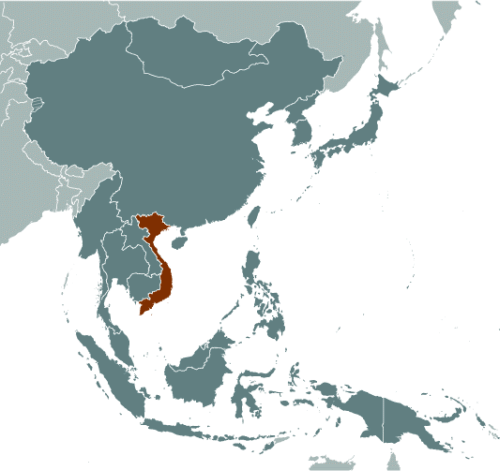
MAP OF VIETNAM IN SOUTHEAST ASIA
MAP OF VIETNAM
Summary
- After nearly a century of French rule, in the mid-20th century, Vietnam was split into communist (north) and non-communist (south) halves.
- By 1975, Vietnam was made whole again, but as a communist country.
- Human rights, especially freedom of religion, are limited in Vietnam, even with economic reforms and restoration of diplomatic ties.
Area
- 331,210 sq km (Vietnam is about 2 times smaller than Texas)
Culture
- The vast majority of the Vietnamese population is poor. The average monthly earnings for a family is around $150USD.
- In order to show your social standing in Vietnam, the most common symbols are the possession of a motorcycle (particularly one of Japanese manufacturing) and a cellphone. Other items include refrigerators, televisions, video players, and gold jewelry.
- Most Vietnamese families have two or three generations living together in one home.
- Polite behavior is highly valued. One of the most important dimensions of politeness is for the young to show respect to their elders.
What I am going to do there?
- I will be working with House of Hope Vietnam in Ho Chi Minh City. My team and I will be helping care for orphans, providing daycare for poor children while their parents are at work, and teaching English. While doing this, we will be creating relationships in order to share the Gospel. (IT IS IMPORTANT FOR MY TEAM AND THE MINISTRY’S SAFETY THAT THIS INFORMATION IS NOT SHARED ON THE INTERNET!)
Climate
- The northern part of Vietnam is on the edge of the tropical climatic zone. During January, the coldest month of the year, Hanoi has a mean temperature of 63 °F (17 °C), while the annual average temperature is 74 °F (23 °C).
- Farther south, the average annual temperature in Hue is 77 °F (25 °C) and in Ho Chi Minh City is 81 °F (27 °C); in the highland city of Da Lat, it drops to 70 °F (21 °C).
- The winter season in northern Vietnam lasts from November to April; from early February to the end of March there is a persistent drizzle, and March and April are sometimes considered to be a transitional period.
- The summer in northern Vietnam lasts from April or May to October and is characterized by heat, heavy rainfall, and occasional typhoons.
- In central and southern Vietnam the southwest monsoon winds between June and November bring rains and typhoons to the eastern slopes of the mountains and the lowland plains. The period between December and April is drier and is characterized by the winds of the northeast monsoon and, in the south, by high temperatures.
Language
- The official language of Vietnam is Vietnamese. However, there are many other languages spoken between the different people groups in the country.
Greetings
- Vietnamese people generally greet each other by joining hands and bowing slightly to each other.
- However, in big cities, some men have adopted the Western practice of shaking hands. Hugging is reserved for relatives only.
- Vietnamese women generally do not shake hands with each other or with Vietnam War men but the custom is acceptable between a Vietnamese woman and non-Vietnamese man.
- Vietnamese also often refrain from shaking hands with a senior or someone of higher rank.
Fun Facts
- The capital city of Vietnam is not the largest in the country. Hanoi (the capital) has a population of 6.5 million people, whereas Ho Chi Minh City has a population of 7.5 million people.
- Vietnam is the world’s largest cashew nuts exporter, producing almost 30% of all cashew nuts in the world.
- Vietnam is ranked 16th worldwide for biological diversity. There are nearly 16,000 different species of plants within its borders, 840 bird species, and 310 mammal species, 78 of which are endemic.
- Vietnam is the world’s second largest coffee-producing nation after Brazil, producing 16% of the world’s total coffee.
- Even though Vietnam is a very poor country, they have a literacy rate of 97.3% for adults ages 15-50 years of age.
Is it safe?
- Yes, especially with the proper precautions.
- The biggest precaution is to know that we will not use the “M” word while in Vietnam. We are not, and cannot be there as missionaries, so we will erase that out of our vocabularies before we arrive. We will be on a “cultural exchange and humanitarian trip to 11 countries in 11 months.”
If you want to read other blogs in the Where in the World series, click on the country below!
As always, I invite you to make my journey, your journey. Here are three simple ways:
- The most important, PRAY.
- Subscribe. (If you want to subscribe to my blog and stay up to date on what God is doing in my life, click the orange “Subscribe for Updates” in the left-hand corner.)
- Share. (If you like what you read or feel called to, please share my blogs on any form of social media!
Also, if you are feeling called to support the World Race in a financial way, a couple of my teammates are still in need of help. Click on their names below if you would like to know more about them!







