
So, lastly is South America! While in South America, I will be going to Colombia, Ecuador, Peru, and Bolivia.
Last but not least for South America is Bolivia!
MAP OF BOLIVIA IN SOUTH AMERICA
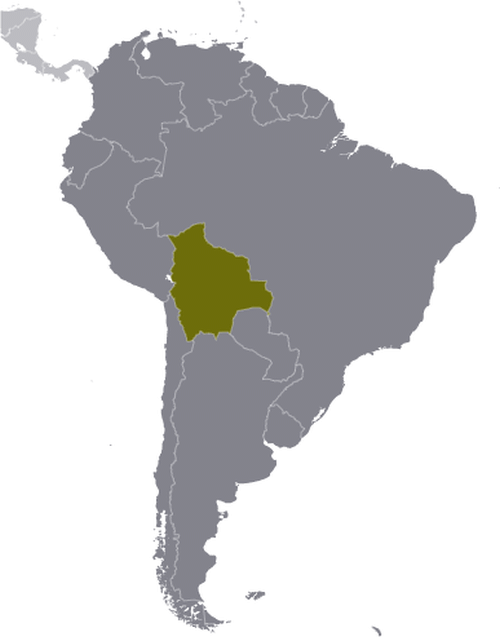
MAP OF BOLIVIA
Summary
- Although the poorest country in South America, Bolivia is the wealthiest in terms of natural resources. From the Andes Mountains to the Amazon Basin, Bolivia is full of natural beauty.
- The most indigenous country in South America, over 60% of the population traces their heritage back to one of over 30 different ethnic groups. Ancient traditions and social customs heavily influence the local culture.
Area
- 1,098,581 sq km (Bolivia is about 2 times larger than Texas!)
Culture
- Bolivia is rich in folklore tradition, including a regional folk music unlike any other. There are many dances and traditions that are performed at carnivals and festivals across Bolivia.
- Modesty is usually expected of women in much of Latin America. Walking with confidence and conservative dress are helpful when relating with the culture. The best advice is to imitate well-dressed Bolivian women to assimilate with the culture.
What I am going to do there?
- I will be partnering with CRU Bolivia where we will be evangelizing in the local universities in the Santa Cruz and Sucre areas.
Climate
- Differences in topography and climate separate Bolivia’s lowlands and highlands into distinct areas. Weather conditions vary significantly from region to region.
Llanos (lowlands) – Santa Cruz, Rurrenabaque, Cobija, and Trinidad
A humid tropical climate with clear-cut wet and dry seasons and an average temperature of 30 °C (86 °F). One of the wettest regions in Bolivia, the rainy season extending from late September to May, sees an annual rainfall average between 1000 and 4000 mm (40 – 150″). The heavy rainfall is caused by winds blowing in from the Amazon rainforest. From the month of May there is less rain and more blue skies due to drier winds. December and January are the hottest months of the year with humid days and warm nights.
Altiplano (highlands) – Lake Titicaca, La Paz, Oruro, Cochabamba, Sucre, Potosí and Uyuni
Climate varies from cool and humid to semi-arid. The average temperature ranges from 15 to 27°C (60 – 80ºF) with the coldest temperatures occurring in the south-western portion of the Altiplano during the months of June and July. The rest of the year tends to be dry and sunny, however nights can get chilly, dropping to just above 0 °C. The unrelenting rainy season occurs between December and March seeing an average rainfall of around 200 mm (8″) to the south west and more than 800 mm (31″) over Lake Titicaca. Between April and September there is a chance of snow, especially to the north, but it is not very common.
Language
- The official language of Bolivia is Spanish and Quechua.
Fun Facts
- At 3,650m (11,975ft) above sea level, La Paz is unofficially the highest capital city in the world. The official capital is Sucre but the working capital (the seat of government) is in La Paz.
- Zebras (or rather people dressed as zebras) wander the streets of La Paz helping children cross the road safely and educating drivers and pedestrians about road safety.
- A clock on the National Congress building in the main square of La Paz runs backwards to remind citizens to think differently.
- The Camino de las Yungas road, 56km (35 miles) northeast of La Paz, is known as the “world’s most dangerous road”. There are an estimated 200 to 300 fatalities every year on this stretch of road less than 50 miles long.
- Bolivia is one of the few places in the world where you can mine Ametrine. Also referred to as Golden Amethyst, Trystine or Bolivianite, the precious stone is formed when citrine and amethyst combine.
Is it safe?
- Oh yeah!
If you want to read other blogs in the Where in the World series, click on the country below!
As always, I invite you to make my journey, your journey. Here are three simple ways:
- The most important, PRAY.
- Subscribe. (If you want to subscribe to my blog and stay up to date on what God is doing in my life, click the orange “Subscribe for Updates” in the left-hand corner.)
- Share. (If you like what you read or feel called to, please share my blogs on any form of social media!
Also, if you are feeling called to support the World Race in a financial way, a couple of my squadmates are still in need of help. Click on their names below if you would like to know more about them!







