
There are a few questions that every Racer will hear anytime they tell someone about the trip they will be going on: 'When do you leave?', 'Why are you going?', 'How long are you gone?', 'Can we have them abandon you somewhere along the way' (maybe I'm the only one who hears that one), 'What will you be doing?', etc…
The World Race is still fresh enough for me that I still love to answer any questions posed to me, but I'm sure that most of these general questions will get old over the next 9 months.
But one question that I will never get sick of is when people inquire about where I will be traveling to. I am ecstatic about the route that my squad has scheduled, and even though I would be happy to go on any route, I don't mind saying that I would have been slightly disappointed if I hadn't made the cut on this route. The only way this route could get any better would be if we took a detour to New Zealand and evangelized to the Hobbits of The Shire, helped Gimli and the Dwarves in the construction of mines, and cast demons out of Ringwraiths.
I'd like to give an expanded tour of each country we will be viciting, so I can hopefully give a small preview of what we will be doing at each stop; and it will also give me a chance to gain a better cultural understanding of the countries I will be serving within the year.
First stop: Ireland
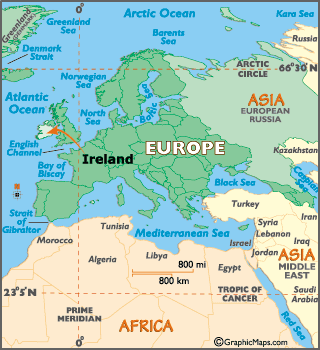
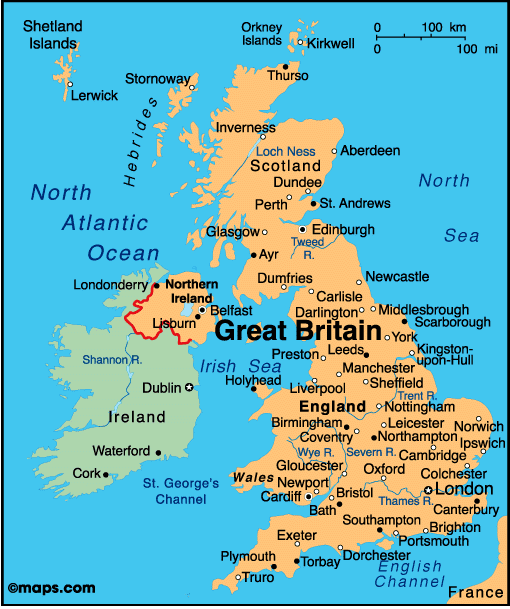
Boring history crap:
The history of Ireland goes back much longer than I ever would have expected, dating back to a few thousand years before Christ was born.
Through the first few thousand years of Ireland's existance, the country was mostly made up of a series of tribes and provincial kingdoms that were ruled by one official "High King of Ireland", starting in or around the 7th Century AD.
It's tough to pinpoint when the word of Christ first came to Ireland, but one of the earliest historical references comes, not in the form of Saint Patrick, but with Bishop Palladius, who in 431 AD, arrived in Ireland on a mission from Pope Celestine I to minister to the Irish who were, "already believing in Christ", according to The Chronicle of Ireland (not written by C.S. Lewis). That same chronicle claims that Saint Patrick, Ireland's best known Saint, arrived the following year. Both of these visits proved to be crucial for Christ's work in Ireland, as it's believed that the ancient druid traditions of Ireland collapsed in the face of the new religion.
How cool is that? Thanks to the efforts of two men, God's word totally overtook the thousands of years of evil practices, and completely changed the face of a nation. Our squad can only hope that in our time in Ireland, we can follow in the footsteps of these great men and make some changes in this country that has gone the way of most of Europe in turning to a more agnostic approach to life.
Truly some great mission work has gone through this nation; in 563 AD, a mission founded on Iona (Southwestern part of Ireland), by an Irish monk name Saint Columba, began a tradition of Irish missionary work that spread Christianity and learning to Scotland, England, and The Frankish Empire on continental Europe. These missions continued until the late Middle-Ages (roughly 1500 AD), as they established monestaries and centers of learning that established learning in parts of Europe that were mostly illiterate during the Dark Ages, after the fall of Rome. The education and faith of the Irish population earned the country it's nickname, "The island of saints and scholars".
What the heck we're doing in Ireland:
Though Ireland has an incredible history of faith, through Catholicism, the country seems to have the same amount of faith as many European countries, where a more care-free, agnostic, and worldly way of living has taken hold of it's people.
When you think of Ireland, one of the first few things that comes to mind is: drinking. The country is well-known for it's pubs, and a lot of people don't take this idea too seriously, but the recent rates of alcoholism and suicide are clear proof that this country is desperate for hope, and in dire need of Christ's love.
According to the World Race website, "Through sports, children's outreach, street evangelism, pub ministries, and the relationships that just happen along the way, the World Race reintroduces a life-giving faith to this beautiful, historic culture."
Why I'm excited:
Ireland has always been a country that has fascinated me. I've always found the scenery there to be beautiful, and it has been one of those countries toward the top of my wish list of places to visit. In college, I had an opportunity to visit Ireland with the men's glee club that I sang with, but I passed it up, due to the price; so now I feel a little bit like I'm making up for lost time, only with a vastly more important mission this time around.
Fun facts:
Underneath present day County Mayo, lie the Ceide Fields, which is an extensive field system that is believed to be the oldest in the world.
There are only 26 species of mammals that are native to Ireland, including the red fox, red deer, pine marten, badger, and hedgehog… Hedgehogs? Who knew? I think we have our unofficial mascot for R Squad.
The 2 main languages spoken in Ireland are Irish and English. English is spoken by the majority of the population, but Irish is kept alive as a minority language.
Ireland produced four winners of the Nobel Prize for literature in the 20th Century, including George Bernard Shaw and W.B. Yeats. Other Irish authors who failed in their noble Nobel attempts include James Joyce and Jonathan Swift.
Long story short, there's a lot to be excited about with our first leg of the journey. I think it's the perfect location to be slowly introduced into non-American culture, while still having the air of Western civilization.
With Ireland still being almost 9 months away, it's hard to know what exactly to expect from our time there, but we need to remember to keep this nation in prayer for their current struggles with alcoholism, and the ever-increasing population that loses their faith in Christ.







