
Month 7: Cambodia. Although there is such a striking beauty to this country, it has clearly struggled to move past the events of only a few decades ago. That’s what we so quickly forget—it was not even four decades ago that Pol Pot and his Khmer Rouge wreaked havoc on this small country, killing perhaps over one-quarter of its 8 million population at the time. That should not be forgettable. And yet with Kosovo/Bosnia, Rwanda, Sudan, and now Syria, we do forget. We do ignore.
Afterwards, we ask: how could something like that happen?
I recently read a book by humanitarian Somaly Mam titled The Road of Lost Innocence, and one line stuck out to me above all: “To avoid going mad, they shrank to the smallest part of a human, which is “me.”
I could not imagine a more beautiful and yet devastating way to describe how we treat each other as human beings sometimes, and why these atrocities occur, why they continue with little attention given, and why Cambodia is still in the midst of a great battle—sex trafficking and slavery. We let ourselves shrink to “me.”
This past weekend, a few teams visited one of the killing fields using during the Khmer Rouge. It was a somber visit. But I believe it will be one of the most memorable parts of my year.
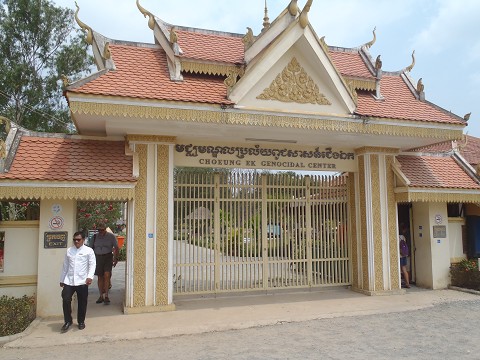
Entrance to the Killing Field.
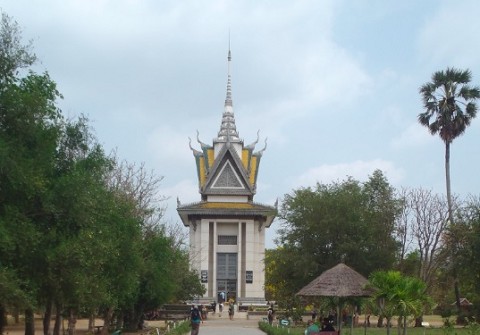
The largest memorial in Cambodia dedicated to victims of the regime.
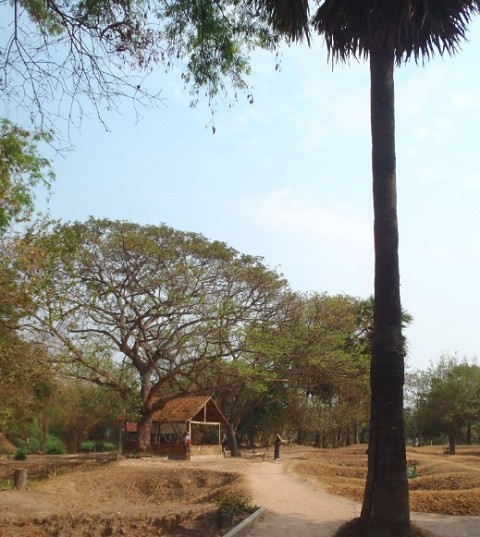
The story of the large tree in the background is not one I wish to recount on this blog.
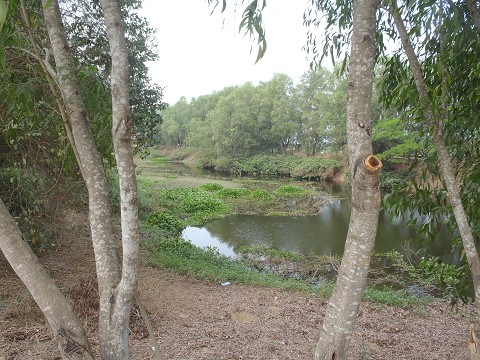
The dust and barrenness of parts of the grounds was in stark contrast to this lush plot.
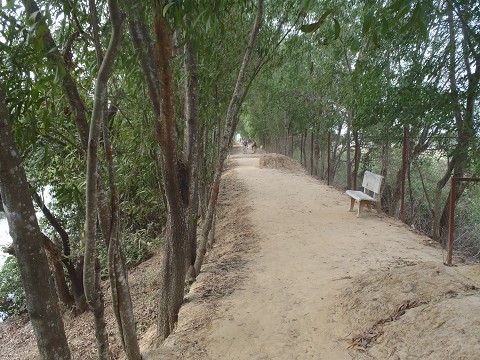
A walkway around the perimeter allowed for visitors to listen to an audio player’s stories of the period.
All of this brings to mind a provocative quote from Carl Sagan, which I was first introduced to by one of my good friends, Arben (it is worth reading):
The Earth is a very small stage in a vast cosmic arena. Think of the rivers of blood spilled by all those generals and emperors so that, in glory and triumph, they could become the momentary masters of a fraction of a dot (italics are mine). Think of the endless cruelties visited by the inhabitants of one corner of this pixel on the scarcely distinguishable inhabitants of some other corner, how frequent their misunderstandings, how eager they are to kill one another, how fervent their hatreds.
Our posturings, our imagined self-importance, the delusion that we have some privileged position in the Universe, are challenged by this point of pale light….
The Earth is the only world known so far to harbor life. There is nowhere else, at least in the near future, to which our species could migrate. Visit, yes. Settle, not yet. Like it or not, for the moment the Earth is where we make our stand.
It has been said that astronomy is a humbling and character-building experience. There is perhaps no better demonstration of the folly of human conceits than this distant image of our tiny world. To me, it underscores our responsibility to deal more kindly with one another, and to preserve and cherish the pale blue dot, the only home we've ever known.
— Carl Sagan (1934-1996)
I invite your comments on that quote, and what hope looks like on a pale blue dot some of us call home. Thankfully, it is a temporary home.







