
In preparation for my departure in late June, I wanted to spend some time learning about and praying for the countries I will be visiting. For my first 2 months on the race, I will be in Eastern Europe. Today, I want to put the spotlight on Albania, where I’ll be for the month of July.
WHERE IS IT?
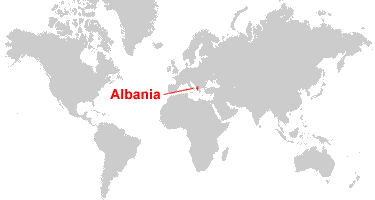

Albania is in the Balkans. It is just north of Greece, and it is neighbored by Montenegro, Kosovo, Macedonia, and the Adriatic sea.
BRIEF HISTORY OF ALBANIA:
Albania considers herself to be descended from the Illyrian tribe. They were controlled by the Roman empire(167 B.C. – 395 AD), the Byzantine Empire(535-1204), and then the Ottoman Empire (1385-1912). In 1912, Albania declared independence from the failing Ottoman Empire. This was followed by the ceding of about 1/3 of their land (Kosovo) to Serbia. Resulting from WWI, Albania was occupied: by Greece, Serbia, France, Italy, and Austria-Hungary from about 1919 to 1944. In 1944, Communism took hold in Albania. From the 40s until the late 60s, Serbia had tight relations with the U.S.S.R., and Albania’s leader, Enver Hoxha, imitated Stalin’s harsh rule. Around 1967, Serbia changed allegiances and molded their communism off of Mao’s model in China. Communism fell in Eastern Europe in 1989. Albania was “free”…but was also isolated, impoverished, and underdeveloped. Basic reforms started in 1990, but were strained when a major economic collapse occurred in 1997. About 70% of the Albanian peoples lost their savings in economic scandals believed to have been allowed by the government. Rioting destroyed more infrastructure. In more recent politics, Albania joined NATO in 2009. On its third attempt, it received EU-candidate status in June 2014. Their socialist party Prime Minister, Edi Rama, has made inclusion in the European Union his goal.
SOME CULTURE:
Albania has been a neglected country in many ways. It has received little respect from Europe, and is still developing in many ways. The culture was imprisoned by the harsh communist rule for some time. With the fall of communism, there has been an influx of western influence through media, as well as an increase in proselytizing. It is estimated the majority of Albanians (62%) identify themselves as Muslims. About 30% are orthodox Christians, and less than 1% of Albanians are protestant Christians. The culture, like other cultures in the Balkans, is very relationship-driven. That said, there are significant racial tensions between the Albanians, the Romani peoples, the Serbians, and the Greeks. Human trafficking is an issue, and women’s rights are lacking.
The Albanian people are very welcoming toward Americans. Former president George W. Bush honored the Albanian people by being the first U.S. president to visit post-communist Albania (there is a statue of him in Albania!). Furthermore, the U.S.’s efforts in ending ethnic cleansing of Kosova Albanians, encouraging NATO, and honoring Albania’s democratic dreams has led Albanians to have much respect for the U.S.
HOW TO PRAY:
After the fall of communism, there were widespread efforts, by Christians and Muslims, to evangelize to Albania. There has been a transition from shotgun evangelism to a more focused approach. Pray for increased leadership in the evangelical churches in Albania, Biblical models of leadership, a healing of the racial and ethnic wounds, and that unreached peoples in Albania would hear the true gospel. Because of its Islamic history, Albania could offer an opportunity for Albanian Christians to reach many Muslims. Pray for an equipping, a strengthening, and a maturing of Albanian missionaries. Western influence through media has been pervading this culture as well. Pray for eyes, ears, and hearts that would see the truth and would honor God, rather than mimic hollywood.
I’m excited to meet the Albanian people and usher the presence of Yahweh into their country. For more prayer guides on Albania, see this link: http://www.operationworld.org/alba
–Natalie







