
During our last week in Ukraine my team and I had the opportunity to go and visit a very special orphanage in the Carpathian Mountains, about 3 hours away from Uzhhorod, where we were staying. When I tell you that this orphanage looked like it was set against a green screen background of the most beautiful mountains ever, I’m not lying. They even had a very beautiful, picturesque, little blue church right in the middle of their property. (I forgot to take my phone to use as a camera, luckily my team did not- so you can thank for the visual aids)
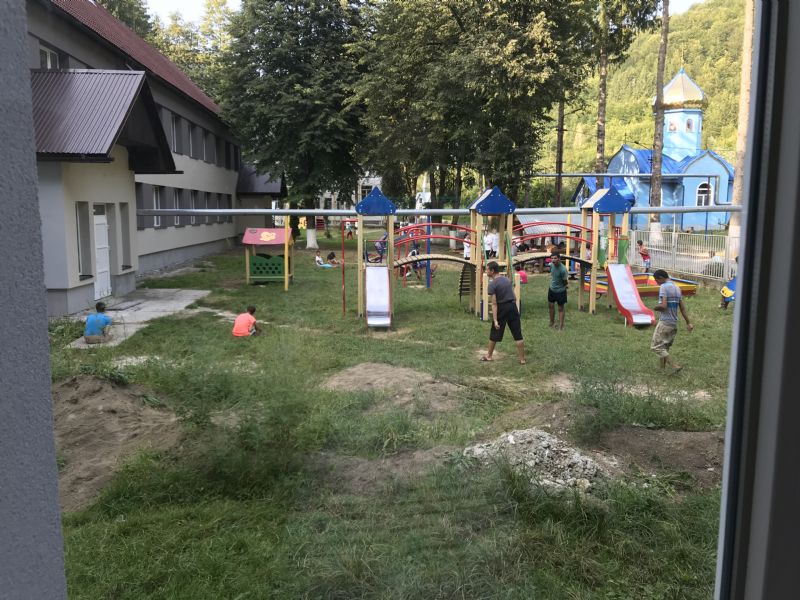
This is not an orphanage like we typically think of, in fact, some of the people living in this orphanage are a lot older than I am, and thats because this orphanage services around 200 special needs individuals from the ages of about 6-56 from all over Western Ukraine. These individuals range from the extremely physically and mentally disabled, to individuals with more mild/moderate disabilities. The orphanage is run by caretakers who work in shifts of about 10 people at a time, which is, as you can imagine, nowhere near enough. We were told that the workers at this orphanage in particular make about half as much as their counterparts who work at other orphanages and as we got to spend time with one of the caretakers you could see that she was there, not for the salary, but because her heart was for the people that she cared for.
We also got to meet with the Director of the orphanage before he had to leave for a meeting. In the short time that we had a chance to speak with him, several of the more able-bodied people living in the orphanage came up and in the most intimate and tender way, cuddled into the Director while he stroked their heads and talked with us. You could see that all of the people who were working there, wanted to be there. One of the cool things that we got to learn about during our time talking with the Director was the orphanage’s connections to a hospital in Boston. Several of the more critical individuals at the orphanage have been able to fly to Boston to receive life-changing surgeries. This relationship is something that has been so beneficial to the orphanage and we were actually able to meet and talk with (through Rudy) one of the surgery recipients, which was so cool!
Rudy, one of our ministry contacts, who drove us to the orphanage, talked about how hard it is for him to get teams to go up and visit, and that when he finally does get people to go, they don’t want to go back.
Thinking that the long journey through the mountains might have had something to do with people not wanting to go, (because I’ll be honest when I say that all of the mountain traveling we’ve done in Ukraine has been a bit of a bummer for me) one of my teammates asked a question that I had been thinking:
Why is this orphanage all the way up here?
I mean its beautiful and breath-taking, but wouldn’t it be easier to get people to help and volunteer if it was easier to get to? How did this location get picked?
And here is the ugly truth we learned: Back in Soviet times, the idea of ‘Perfect Nation’ was in full effect (the undertones of which are still prevalent today) and anyone who was viewed as less than perfect, or a blemish to the country, was shipped off and hidden in the mountains. Rudy said that even today he doesn’t know anyone who cares for their special needs family members. He also told us that very few families come to visit the special needs individuals who are living in the orphanage, even though many of them do have families.
Oh- well didn’t think about that.
As I’ve processed this, it’s hard for me to imagine having that mind set only because I have been blessed to know and love so many differently-abled people in my life. (Side note: before we start to judge/look down on the Ukrainian mindset too much, let us first stop and think about the lies and injustices that have been told to us through our own culture for generations and how that impacts us and our ways of thinking still to this day. Our mindset isn’t better, or more advanced, our prejudices are just different.)
We didn’t learn this until we were leaving, but while it is hard to get volunteers and workers to go the orphanage, it is hard to get doctors to go to the orphanage too. These individuals living there are taken care of to the best of the caretakers ability, but very few of them have ever received official diagnoses. People are living in this special needs orphanage because they are different, but no one actually knows what their official condition/diagnosis is. People who’s condition could be greatly aided by medication are going without because no one knows what to give them and the orphanage does not have the resources to bring doctors in so that they can find out.
The ride home was pretty quiet, as we were all processing everything we had seen and heard. On one hand, the orphanage was very nice, clean, and the staff seemed to genuinely care for the people living there, but on the other hand, they were so understaffed and many of the them didn’t have a diagnosis or the medication that they needed. Its a lot to think through…
Rudy told us how he got involved with this orphanage and how he has seen so much improvement in the lives of the people living there over the past few years to lighten things up a little bit and to get us out of our heads. It was good and really cool to hear (Rudy has the best stories), then someone asked: out of all of the needs, what does the orphanage need the most to keep improving and getting better?
Rudy, without hesitation, said doctors.
Every few months Rudy drives 3ish hours over (horrible) mountain roads and brings a van load of food, clothes, and hygiene products to the orphanage. He talked about how those things are helpful but at the end of the day the biggest improvement that could be made in the lives of those living in the orphanage are diagnoses, which would allow them to help control their symptoms. And who knows- maybe with medications some of those people could be able to live on their own and be able to take care of themselves.
I am not a doctor and I never plan on becoming a doctor (also scared of doctors- fun fact).
I will never be able to help them in the way that they really need help.
All I can do is tell you their story, love them while I am with them, and pray that the Lord provides doctors, volunteers, and loving staff members to care for His children that are hidden in the mountains.
My Challenge: Find where God is specifically calling you to serve- then go do it. We all have skills that God wants to use, ask Him to tell you where He wants you. If you are a doctor who can help with diagnoses and your heart is for special needs people, let me know! They need your help, more than I can express.
Thats all for now guys, I hope this story sits with you, as it has with me.
Much love,
Morgan
As always, I invite you to make my journey, your journey. Here are three simple ways:
- The most important, PRAY.
- Subscribe. (If you want to subscribe to my blog and stay up to date on what God is doing in my life, click the orange “Subscribe for Updates” in the left-hand corner.)
- Share. (If my blog has touched you in any way tell a friend by clicking the “Share with” links to share this on social media.)







