
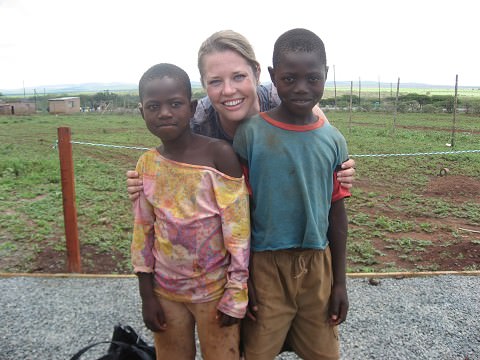
 “How old are you?” I asked.
“I am ten years old,” the boy responded in his distinctive African accent.
Turning to his sister I enunciated the same question, “How old are you?”
“I am eight years old.” Her voice was soft, her eyes full of life, expectant, hopeful.
Such a far cry from the very same kids just 16 months ago. The scene plays in my head deeply ingrained. It’s the last day of my time in Swazi on the World Race. I ask Nicholas our translator to help me talk with some of my favorite kids. “How old are you?” I think it’s going to be a simple question but it spurs a ten minute conversation. I have no idea what’s going on until Nicholas informs me, “They don’t know how old they are, they don’t go to school and do not have ways to know these things.” Finally Nicholas grabs the kids peels back their gums and determines their age by checking teeth.
Fast-forward one and a half years. Instead of standing outside of a dilapidated old chicken coup with kids huddled in the cold waiting for inconsistent at food, I’m standing under a huge metal roof providing essential shade, watching children crawl all over a giant play ground. There’s a community center, a pastors house, a huge back deck with veranda, a newly built clinic, lots of water and plenty of food to go around. Life abounds.
I ask Thulane, the 10 year old, if I can see his brother Sandiele. I suck in a deep breath, my stomach lurching as I wait for a response. Sandiele was the sickest looking kid I had ever seen. He cried all the time, had bright yellow hair and a huge pop belly, from either worms or malnutrition. I honestly wonder if he has died, sadly it wouldn’t be a surprise.
Commotion ensues, the kids walk me towards a little guy, and I can’t believe it’s the same baby. Twice the size of before, dark hair, smile on his face. There is a very real possibility that with out the care point in Nsoko this beautiful boy would not have survived.
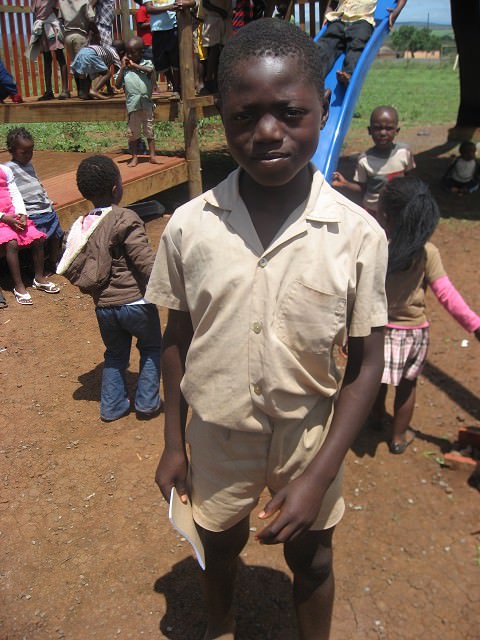 “Are you still in school.” I can’t resist asking even though the answer makes me nervous. After writing about Thulane and Eliza last year in my blog, friends sponsored both of their education. We only paid for a years worth and I’m hoping beyond hope that they were able to continue.
“Yes, they are both in level 2.” My translator responds. I repress the urge to stick my arm in the air and jump in circles. I can’t help but encourage them not to miss classes, and to continue to get good grades.
Despite the brutal reality, my moment with Eliza, Thuland and Sandiele is a tiny glimmer of hope. It’s beautiful to see how seemingly little things while I was here last time, made a lasting impact. Their stories are a testimony of every penny given to Nsoko, every team that came after us, and every person who supported the tuition costs. Although there are still many children needing support for education, this is a victory!







