
I disgraced the sport of baseball as a child. I struck out in tee-ball … regularly. Yet, a baseball analogy felt right — maybe it’s because baseball and western culture are so closely tied together.
A Father and Son
A father takes his son out every day to practice baseball. The father spends countless hours teaching his son the basics of batting first: proper stance, smooth swing, chin down, follow through and twist on the back toe. The son works hard and cherishes the time with his father. Then he learns to pitch: knee up, 90 degrees at the elbow, turn the hips, twist and follow through with the back leg. The son develops a hard work ethic and discipline.
The father cheers for his son over the years. The son learns the significance of family support, how to handle loss and failure, teamwork and the joy of success.
The son’s team goes to the state championship his senior year of high school. They play their hearts out, but lose.
The father sinks in the stands, slumped like a sack of potatoes, and thinks about how he failed.
Christians Today
I think many Christians get this mentality. “If we don’t get them to heaven, we failed.”
Somebody, somewhere, right now is printing Uncle Sam “We Want You” posters for their church.
A new billboard campaign.
Call me radical, but I believe heaven is God’s domain. The way other people think and what they believe is outside of my control. The only remnant of control I have is how I interact with people. We are called to interact in a specific context — love.
What Does That Love Look Like?
All of the effort that the father invested with his son: the hours, the lessons learned, the hard work, the struggles, triumphs and failure — that’s where I see the love. It’s easy, however, to focus on the state championship and lose sight of what is happening now
I went on a mission trip a few weeks back with my church’s youth ministry. A wonderful woman, Lisa, and I lead a group of 13 high school students to Lake Providence, LA. We roofed a home over the course of five days.
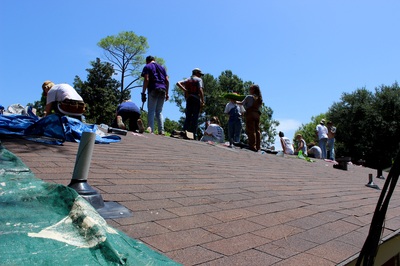
These kids amazed me.
I watched a group of students come together and work as a team. They encouraged each other through 110-degree heat and hours in the sun. They laughed and cried together over the week. The family appreciated our work, and contributed to our collective spiritual experience in prayer and meals.
It’s tempting to say, “I sure hope the people who we roofed for come to know Christ,” which implies if they don’t, then the trip was a failure.
It was a complete success, and I wasn’t sure how to explain that until this past week.
Road Trip
Last week my friend, Coleman, and I took a road trip to Big Bend National Park. We hiked through a seamless blend of mountainous terrain and arid dessert. The landscape yielded an unprecedented southwestern vibe in Texas. We searched for some decent rock climbing and found ourselves at the iconic “balanced rock.”
“You think we can climb that?” I jokingly asked.
“Sure.” Coleman said, already half way up the rock. I scurried up after him.
We hung out for a while before Coleman climbed down to take a nap in the shade, and I found myself alone on top of the rock. I looked out over miles of breathtaking beauty. I decided to meditate and converse with God.
Big Bend National Park
I hoped to have some great epiphany while praying and meditating in the wilderness. I waited for an eagle to talk to me, and worried when the clouds didn’t even part for an angel to come down. In fact, the only incredible thing that happened was how much I managed to burn my shoulders. I did, however, receive a small dose of clarity.
Applying words to spiritual intuition is tricky, but it went something like this:
- the past and future are outside of this moment,
- the only thing tying me to the past and future is my ego,
- if I let go of that, then all I have is now,
- therefore, there is no basis to compare/judge how this moment is going relative to other moments
- with no standard for comparison, there is no need to worry about how great or terrible this moment is.
- This moment simply is.
Long term mission trips are easy to understand, because we can see the effects on lives and communities over a greater timeline. A short term mission trip is more difficult to rationalize. It’s like asking a tee-ball coach why he coaches tee-ball. In most cases, he won’t coach his son in the state championship, so why bother? Why on earth would anyone ever coach tee-ball?
Our minds are so focused on the past and future that we often lose track of the present moment.
The Kingdom
When Jesus spoke of “The kingdom of God,” he typically spoke in the present tense. In Luke, Jesus sent out his disciples with directions to, “…cure the sick who are there, and say to them, ‘The kingdom of God has come near to you’” (Luke 10:9).
He instructed them to help those who were sick, and in that moment of selfless giving, the Kingdom of God would be near.
Let me define my understanding of the Kingdom of God.
The “Kingdom of God” is how the world would look if a loving God were literally king. It is a world where we would live with a yearning for selflessness and a deeper meaning. We would forgo the surface level distractions of the ego and dive into a fruitful coexistence with the universe.
That is the Kingdom I experience when I follow the call to go out and help those who are sick, poor, needy, etc.
In one week, we may not have ushered a billion souls past the pearly gates, but we lived in the Kingdom for a whole week and invited the community in Lake Providence to join us there.That was the beauty of the high school mission trip.
That is the same Kingdom I want to bring to each of the 11 countries I will spend time in. I’m not out to hit a quota of conversions. Maybe in the future I’ll concern myself more with winning the state championship, but for now I just want to invite 11 different communities to join me, for one month each, in a relationship of unconditional love. If that makes me a loser, then I’m okay with that. Someday I would like to spend more time with a community, but I have no doubt that one month in the Kingdom is enough to change a life.







