
This month Arise&Go is working with an organization called Hospitals of Hope. The past few afternoons we have ridden in two trufis (small public transportation buses) on an hour-long trek to the pediatric unit of a hospital in Vinto where we are volunteering with a program called “Movimiento Sonrisa” (The Smile Movement). While there, we play games, color and hang out for a couple of hours with children who are victims of trauma, cancer or severe burns.
“Are you guys students?” asked the 30-something woman sitting next to me on the wooden hospital bench in her traditional Bolivian garb, a dull colored, full-bodied skirt topped by a fitted, bolero style shirt that must be as hot as it is uncomfortable. The little girl in her lap squirmed and grabbed at the woman’s long, dark braids that hung their frayed tips all the way to the bottom of her lavender jacket.
I snapped out of my trance, groggy from a long trek to the hospital, zapped of energy by the heat radiating out of the trufi’s polyester/wool blend seat covers and frustrated after spending more than ten minutes trying to teach the young boys in front of me how to play poker and Go Fish. My mood not chipper, I answered curtly (but with a smile) and told her that we were missionaries and volunteering at the hospital for a month and turned away again, hoping to resume my daydream of happier things from which I had been roused.
“Oh! Perhaps you guys could offer me some help then…” she smiled brightly as she launched into a rapidly spoken Spanish story about how she needed money and help and how we could give her those things since we were white missionaries. (It’s a common misconception in other countries that we carry billions of dollars with us everywhere we go.) After having experienced this mentality more than once and in no mood to feel guilty that afternoon, I politely yet strongly answered that we had come to serve with full hearts, not full wallets, noticing that the edge in my voice was easier to detect than I intended; however, this lady had caught me in the wrong moment to share her sob story and have me make the church look bad for not helping the least of these. After all, didn’t she know I don’t have money to hand out? Why would she be so audacious to assume that I had anything to give her at all?
Angry thoughts racing and feeling guilty anyway for not being kinder, I let my gaze fall to the floor and wished to have the moment back, to say something different, to offer the love I supposedly do have to give instead of the offense I am so ready to carry. The child in her lap squirmed again, tugging at the braids and giggling contagiously as the woman made kissing faces and cooing noises, and I decided to try to right my wrong. I asked if she was the girl’s mother, and one simple question led to one of those experiences that are difficult to recount; the kind that often lead the person involved to only wistfully gaze toward the sky when they try to explain it, the sort of look that makes you feel like you’re intruding on someone’s personal moment with him- or herself just by standing there. It’s a moment I’ll never forget.
The woman, Prudencia – I like to call her Prudence – began to tell me about her niece Mariela, the nearly two-year-old angel in her lap that stole every inch of my heart and made me consider motherhood for the first time in my life. She’s a bright-eyed, sparingly-toothed toddler with a hastily, unevenly shaved head – the hospital’s treatment for lice that makes such a precious thing seem more like a prison inmate than the beloved child so full of life and potential she is. Mariela woke up from a month-long coma a week ago, induced after being dropped on her head at home. Her mother is in a psychiatric ward where she is being treated after having attempted suicide after her husband left her, their four kids and one she was carrying and subsequently lost. Mariela has been left practically orphaned with no one to care for or visit her and so suffers from extreme abandonment issues, bursting into heart-wrenching cries for “mama” every few minutes even if she’s being held.
Her shrill cries invoked something desperate yet natural within me, reaching some innate desire that’s always yearning for the soothing touch only my mother can give, and I found myself watery-eyed watching the child’s eyes fill and spill for a number of minutes. I could already tell this would be an emotional experience.
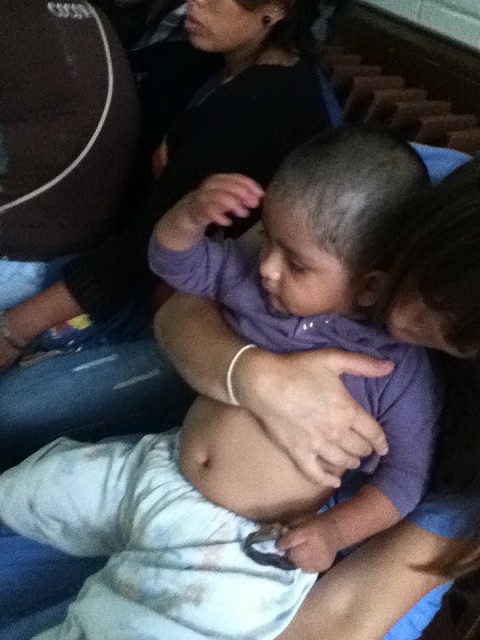
Gently resting my hand on Mariela’s tiny, lovable leg, rubbing it when she began to get upset, I now listened with rapt attention as this woman on a Bolivian public hospital bench shifted from Mariela’s to her own story, recounting her life as an orphan on the streets of Vinto, abandoned by her own parents with no chance at an education of any kind, unfortunate circumstances in an unforgiving life that have led to her to this stage where she cares for her sister’s four children just as her own three, her husband working to support them all. Her sister’s suicide attempt was the icing on the cake that life refused to let her have or eat, but having no parental care or affection growing up has motivated her to care for Mariela as though she were her daughter. Prudence refuses to let her sister’s children have the same childhood she did even though no one has asked her to take on the responsibility of two mothers or thanked her for the amount of energy she puts into caring for things that were never hers to love.
She visits Mariela during the one allotted visiting hour every day that she’s able. While there, she simply holds her in her lap and arms, talking to her as though she could talk back, gently singing and rocking her back and forth and to and fro, cradling the shaved head with the lopsided smile that laughs louder and more powerfully than it cries.
Her voice trailed off with a sigh that said more than all of her words and I sat stupefied, mouth slightly gaping and in shock after hearing of such harsh reality met not with victimization but with such intense love.
I found myself speechless, but desperately wanting to say more. So, I did.
[click here to read part two of the story]







