
for granted. Most of us are used to three meals a day, snacks, and going
out, sometimes just to get coffee or sweet tea. While this is the case
for us, most families in Camp Vision are struggling to eat one meal a
day. We are accustomed to readily accessible food and drive thrus.
People in Camp Vision have to walk a long distance to the market because
they lack access to transportation. They attempt to grow their own
crops but although most crops are easily grown and tended elsewhere,
they cannot afford the seeds to plant and grow them. They also lack the
water to tend and irrigate them, and the money to purchase or rent the
land on which to plant them. The problem goes so much deeper than the
fact that they do not eat on a regular basis.
It begins with
those who have been simply handing them bags of food for the past three
years. It is an attempt to fill their bellies but does not address or
make gains to solve the underlying problem. We want to address the root
of the need, the real problem, not just the symptoms.
Meet
Elizabeth Wanja Morrie. This is her story. Her story shows the need for a
sustainable way to produce her own food and provide for herself and her
family. Elizabeth is a thirty-one year old single mother of four
children. She and her three boys and one girl have been living in Camp
Vision since the 2007 presidential election. Prior to the election, she
earned 50,000 Kenya shillings (ksh) a year (about $700) farming in her
hometown of Narok. Now if she is lucky, she can earn up to 300 ksh a
week (about $4) working random odd jobs. Sometimes her family eats one
meal a day. However, many days they do not eat at all.
Saving money to purchase land or hens and chickens for long-term food
supply is difficult because she is trying to provide food for her
children for today. However, she and many others in the community are
choosing to save and plan long-term, even if it means sacrificing today
so that they can eat consistently in the future.
When Matt and Logan visited her tent, she was eating Githeri (beans and corn) and some cooked green 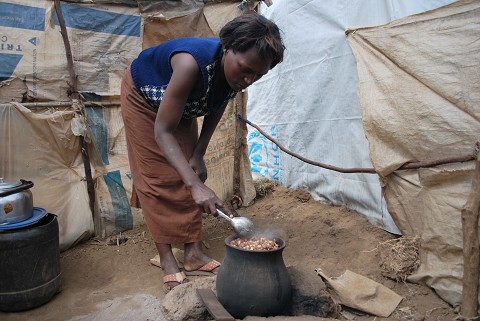 vegetable leaves. This is what she is cooking in the picture.Her
eldest three children were on a break from school but weren’t present
because they were out searching for food. Thankfully, Elizabeth has
somehow managed to afford to pay their school fees thus far, and they
have been attending school!
It is easy to see needs, but much
more difficult to arrive at and implement ideas for a solution. The
existing need is for them to begin eating now and to have resources to
eat and provide food for their families long-term, apart from any
outside help or resources. Our ideas to address this need do include
meeting the immediate crisis, however on the larger scale we hope they
will reach a place of complete reliance on themselves. We will
accomplish this by providing them with start-up capital, such as
chickens, coops, and seeds, with the long-term goal being that people
will take ownership of producing their own food.
Can you picture
the day when Elizabeth, her children, and her community all have full
bellies and know where their next meal is coming from? Please dream and
partner with us to help make this reality for them.







