
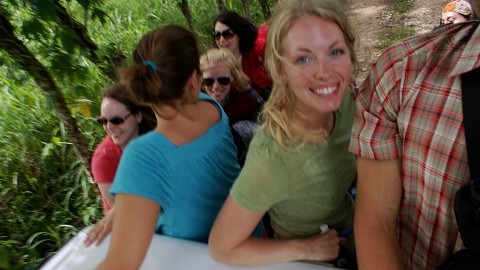
Team B.O.L.D. is heading out of Palenque today to visit a village on the outskirts of the town, called Trinidad (I am not 100% sure this is the name, but this is the name our host provided. It is near Salto de Agua). This is one of the hundreds of small villages around Palenque made up of Mayan descendants. We are meeting a pastor there to help with her new church. It is one of the five (at most) churches in the village, so the area is lacking goodness from El Senor Cristo. The majority of locals are Catholic and alcoholism is said to be one of the largest problems in the village. Instead of spanish, these people speak Ch’ol, a maya language. Here is some info I found on this group:
The
Chol region consists of jungle-covered mountains, tropical river
valleys, and flat coastal plains. Most Chols are subsistence farmers
who live in small, rural farming communities and cultivate maize,
squash, beans, and chiles. Local elevation determines what other types
of fruits and vegetables can be grown. There are commercial coffee
plantations at the higher elevations and large cattle ranches on the
coastal plains where many Chols work at least part of the year.
Chol region consists of jungle-covered mountains, tropical river
valleys, and flat coastal plains. Most Chols are subsistence farmers
who live in small, rural farming communities and cultivate maize,
squash, beans, and chiles. Local elevation determines what other types
of fruits and vegetables can be grown. There are commercial coffee
plantations at the higher elevations and large cattle ranches on the
coastal plains where many Chols work at least part of the year.
Many
Chol people are Catholics who follow either mainstream Catholic ritual
or a syncretic Maya-Christian version of Catholicism. To many Chols,
caves are sacred places that belong to the “Earth Owner” (locally
called “Don Juan”). Rituals take place in the sacred caves and
offerings are made there. An especially sacred cave containing an
anthropomorphic stalagmite considered to be a figure of the Black
Christ is located in the town of Tila, home to a major pilgrimage
church. Many Chols have converted to Protestant religions, especially
evangelical sects, and some municipios (like Salto de Agua) are home to
as many Protestants as Catholics.
Few
Chol men and women today wear anything except western-style clothing.
Many Chol women wear simple print dresses, but some older women in the
Palenque area still wear a costume consisting of a blue or black
ankle-length skirt that is trimmed with satin ribbons, an embroidered
one-web huipil, and a woven cotton sash. Some younger women know how to
embroider the huipils, but only wear the “traje” for special occasions.
Chol men and women today wear anything except western-style clothing.
Many Chol women wear simple print dresses, but some older women in the
Palenque area still wear a costume consisting of a blue or black
ankle-length skirt that is trimmed with satin ribbons, an embroidered
one-web huipil, and a woven cotton sash. Some younger women know how to
embroider the huipils, but only wear the “traje” for special occasions.
-http://www.mexicantextiles.com/grouppages/chole.html
We’ll be there for two weeks and possibly driving back to Palenque in the middle over the weekend depending on time and money. The hosts are planning to set us up in houses because of the rainy season. They know all 6 of us are married, so they’re trying to accommodate us as best as possible. It would be so nice to have a room to ourselves! But, we are well aware those opportunities are few and far between. We are packing our tent in case we want to get away for a little while. Johnny has dominated the spanish language, so we are blessed to have him around to help communicate with the locals. Most likely, there will be no English speaking people in our village.
We will not have many opportunities for internet, so don’t be worried if you do not hear back for a couple weeks. But, we plan to go into Salto de Agua if possible, a town with internet, food, etc. about 20 miles from Trinidad.
Love you all!
PS. Skype has been so great to stay in touch. If you have a skype account, please email your username and we can email eachother to arrange a time to get on. Skype.com







