
Cambodia has a tragic history. This nation is just beginning
to rebuild after the Khmer Rouge in the late 70’s. Cambodia’s borders were
heavily bombed during the Vietnam War because Vietnamese troops often traveled
through parts of Cambodia. During this time, Lon Nol, backed by the US
government, overthrew the King. Cambodia was in the midst of civil war as
different factions fought for control of the government. When the US pulled out
of Vietnam, we no longer had an interest in Cambodia so troops pulled out of
that area as well. This left Lon Nol’s new, weak government vulnerable to
attack.
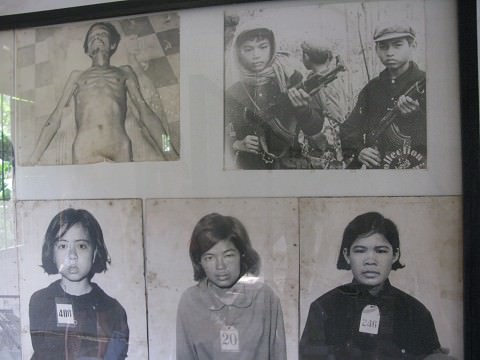 Communist
leader, Pol Pot, and his Khmer Rouge regime quickly defeated Lon Nol’s
government and came to power in April 1975. At first the people of Cambodia
were overjoyed to simply have an end to the war. Their joy quickly turned to
despair and terror! The next day the Khmer Rouge evacuated all of the cities
and forced all the families into the countryside. Their vision was to create a
pure agrarian society that was uncontaminated by the western world. Pol Pot’s
regime began systematically torturing and slaughtering anyone who seemed to be
a threat to this new way of life: all who worked for the old government, any who
were educated, wore glasses (seen as a sign of intelligence), lived in cities,
had mental or physical disabilities, and all religious leaders. In their
four-year reign (1975-1979) the Khmer Rouge killed approximately 2 million
Cambodians (about 1/3 of the population).
Toul
Sleng, the largest torture and execution prisoner, held approximately 12,500
prisoners during the four years;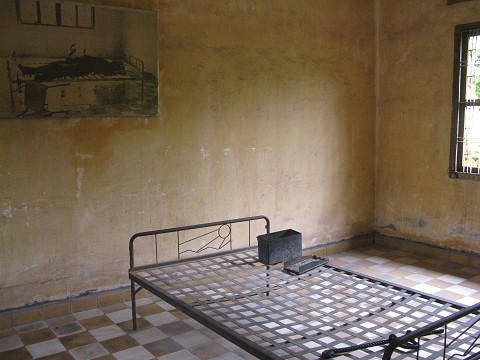 there were only 7 survivors. Toul Sleng was
once a thriving high school, but under Pol Pot it became home of unspeakable
terror and torture. Men, women, and children were starved, beaten, locked to
beds unable to move without permission (even when sleeping), tortured in the
most heinous ways, and eventually killed and buried in mass graves in the
Killing Fields. For more information about this tragedy, I highly recommend
reading First They Killed My Father, which is an autobiographical
account of a young girl’s life under the Khmer Rouge.
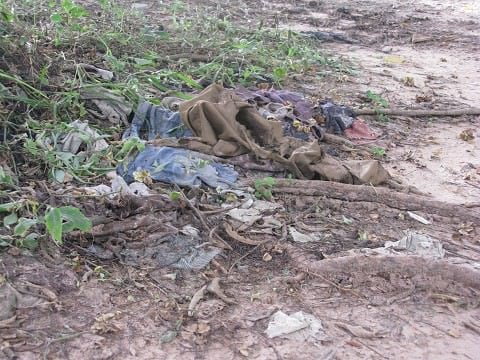 I
I
walked through the Killing Fields where large holes still stand reminiscent of
the mass graves that were once there. Teeth and clothes belonging to the
victims are still washing up in the soil, reminders of the lives that were
lost. These reminders can also be seen in educational and medical systems that
are significantly behind neighboring nations and in the fact that 80% of the
population is under the age of thirty. Although Cambodia’s history is tragic
and the effects of the Khmer Rouge’s terror still linger in this nation, there
is much beauty found in their hope. This is a nation that is finally being
given the chance to rebuild.







