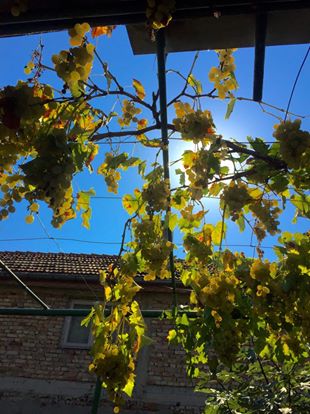
We walk in the rusted iron gate and see a wire overhang above the garden. Grapes hang down in bundles—red, green, and a deep purple. Smoke billows from the furnace containing jars of fruit to make compotes. There is a woman whose skin browned by the sun contains wrinkles telling a thousand stories. Her brittle hair is still a deep gypsy brown though graying at the roots. She invites us with a smile colored by some missing teeth and some gold ones. Her name is Elenka.
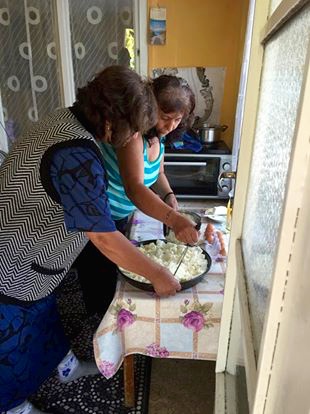
She gestures to us to sit in a collection of mismatched chairs next to a bowl of freshly washed grapes. Her neighbor Marika arrives and we give them the groceries. They are teaching us to make the traditional Bulgarian pastry banitsa. The ladies slip off their shoes to enter the kitchen—one table, a deep sink, and a toaster oven. Swift hands with ages of practice throw in a pinch of this and a dash of that. Our sweet friend Debbie translates the Bulgarian babbling as they describe each step in the process. It goes into the oven and we wait.
Married at 15. First child at 16. 9 children, 9 grandchildren—8 more now, because she has decided to adopt us. She says she is our new “Baba” and thanks us for spending time with her. Her husband died last year. She is lonely, but she and Marika have each other.
Marika brings the cheesy bread out, warm and oily, and announces “Eat Bulgarian banitsa!” I hear my Nonnie’s voice as they encourage “Eat more!” We will gain weight in Bulgaria, they say.
The conversation turns to jokes and questions. They want us to marry their grandsons and live in Bulgaria. “What do our yards look like? Do we have grapes?” They ask if it is a good life in America. Life in Bulgaria is hard, they say. She asks us what we do and we ask her. They sit and wait for new friends with whom they may share their grapes.
The whole neighborhood stops by to see the Americans, all nephews or great nieces or cousin-in-laws. Gypsies have big families. The government gives them money per child. Children come out of the woodworks just to stare at us—we talk to them nonverbally and they grin and giggle.
Though we do not talk directly about the Lord on this day, I feel his presence very tangibly. Tears come to my eyes as I give my Baba Elenka a “Ciao Ciao” hug and she extends an open invitation to her home anytime we need a place to lay our head. Language barrier is no hindrance here. Hospitality and joyous spirits in the face of adversity communicate more than words are able. Love is a universal language.