
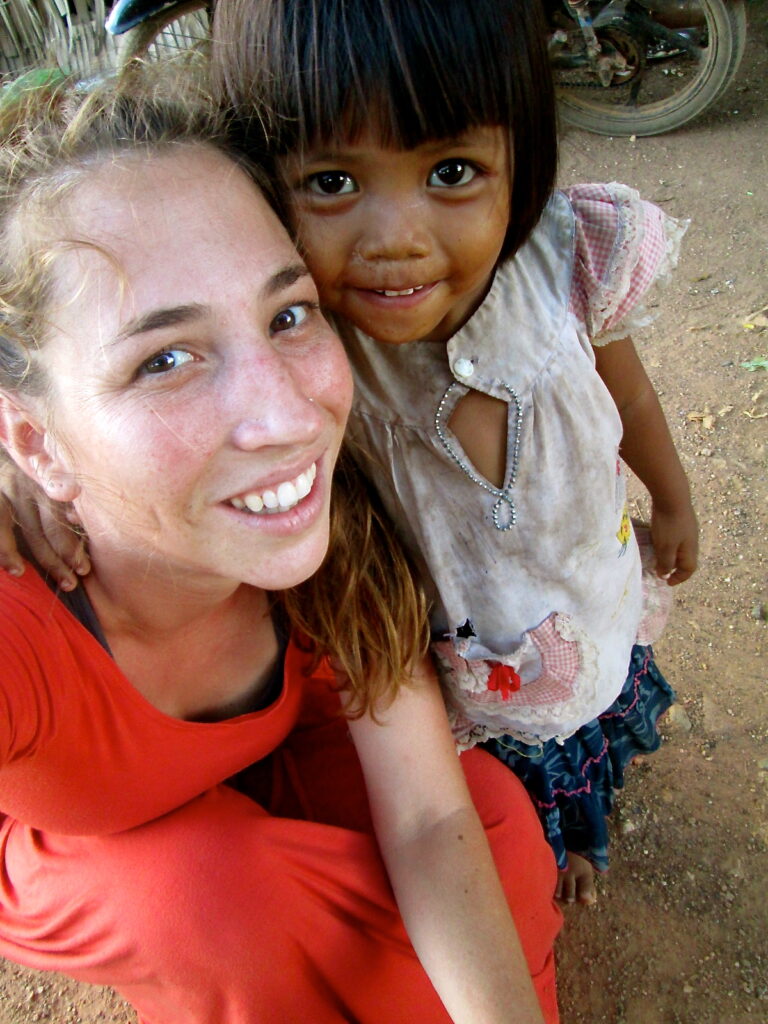
Insert from my journal, July 22, 2013 (Written in Cambodia):
“…Cities are convenient, but village people are generously kind. They value human interaction and treat one another respectfully. People in the village work hard for their food. Everyone is fed. People in the city also work, but the work is dirty. Everyone is busy. Not everyone is fed. City faces are hard; they mask the truth. Village people are honest, there's nothing to lie about. They have nothing to hide. Though the city is full, it feels empty and the people are lifeless. I am suffocated. There are few people within the village, but greenery and *kids at play, give life. There is an openness here; freedom to run. I love the stillness… People may move slowly, and time is never rushed, but the days always sneak by”.
At launch, the speaker said, “every racer's race will be different, have no expectations…" More specifically, he said, "there may be a team who gets placed on a small island, or the beach. Teams might be placed in hostels within a famous city every month. It's also possible that a team will be placed in the middle of nowhere; in a village every month. Every racer's race is different, have no expectations."
Why are these words still ringing in my ears? Because I am a member of that team. We are the “village team”. The world race does a good job at separating you from your typical environment, routine, and comforts, but living in a village takes you a step further than that. Coming from a first-world life style, village life will strip you of everything you know, and force you to revert back to the basics of life. That may seem dramatic, but it's exactly what I needed to get back to the fundamentals. Sleeping in my tent for four months wasn't preferred, but I wouldn't trade that experience for anything. I had to first experience real “abandonment” in order to find that theres something beautiful about the simple life.
When I say, “simple,” i'm not talking about living more easily. It's the exact opposite actually. The low standards of village life do make day to day chores more difficult. Going through the day without a toilet, car, or washing machine is embarrassingly difficult for a person who has had those “necessities” their entire life. But similarily, that's not the “complicated” i'm referring to. I refer to life outside a village as “complicated” because of the wide variety of options we have in almost everything we do. For example, whether it be a career path or where we decide to raise our family, these are choices that villagers do not have. Whatever family they are born into determines what they will be doing and where they will live their entire life. Furthermore, with having less options they are also forced to proritize differently. You couldn't gain the perspective that this was a good thing without first slowly taking away more and more of your options. Give me a second to guide you through the process of abandonment:
Right now, maybe missing a day of work means you would have less spending money over the weekend. You would probably still go out Friday night. In fact, swiping your credit card would get you by just fine. Now, if missing a day of work meant you wouldn't have food to prepare for dinner, you would find a way to work. If doing your laundry means taking 1-2 hours of physically hand washing your clothes, hanging them to dry, and then taking them down again afterwards, you would sacrifice time you would prefer to spend otherwise. If electricity wasn't promised, you wouldn't depend on it. In fact, computers, tv and cell phones would be unnecesary. Going further, if you had no way of knowing about the town outside your village, the people in your own country, or the world at large, you would care a lot more about the relationships you could acquire. If you had to work to live, death would become more of a reality; you wouldn't take life for granted. Above all else, what I observed of the villagers was that they understood the shortness of life. In that, they sought after the greater purpose for their existence moreso than other people. Regardless of what religion they claimed, they wanted to live righteously, because if there is life after death, they wanted to get there.
The priorities of a person working towards success are completely different from the priorities driven by a person working to survive. For example, when your goal is success your attention is focused on getting into and graduating college, attaining a job, and buying a house, etc. When your life is reduced to means of survival, success means staying alive, and living well. Politics, social status, and popularity become entirely unimportant where the well-being of your family, loving your family, and doing right or preparing for the afterlife become priority. The things that matter most in life, actually become what matters most. The reason a life working towards success becomes what i've classified as “complicated” is because what is done on earth becomes an end goal, and life after death becomes an afterthought. If Heaven and Hell are real, then life on earth doesn't matter at all. Because we've had everything we've ever needed our entire life, death is less of a threat. In other words, we put so much emphasis on the quality of life we spend on earth that the time we think about eternity is little to none. Our priorities have been clouded.
Believe me, I could've written on and on about what made village life hard. I know readers back at home like to entertain themselves with those things; trying to imagine themselves being under the same circumstances. Or maybe you're a future racer; skimming blogs for the worst possible scenarios, trying to catch a hint as to what your 11 month journey could be like (as I had done before the race). Though amusing, what I've learned is that those things actually don't matter. At all. In fact, what the people living in these rural areas taught me is far more important then the difficulties we had living amongst them.
It wasn't till I got to Cambodia, the last village on the race that we would be living in, that I realized how much I was going to miss this unique people group and their lifestyle.They work hard, and they count everything they have as a blessing. They may not have some of the privileges that we do, but they have a very clear perception of what truly matters in life. Whether the villagers were Buddhist, Hindu, or Muslim, they believe in something greater than themselves, and are loyal to it. They may be considered “behind” in terms of progression, but in hindsight, it seems that progress might be the very thing that has made our life more complicated. In the midsts of our blessings, it's time to remember the beauty of the simpler things in life; the things that really matter.
"Whoever loves money, never has enough;
whoever loves wealth is never satisfied with their income.
This too is meaningless.
As goods increase,
so do those who consume them.
And what benefit are they to the owners
except to feast their eyes on them?
The sleep of a laborer is sweet,
whether they eat little or much,
but as for the rich, their abundance
permits them no sleep.
…Everyone comes naked from their mother’s womb,
and as everyone comes, so they depart.
[we] take nothing from their work
that [we] can carry in [our] hands.
…As everyone comes, so they will depart..
Then what do [we] gain?
[we] work for the wind."
~Ecclesiastes 5:10-16







