
The Story
“I will leap into my grave laughing because of the feeling that I have five million human beings on my conscience is for me a source of extraordinary satisfaction.”
– Adolf Eichmann
My favorite
teacher, Pastor Paul Barker, tells the story better than I can. I would start with him. But one of the greatest story-tellers of all
time, Mike Wallace, tells it better than he can. I’ll start there.
Indicted for crimes against humanity, crimes against the
Jewish people, and 13 other criminal charges, Eichman sat inside a bulletproof
glass booth in an Israeli courtroom. The
1961 trial produced over 1,500 war documents and 90 prosecution witnesses that
survived the Nazi death camps. Yehiel
De-Nur was one of the ninety.
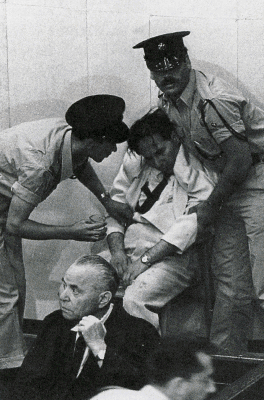
De-Nur entered the courtroom, sat in the witness chair, and
described Auschwitz1 in his opening statement. “Planet of the Ashes,” he said. Then the prosecution began to ask him
general questions that they had prepared about the camp, but De-Nur didn’t
answer. He couldn’t finish his testimony.
Instead, De-Nur looked at Eichmann, and fell over in
agony. His weeping was frantic and
uncontrollable. Then he passed out.
Twenty-two years later, Mike Wallace interviewed
De-Nur for a 60 Minutes story on Eichmann.
Wallace showed De-Nur the film clip of his testimony and subsequent
collapse, and then asked what overcame him on that day.
What was the emotion that caused such a
reaction? Fear? Anger?
Bitterness? Regret? Memories?
Sorrow? Was it hatred?
“No,” said De-Nur, “When I saw Eichmann, I realized that he
was just a man. Just like me. There was really no difference. I was capable of the very thing that he did,
and I collapsed because I saw my reflection in him.”
Wallace ends the interview by stating, “Eichmann is in all
of us.”
The Point
Remember when Clark Griswold received his membership to the
Jelly of the Month Club, and then he tells his family exactly what he would
tell his boss if he were there tonight?
(Thanks Cousin Eddie) “I wanna
look him straight in the eye and tell him what a cheap, lying, no good, rotten,
four-flushing, low-life, snake-licking, dirt-eating, inbred, overstuffed,
ignorant, bloodsucking…” Yeah, you
remember.
I always think about that rant when I read Romans
1:29-31. We tend to read those verses
and think this is talking about some other people – some other, bad
people. We think that Paul isn’t writing
this to us. But, really, this isn’t a
picture of somebody else. It’s a picture
of you. This is your biography. When reading this, think differently. Think, this is who I was!
“Their lives became full of every kind of wickedness, sin,
greed, hate, envy, murder, quarreling, deception, malicious behavior, and
gossip. They are backstabbers, haters of
God, insolent, proud, and boastful. They
invent new ways of sinning, and they disobey their parents. They refuse to understand, break their
promises, are heartless, and have no mercy.”
Okay. Alright. I know exactly what you’re thinking.
“Heartless?
God-haters? Malicious? I’m sorry, Kellen. You’re a brilliant writer and all, not to
mention ravishingly good looking, but though I acknowledge I’m not perfect,
that’s just not a description of who I really am.”
Maybe not. But
consider this…
What if you grew up somewhere else? What if you had completely different
friends? What if the hand of God’s grace
was lifted from your life?
Maybe you were born in a war torn nation. Maybe you lived through genocide. You witnessed the rape and torture of your mother,
sisters or daughters. Maybe you didn’t
know where your next meal was coming from, and every day was a struggle to
survive.
What kind of person would you be then?
Or worse yet, maybe you had unlimited wealth. At the snap of a finger, everything you ever
wanted was yours. Islands, servants, cars, mansions, jets,
chefs. What if everyone submitted to you
and everyone wanted to be you?
You’re still the exact same person. Same mind, same heart, but now what kind of
person are you?
This is why the sweet girl from Once can’t be judged solely on her actions. It’s not just. Her actions – her character – only reflect
the worldview and the culture that she’s experienced. Change that and her actions change
completely. Take away God’s grace in our
lives and every one of us could be as wicked as Eichmann. That’s why Jesus takes the boundaries of
morality beyond just the external, and he extends them down to the
internal.
Pastor Barkers says,
“You see, it’s not so much what you did
do. It’s what you would do, if you could and not get caught.”
In the courtroom that day, beyond the bulletproof glass, Yehiel
De-Nur saw the man Eichmann was before his circumstances got the best of him.
The Epilogue
This sounds like a whole lot of bad news, doesn’t it? There’s some good news, too.
“Day after
day, in the temple courts and from house to house, they never stopped teaching
and proclaiming the Good News that Jesus is the Savior.” (Acts 5:42)
There’s no
Good Rules and there’s no Good Advice.
There is only The Good News.
We’re far more evil than we could ever
comprehend, yet far more forgiven and loved than we could ever imagine.
The
headlines are free and, like most news stories, they’ve already happened. It is done. Now there’s nothing else left to do besides
accept the Good News.

“May you
have the power … to grasp how wide and long and high and deep is the love of
Christ … that you may be filled to the measure of all the fullness of God.”
Wallace was almost right.
Eichmann was in all of
us. But when we’re filled with the
fullness of Christ’s love, there’s no longer any more room for Eichmann.
1 I spent a
day in Auschwitz-Birkenau in the summer of 2008. The experience is indescribable, so I won’t
describe it. But, I will tell you a
slightly funny story about one of the least funny places in history.
My friends Joseph
Sherer and David Meslar joined me on the trip, and we spent a solemn, tearful,
humble, eye-opening day walking inside gas chambers, around the shooting wall,
and through Dr. Mengele’s human experimentation chambers. We learned a lot that day. Joseph (just engaged, congrats Jo and Lindy) was
very interested in the psychology behind the death camps. And after we left Auschwitz, he wanted to
know more. In 1925, Adolf Hitler wrote
‘Mein Kampf’ (My Struggle), which discussed Hitler’s early life and his belief
of a Jewish conspiracy to gain world power.
So Joseph decided he would read this book, and gain a little insight
into Hitler’s psychology. There was one
problem though – we were still in Poland.
We got off the train from Auschwitz to Krakow, and he immediately went
to the first bookstore he saw. He looked
through the ‘M’ section, but could not find it.
Then he looked through the ‘H’ section, thinking perhaps it’s arranged
by author. Still, could not find
it. Finally, he decided that asking an
employee would be the most efficient way to locate this book.
He went to the front
desk, where there were two young Polish girls busy organizing books. “Excuse me, where can I find the book Mein
Kampf?” As soon as that last word came
out of his mouth, they dropped their books and stared at him in
bewilderment. “umm..” said the girl,
after a few seconds of shock, “We don’t sell that book here.” The other girl chimed in. “In fact … You can’t find that book anywhere
in this country.”
“I.. uhh..eh,” he
stammered. At a loss for words, he
lowered his head and quickly walked out of the store. The two girls stared at him all the way out
the door.
2 The 1963 book, ‘Eichman in Jerusalem: A Report on the Banality of Evil’ described how the great evils in history were not committed by terrible people, but by normal people that accepted the premise of their abnormal, ‘evil’ situation or culture.
New reader? Thanks for visiting – Feel free to add your e-mail address in the space provided on the left to receive blog updates. Also, if you’re interested in partnering with me financially, please Click Here.







