
Next March, I will celebrate my 32nd birthday in Chile!
FUN FACTS
Distance from Andover, KS (my hometown) to Santiago, Chile (capitol of Chile) 5,202 miles (or a 13+ hour flight)
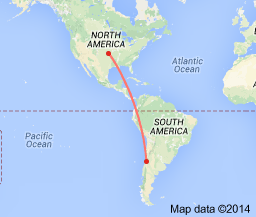
Distance from La Paz, Bolivia (country #2) to Santiago, Chile (Country #3) 1,760 miles (or a 36+ hour bus ride)
Time Difference
Chile is on the same time as Eastern Standard in the US. For example, when it’s 5pm in Kansas, then it’s 6pm in Chile.
Currency
The Chilean Peso is the official currency of Chile.
$1 US Dollar = $583.54 CLP
Geography
Area: The country is shaped like a long and narrow ribbon and is one of the longest and narrowest countries on the planet. The coastline along the Pacific Ocean stretches for 2,700 miles (about the same distance from New York to LA as the crow flies!), but the width never exceeds 150 miles.
Average Temperature in March
- Northern Chile: On the coast – dry (considered one of the driest regions in the world), cool, and foggy…Inland – summer/rainy season
- Central Chile: Summertime is temperate and similar to what we’d expect in the Mediterranean (sounds perfect to me!).
- Southern Chile: March is considered their summer, but feels more like Fall in the US with highs of 57°F and lows of 41°F.
- At home in Wichita, KS: the end of winter – 35°-58°F…burr!
Religions
Roman Catholic 66.7%, Evangelical or Protestant 16.4%, Jehovah’s Witnesses 1%, other 3.4%, none 11.5%, unspecified 1.1% (2012 est.)
Languages
Spanish 99.5% (official), English 10.2%, indigenous 1% (includes Mapudungun, Aymara, Quechua, Rapa Nui), other 2.3%, unspecified 0.2% ***note: sum is more than 100% because some respondents gave more than one answer on the census (2012 est.)***
Points of Interest
Parque Nacional Torres Del Paine: This national park lies in the southern Chilean Patagonia. Visitors take in breathtaking sights that include waterfalls, forests, mountains, glaciers, lakes, rivers, mountains, and beautiful wildlife.
Chilean Wine Country: With its wine-making history dating back to the 1550s, Chile is the oldest wine-making country in the Americas, and the Casablanca Valley (only a short drive from the country’s capital) is considered one of Chile’s top wine regions.
Rodeos and Huasos: In 1962 the rodeo became the national sport of Chile. Since then its popularity thrived especially in rural areas. The rules of the rodeo are pretty simple. A steer enters the Media Luna (half moon arena) from one side and runs clockwise. The huasos (pronounced ‘waso’) compete in teams of 2. They pin the steer against the side of the arena, turn it in the opposite direction (with finesse and style) to earn the most points. I can already imagine the hubbub all around. I can hear the fans cheering for their favorite riders, smell (and almost taste) the delicious empanadas cooking on the open pit bbq, imagine the hausos dressed in the colorful ponchos and sashes, and feel the excitement of the celebration! I’d love to visit this kind of rodeo!
Here’s a video of the 2014 National Finals (It’s nearly 25 minutes long, so fast forward to the good parts!)
Love, Love, Love
Kate
If you want to learn more about Chile, here are some helpful websites I used to gather my information.
http://www.gochile.cl/en/
http://www.foodandwine.com/articles/the-next-wine-country-chile
https://www.cia.gov/library/publications/the-world-factbook/geos/ci.html
http://www.exchile.com/ChileanRodeo.html







