
We spent our month in Costa Rica in a little beachy, jungley, touristy town called Puerto Viejo de Talamanca. We worked and stayed at a ministry house called “La Casa de Restauracion” (Restoration House). It was an old, broken down home that our ministry hosts had a beautiful vision for: the home would be used as a refuge for broken people, for addicts, for abandoned women, for neglected children, for hard teens, for purposeless men. The plot of land that the house is on is being stripped, tilled, and planted for a community garden. And the best part: the people who need the Restoration House the most are the ones investing in its physical restoration.
Photo credit: Katie Axelson
Photo credit: Jaide Penney
We spent our first few days in Puerto Viejo working on the inside of the house, cleaning and painting and bringing it to a place where it was livable for us for the month, then we moved in. My first impressions of the house when we started work were not great. The walls were so termite-ridden that you could see into the next room in some places, the floors had gaps big enough to see down to the earth below, there were as many mosquitoes inside as there were outside, and there were patches of floor that we had to step over for fear of falling through. When we started working outside in the garden space, we ended up spending most of our time cleaning up the years and years of garbage and glass that had been collecting in the back. As we were first working, I thought of that old Southern saying, that we were just “churching up” the place, meaning that we were making it look nice externally, but not fixing the internal issues.
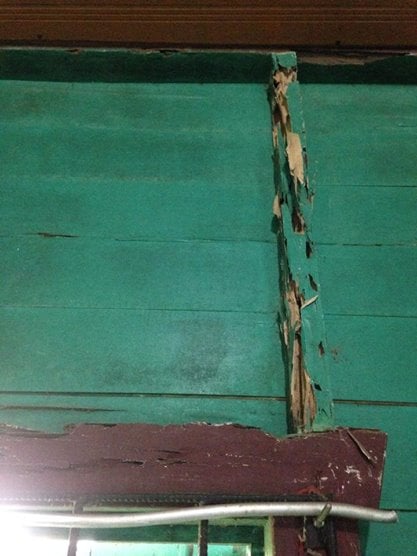 Photo credit: Jaide Penney
Photo credit: Jaide Penney
In my limited knowledge of carpentry and restoration, I thought that the only way to really fix this house, to repair everything that was wrong, would be to tear it down and start over. If we tried to replace every board that was damaged, if we brought the plumbing up to modern par, if we rewired the house properly, and modernized the appliances, there would literally be nothing from the original house left.
But as the month went on, I started to see how much a few coats of paint and some elbow grease could transform a place. I saw the way that people investing time and effort in a project gave them ownership over it. I saw that a place where people come to worship and learn and grow is sacred, even if it’s broken.
I wondered, if I were a house, what would I look like? How much work would I need?
I realized that this struggling house is a lot like me. If everything that’s broken or not-up-to-par in me were taken out for repair at once, there wouldn’t be enough left of me to stand. I couldn’t handle that kind of overhaul. There’s so much in me that needs to be set right, but Jesus has the grace and patience to fix what’s most necessary, in the timing and dosage that I can take. And somehow, in the refining process when I’m a mess and feel like I don’t have anything together, He can still use me for His good.
How sweet is that?







