The LORD himself goes before you and will be with you; he will never leave you nor forsake you. Do not be afraid; do not be discouraged.
-Deuteronomy 31:8
What, then, shall we say in response to these things? If God is for us, who can be against us?
-Romans 8:31
India, Day one
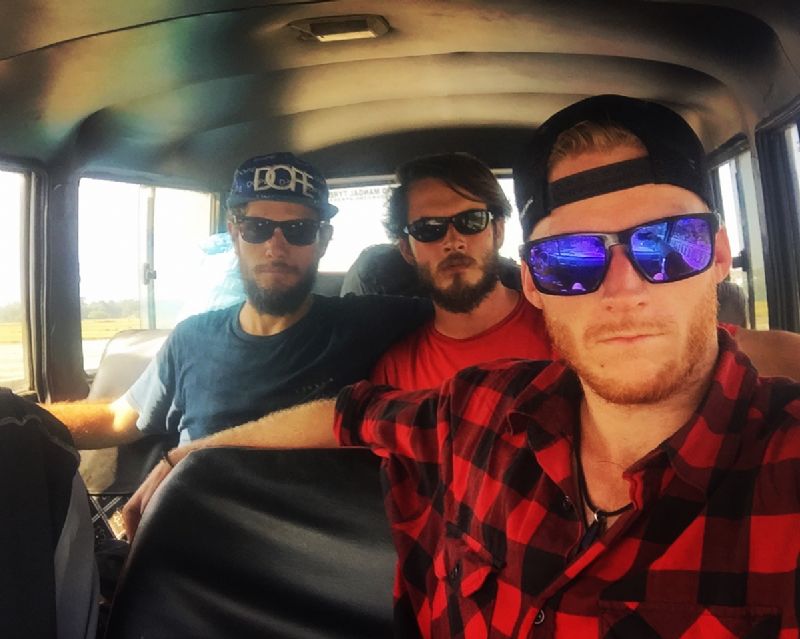
We stood sweating in the middle of a rat hole that is the town of Panitanki – Charles, Lukas, and myself – packs on our backs and our fronts, carry-ons dangling from our shoulders, baking in the hot sun, swarmed by lumbering semis, weaving motorcycles, honking jeeps, and masses of travelers flooding in from the Nepalese border to tread the dung smeared, refuse coated dirt streets of an Indian border town in West Bengal. That town’s name, translated in English, was “Water Tank.” Apparently even the locals could find nothing better to claim about it. After the last hour, we certainly could find nothing good to say about it. We looked at each other, brows furrowed with frustration, gaskets seconds from blowing, and knew there was only one thing we could do. We were going to have to sneak back into Nepal.
Two hours before, I didn’t wake up. I didn’t need to. Sleep hadn’t come the night before. Between the Bollywood movies blaring from a speaker clearly on its last leg and the incessant jerking and jostling and bumping of the bus as it careened down torn up roads to the border of Nepal and India, there was no room for some shut-eye. But I didn’t care. My three man team had just arrived in Kakarvitta and all was set for what seemed to be a perfect morning. Our Indian Visas were in order and as far as I knew Siliguri was only a 30 minute jeep ride away once we crossed the border.
We hiked to the Nepalese immigration station, daydreaming of whatever breakfast feast we might sit down to on the other side of the border. The one employee working there casually chatted with us, stamped our passports, and went back to watching his kung-fu movie behind his desk after wishing us a cheerful goodbye. It was the best border experience we’d ever had. Things were looking up.
500 meters later, across the concrete bridge that spanned a drying river between Nepal and India, we found the Indian immigration station. This one was almost better. A clean, brick building on a secluded, tree shaded side street off the main road, it had actual air conditioning. The cool sensation was almost alien to us now after months of relying on ceiling fans. 15 minutes later, our single entry Indian visas were stamped by an Asian guy singing George Michael songs in broken English and we were set to begin our journey to Siliguri. After a bit of breakfast, of course. Oh, and exchanging USD for Indian Rupees so we could buy that breakfast and pay for transport.
We walked back out to Panitanki’s main road. Kathmandu had been a madhouse, but an organized madhouse. Here, organization wasn’t even a concept. What was road or footpath or storefront or cattle grazing field? Apparently whatever and wherever people made them, and often they made them to be all the same.
Dilapidated shacks and grungy storefronts run out of garages and buildings covered with overlapping signs like post-it notes on a high-school girl’s locker. Vehicles of all shapes and sizes blazed their way down the road, in whichever directions they chose, heedless of the human masses that simply adapted to the empty spaces between wheels and semi-truck beds like a river through stones. Cows grazed among heaps of trash festering between shops and on road-shoulders and added their own sickened refuse to the patina of dirt and grime that covered everything. All was a seething mass of man and beast, metal and rust, trash and dirt and dung.
We navigated this ocean of chaos searching for a money exchange kiosk, encumbered by all of our belongings and growing increasingly frustrated with the drivers around us who took perverse pleasure in blasting their wailing horns in our ears at random intervals.
We found a money exchange kiosk. It was closed. We plunged further into the town, and everywhere we turned no help was given.
We knew that the Indian government had banned all 500 and 1000 rupee notes overnight in an attempt to rid the economy of counterfeit bills, or black money as they call it here. What we did not know is how much of a crisis that move created.
There was a run on the banks, most of which had closed leaving the few open banks mobbed by hundreds of people. None of the ATMs worked.
The Western Union would not exchange USD. The local police responded to our inquiries about where to exchange money to get their own country’s currency with “I don’t know. We don’t know anything about this. Go back to Nepal.”
I prayed for God to send someone to help us. Moments later, a man came and told us he could exchange money. I was in the midst of praising God under my breath when he started trying to pawn off the old currency on us, at a horrible exchange rate no less. We told him in no uncertain terms to be on his way. Still, God is ever faithful and so I believed that He was sending help. That guy just hadn’t been the help intended.
Finally, we walked all the way back to the edge of Panitanki where the jeep driver’s congregate and tried to negotiate a ride to Silliguri, or at least to a bank.
That conversation went something like this:
Us: “Hey, we want to hire your jeep for 1000 rupees. We have USD, but if you take us to a bank or ATM, we can get rupees to pay you with.”
Driver: “You have rupees? You have Nepalese rupees?”
Us: “No… We have U.S. dollars. That we can exchange for rupees at a bank, if you will drive us there.”
Driver: “You need go to bank. Get rupees. It is 5 kilometers away. Not far.” [gestures with hands in vague direction]
Us: “We’re not walking 5 kilometers with all of our bags.” [holds up $40 USD] “See this? You take me to bank, I trade this for rupees, you get money.”
Driver: “Oh, ok. How much you have? How many rupees you have?”
Us: “We don’t have rupees. We have dollars. If you drive us to the bank, we can pay for a jeep ride and give you extra money too.”
Driver: “No dollars. You need rupees. Maybe go to Nepal.”
Us: “We just came from Nepal and our Indian visas are single entry. We cannot go and comeback.”
Driver: “Oh. ok. You need go to bank maybe and get rupees.”
Us: ….
Us: 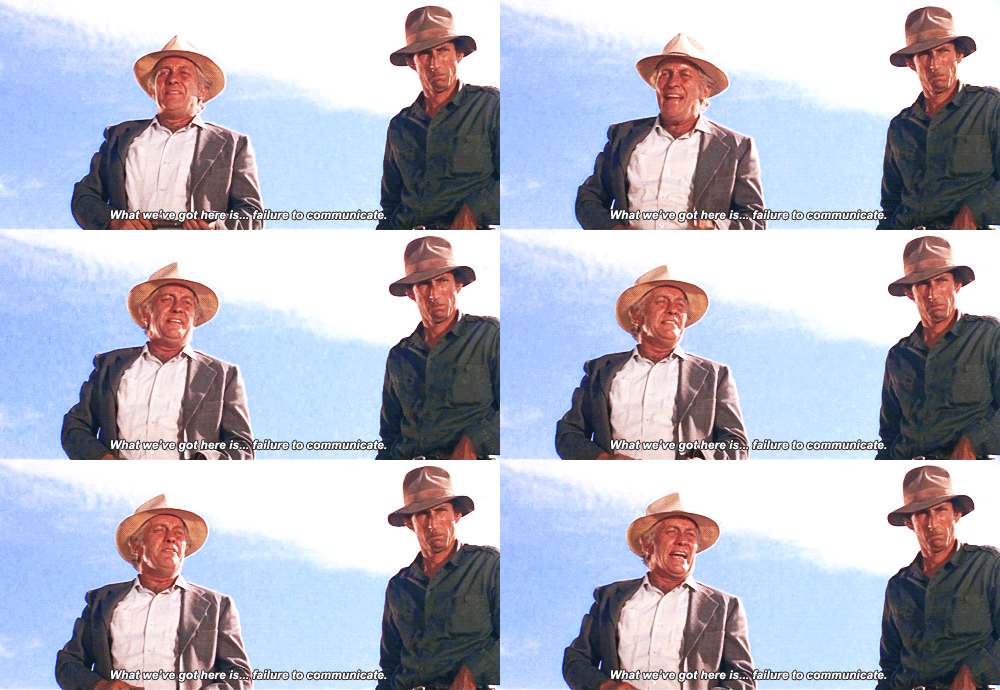
And like the pointless cycle of violence, greed, and death to which the pagan Danes are doomed at the end of Beowulf, so were we doomed to this inane cycle of miscommunication, and it was equally as destructive to our souls, or at least to our patience.
So there we were, in the moment at which I began this tale, with no option before us but to sneak back into Nepal, despite having our Nepalese visas stamped “departed,” and subsequently sneak back into India, despite having used our Indian visa’s single entry already.
The two lane concrete bridge stretched before us, long as a football field, crowded as a rock concert, guarded and patrolled on either side by each country’s military, spanning the divide between India and Nepal high above fields of rock and shallow water. And we had to cross it unchecked, unquestioned, unseen.
I prayed aloud as we approached the bridge. “Father, make us invisible. Allow us to move unseen through the crowd, like Jesus did when He walked the Earth.” We prayed in the spirit as we walked, striding past the Indian military guard. So far, so good. 5 minutes later, after traversing the length of the bridge, we came to the real test – getting into Nepal. Two groups of soldiers stood before us on either wall of the bridge, visually scanning people as they passed in and out. Sometimes stopping and questioning people. We walked right past them, eyes forward, no hesitation.
We had just made it back into Nepal without valid visas.
“Thank you so much, God, for being ever faithful,” I prayed again. “Now please help us find a place where we can exchange money and then get a jeep ride to Siliguri from here.”
At that moment a man walked up to us and began to give us the usual litany of questions curious locals pose to foreigners in Asia, beginning with “Where from you?” Pretty standard, except he phrased it “Where are you from?” He spoke almost perfect English.
Soon after we engaged in conversation and told him about our predicament he said that he would not only take us to a place to exchange money but would also arrange a jeep to take us to Siliguri from this side of the border. Truly, God sent a man of peace to help us.
The money exchange kiosk was mobbed. A zig-zagged queue of at least 200 people clamored toward the exchange window. Turning toward our newfound friend, “Darson,” Charles held up his wallet.
“We have U.S. dollars,” said Charles. “Do you think you can get us up the window quick since we have U.S. money?”
“Oh yeah, of course!”
Darson the God-Sent, as he shall henceforth be known in all the realm, then took Charles and proceeded to cut to the front of the 200 man mob. 5 minutes later, we were in business. We couldn’t get Indian rupees, but all we needed on this side of the border were Nepalese rupees. Now, we had those in spades.
Darson led us to a spot on the roadside where we could wait for our jeep to arrive and asked about our names. When Lukas said his name, Darson asked “Like in the Bible?”
God hadn’t just sent a man of peace to help us, He’d sent a brother. Together, Darson and our team marveled at God’s provision and the unexpected ways in which He works all things together for our good. The Jeep soon arrived, just beyond the Nepalese soldiers gaurding their end of the bridge. Again we walked past them without hindrance and then loaded into the jeep as Darson negotiated the price for us. Mission accomplished…almost. We prayed a quick blessing over Darson as the driver took off, driving us toward Panitanki and the Indian soldiers who waited there.
“Play it cool, guys,” said Lukas, as we weaved our way through the amorphous herd of vehicles toward the queue formed at the far end of the bridge.
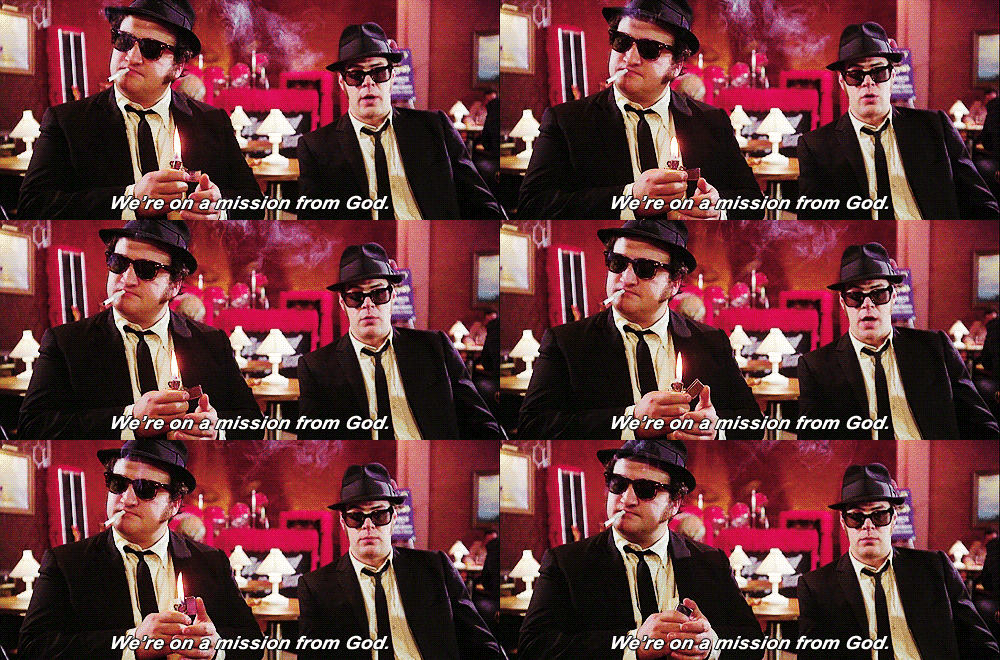
At that, of all the the possible ways to hear from God, John Belushi’s voice sounded clearly in my head. A grin curled at the corners of my mouth.
“They can’t stop us,” I said. “We’re on a mission from God.” I’m glad God appreciates movie quotes like I do. It certainly was a comfort in that moment.
The driver made his steady approach all the way down the end of the bridge, drawing ever closer to the blockade of Indian military police – the last thing that stood between us and a month of ministry in India.
They stopped us. A military police officer strode toward the passenger door on my side, stone-faced.
“Passport?” he asked.
What I said in response was something along the lines of “Sure. No problem. Got it right here.”What I thought was “That’s it. We’re done. Unless the Holy Spirit blinds him or something, we’re barred from entry to India.”
He took the passport from my outstretched hand and immediately flipped through the visa pages, stopping on my Nepalese visa. His eyes never looked up, locked on the “departed” stamp on my visa.
“Did you depart today?”
“Uh, yep. That I did.” I said. ‘And I’m actually not lying,’ I thought.
“Ok,” he said in monotone, and handed my passport back to me.
He motioned to the driver wordlessly. With a rumble of the engine and a jerking shift into gear we rode past the blockade straight onto Indian soil.
We were home free. God had opened the door of India to us. And that was just the start of His show of provision for this month’s ministry.