
My friend JMV is cool. He absolutely nails the whole Rwandan-rastafari-hipster-artist vibe. He has that type of effortless cool, that only appears possible when someone is being their authentic self, that cool.
I met JMV at a cheap AirBnB in Rwanda’s capital city of Kigali. An artist by trade, JMV spends his days painting, procuring his emotions and transposing them into a tangible creation. What I went on to learn is that JMV’s story, and the resiliency in which he lives his life, is what makes his art and his person so compelling.
The scar on JMV’s back is gruesome. 6-7 inches long, and thick, demonstrating that it was not healed through medical attention, but through time and good fortune. When JMV was 5 his country fell into turmoil. Due in large part to western colonization practices, classism, and stark economic inequality, Rwanda was in a highly charged state of social unrest. It was amid these tumultuous tensions that on a beautiful spring day in 1994 a neighbor questioned JMV’s racial origins. Machete in hand, he badgered JMV’s father as to whether his mom was of the minority Tutsi, or the majority Hutu. Despite his father’s advocacy, JMV’s back was severely gashed. Luckily, or serendipitously, JMV went on to heal from the wound, unlike so many of the ~ 1,200,000 Rwandans that perished in this conflict.
JMV’s hardships did not end there as he would go on to experience abuse from his father, homelessness, and seeing his baby sister die at a young age. When I asked JMV, who now is a gainfully employed artist with an impressive intellect and 3 children of his own, what he has learned through his journey, he said without hesitation: “No Fear.”
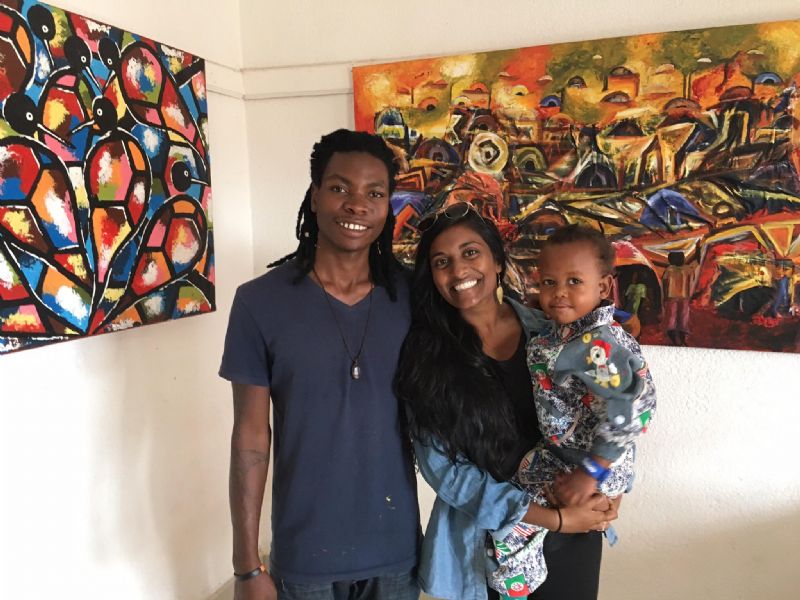
(JMV Poses in front of some of his art with my friend Ashley and JMV’s son, Happiness)
Upon contemplating JMV’s story and that of Rwanda as a whole, I can’t help but marvel of the many parallels that exist between the two. The Rwandan people have scars, literal and metaphorical. Through resiliency, fortitude, and time, the country has begun to heal as well as prosper. Through 2012 Rwanda’s 8% annualized economic growth was among the highest in the world. Over the same time period Rwanda ranked as one of the top 3 countries globally in terms of reducing out-of-school child population.
One weekend in Rwanda we booked a cheap bus ticket out to a Kibuye, a rural lake town that sits in picturesque fashion atop Lake Kivu. Lake Kivu is, undoubtedly, one of the most beautiful places I have ever been. Situated near the center of Africa’s great lake region, lake Kivu basks tranquilly amid the rolling green hills of Rwanda’s countryside, the terraced gardens of the surrounding fields providing a natural framework for Kivu’s placid blue surface.
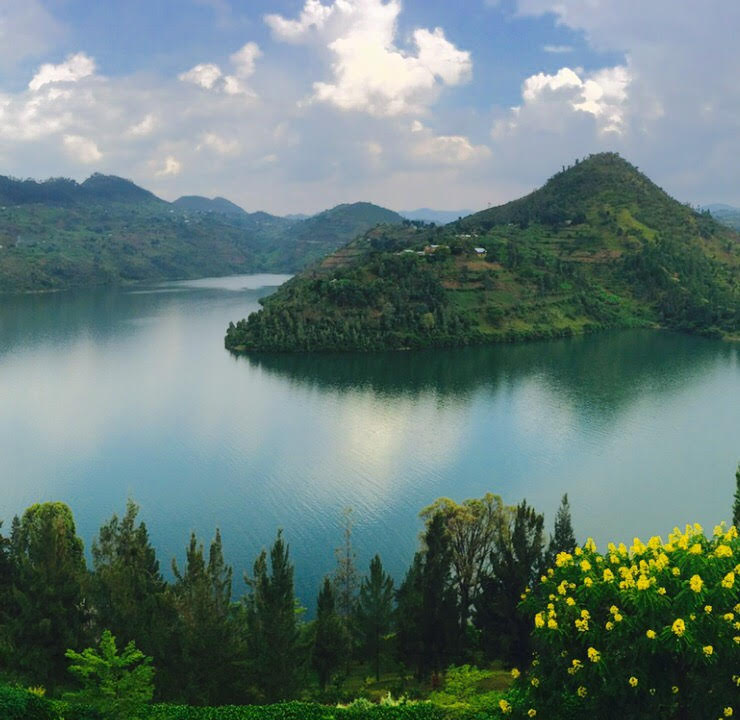
(Lake Kivu)
The first thing we noticed after checking into our hostel was the old stone church on the neighboring ridge. After polishing off some delicious goat kabobs we walked over to check it out. Ascending the entryway I noticed a much newer building sitting just to the left. The building was small, with just 1 room and a big glass window in front. As I got closer I noticed through the window a pile of human skulls, orderly stacked from frame to frame, under large black letters “Never Again.”
What was devastating to learn is that this church, despite being near the Congo border and over 3 hours from Kigali, was the site of one of the most appaling parts of Rwanda’s genocide. It was truly a surreal experience, standing above the lake, remarking at it’s intrinsic and overwhelming beauty, while also contemplating the reality that some 20,000 people lost their lives over 2 days within that charming stone church.
My heart and brain felt painful tension as I sought to emotionally balance the two; the sheer splendor of God’s creation, and the brutal ugliness of the fallen state of this world. What I realized is that Kibuye, is in some respects, a polarized microcosm of this life. The world, as it was created by God, is full of beauty, entertainment and joy. However, because we are also separated from God, it is also full of hardships, challenges, and pain.
In my experience the pain and the hardships can often be thrown into two major buckets. The first being the hardships Christ tells us to expect as a cost of following him. The second are the unnecessary hardships we bring on ourself because we are not following him. In the case of Rwanda, the latter of these is largely responsible for the pain felt during April of ‘94, due to the brokenness adopted by many people, both internal and external to the conflict.
With the added benefit of hindsight, Rwanda has proven to be a case analysis for how tribalism and economic inequality can breed social indignance capable of producing appalling actions. Additional perspective has also demonstrated how resiliency and fortitude can enable people to navigate even the hardest of times.
Tough times can produce the worst in people as they provoke us to act out of our flesh. Ironically, success in these situations requires the exact opposite. Tough times, especially those hallmarked by deep ideological disparities, call for us to be grounded in truth, in ourselves, and in our Creator. Most of all, they require resiliency in our ability to maintain a level head, and more importantly, resiliency in our ability to afford grace and forgiveness towards others.
The old stone church atop Lake Kivu is again thriving. Parishioners come and go, choirs practice, and Christ is extolled from the very place lives were taken. As JMV and the Rwandan people have demonstrated, courage and resiliency are vital as they allow for healing and reconciliation. And once reconciled, from a united position, or at least one of mutual respect, people groups are much better suited to drive towards progress.







