
As a white, male, Christian from a middle-class family in the mid-Atlantic, I am not used to being a minority. Nor am I familiar with my religion being maligned as responsible for incubating terror groups, and I’m certainly not used to Christianity being implicated for committing horrific acts of violence. So this past week in the Bosnian city of Sarajevo was a new experience for me, in more ways than one.
My squad of 30 Christian missionaries met at a hostel in Sarajevo where we fellowshipped, worshipped, and debriefed on our ministry efforts over the past 2 months. I learned quickly that Sarajevo is overwhelmingly Muslim. Mosque towers pepper the skyline, and objectively, the city itself is exceptionally beautiful. I also went on to learn how the Balkan Wars, which were a series of nationalist movements that led to the break-up of Yugoslavia, saw unfathomable atrocities being committed by people who identified with a religion led by Christ, not Muhammed. 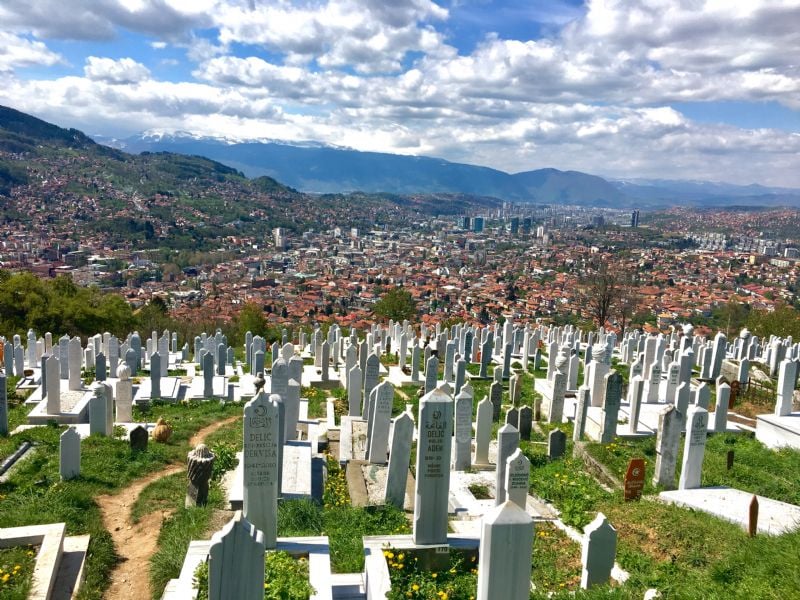
On the outskirts of town, a graveyard containing casualties of the Bosnian War overlooks Sarajevo’s downtown and residential neighborhoods
Taking this all together, living in Sarajevo was not only my first time as a part of the religious minority, but it was also my first time in a place where Christians are viewed as the bloodthirsty extremist, and frankly, for good reason. The Balkan Wars were fought largely over ethno-religious lines, with Catholic Croats and Orthodox Serbs being among the leading aggressors. Most egregiously, Orthodox Serbs are credited with “ethnic-cleansing” around 8,000 Bosnian Muslim men and boys. Side note – in case ethnic-cleansing sounds like a politically-fluffed way of saying genocide, you’re right, as most recently Russia vetoed the UN’s movement to call a spade a spade.
So what does all this mean, for us, today? For me, this experience further contextualized the fact that terrible things have been done in the name of Christ. Once more, it helped me realize that we as Christians have three options in how to handle this reality, in either choosing ignorance, apathy, or ownership.
Ignorance – This is where many Christians live as well as where I have been much of my life. Admittedly, the only thing I knew about the Balkan region prior to this missions experience was that the bad guys from Taken were Albanian. I suppose to a certain extent ignorance is understandable. After all, people are busy, the world is a big place, and researching the religious implications of genocidal movements just isn’t as enjoyable as binge watching Parks & Rec (guilty!). But as Christians, I believe a balance of enjoying life and seeking greater understanding is achievable. Once more, the Bible also calls us to this, as it exhorts us to embrace challenging situations, seek understanding, and be prepared to answer the questions of non believers.
Apathy – For the more well-informed, older, or nerdy Christians (who perhaps were history majors like myself) apathy is also common camp. Similar to ignorance, I understand the inclination to gravitate toward this end. Yes, bad things have been done by Christians, but I / my family / my friends didn’t do any of this stuff, so why should we concern ourselves of it any further? This logic is also made easier when giving into comparing and rationalizing. I can hear myself saying, “Sure, the crusades happened 1,000 years ago, but ISIS and Boko Haram are happening today.” And while this statement holds merit, I believe it too stops short of the true heart of Christ.
Ownership – The third option, which I believe to be the best (and consequently the hardest) is to take ownership of what’s been done. Not in a way that places unnecessary burdens on our hearts, but rather by taking responsibility for what we know, all while recognizing that this represents an opportunity to create a dialogue with someone’s who’s been hurt by the church, and more importantly, an opportunity to live out the message of the gospel. By taking ownership, we are saying that however deranged the person that hurt you was, I recognize that I am affiliated with them, and there is an inherent responsibility associated with this. Once more, if I have the opportunity to do a small part in healing a wound that was caused by anyone, let alone someone affiliated with my faith, why would I not take advantage of this opportunity? For me, it’s helpful in these situations to remember to avoid points of pride, as humility begets an apologetic heart, which produces healing.
—
So here’s a small effort in walking down this path. On behalf of Christians, I am sincerely sorry to Muslims (and to mankind) for the Srebrenica Massacre. I also apologize to anyone else who’s been hurt by the church. If you’ve ever felt judged, or condescended to by a member of the church, I apologize. If you’ve ever been abused, excluded, or overlooked, I apologize. My heart breaks out of a sense of indignance and compassion for anyone whose been hurt by someone representing Christ. And while these sad acts of brokenness may have occurred in the name of Christ, none of them, in the least, were done in the heart of Christ. I know this because the heart of Christ is humble, peaceful, and purposeful. Most importantly, Christ’s heart is love, and although sin nature is real, love is able to make up for a multitude of sins, and in this way love demonstrates the most fundamental aspect of God’s character.
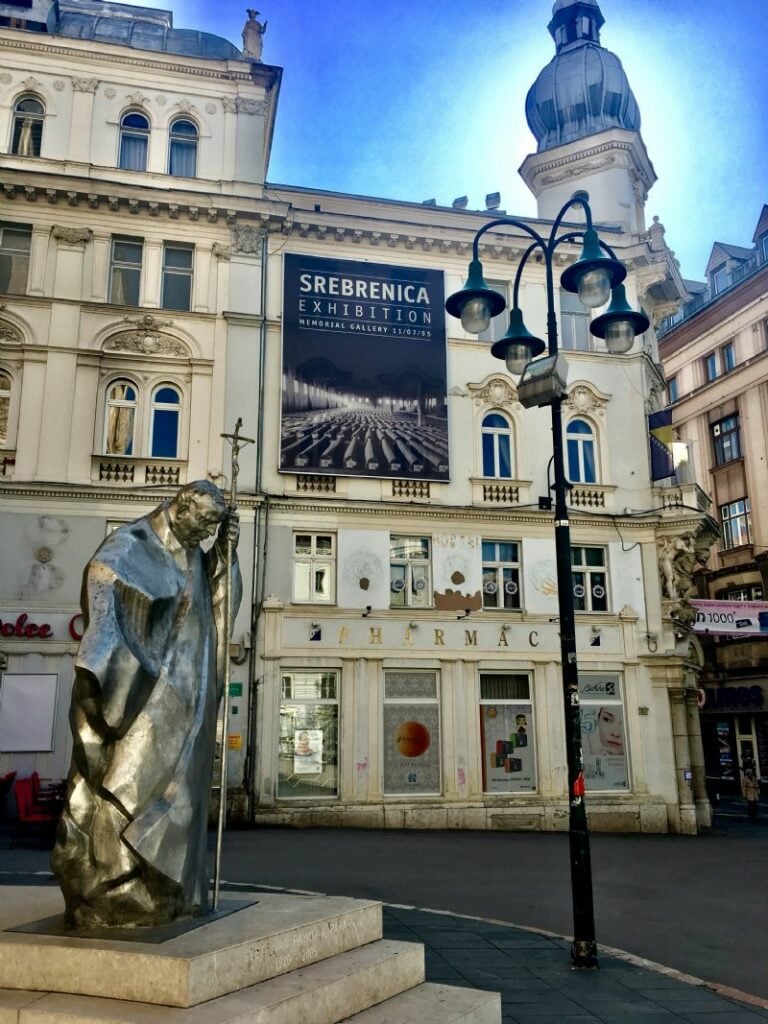
In downtown Sarajevo a statue dedicated to Pope John Paul II stands in front of an advertisement for a museum dedicated to the Srebrenica Massacre, demonstrating Sarajevo’s contrasting religious and cultural influences







