April 17, 1975 is the day that Pol Pot took his Khmer Rouge army into Phnom Penh. The Khmer Rouge went in with no vengeance for city dwellers. The city was completely emptied within 3 days time. Everything was closed. People misplaced. Possessions destroyed. City people were sent out into the country and forced to work on collective farms for the majority of the day with little food in return.
Anyone seen as an enemy of the ‘glorious state’ that Pol Pot had his eye on was killed. This included teachers (or anyone educated), if one had soft hands, if one wore glasses, if they were a monk/nun, etc. Within a time frame of 3 years, 8 months and 20 days- 2 million people were killed. 1 out of every 4 in the country of Cambodia was murdered.
On Saturday my team and I had the opportunity to visit a killing field from the Cambodian genocide. We took an audio tour which walked us through different areas of the killing field and told us information about what took place here 37 years previously. This is a time in history that has permanently scarred the people of Cambodia. Currently, only 3% of the population is over the age of 65, while 80% of the population is under the age of 30. 80% of the population did not even experience the horrendous killings of Pol Pot and his army. Our contact is 38 years old. He was 1 when the genocide began. Thankfully he survived.
At the killing fields, we learned facts about this place and time period such as:
· The Khmer Rouge took names of everyone they killed. People signed their own death warrant.
· Music played to cover up the screams during the murders.
· Bullets were too expensive and so agriculture tools were used for beatings and killings.
· Mass graves were common (we saw one that contained 450 people).
· Survivors that were physically okay were emotionally broken.
· Pol Pot was paranoid and secretive- killing many of his own men by beheadings.
· Bones and clothing fragments are still being uncovered today.
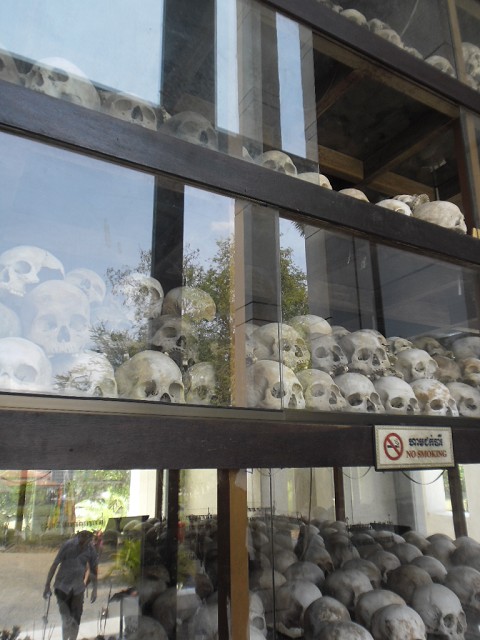
· Over 9,000 people were killed at this particular killing field (the skulls were on display in the center).
· In 2011 there were 300 known killing fields throughout Cambodia.
Thankfully Pol Pot was overthrown and the army fled to the Vietnam border and stayed there for a significant amount of time. In 1997 the Khmer Rouge split and finally lost power. Pol Pot died in 1998.
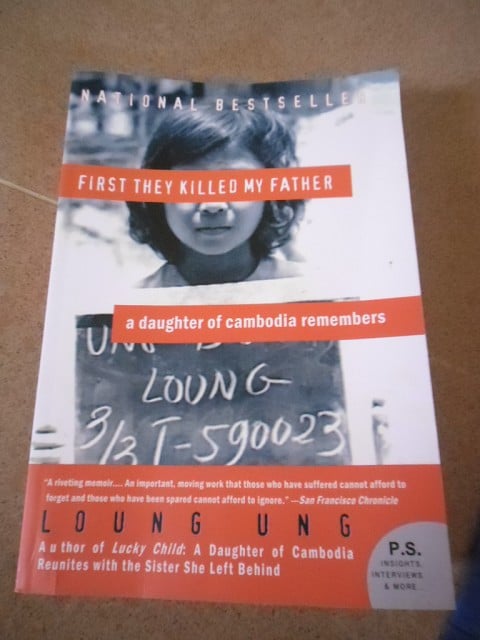
I sort of knew about the Cambodian genocide. I read a book titled First they Killed my Father by Loung Ung (if you have not read it—you need to) which was inspiration for my high school to raise money to clear landmines in Mozambique. (Odd connection, I know). I had read this story and I had even met the author, a survivor of the Cambodian genocide. She was 5 when the genocide began. Preparing for the Race and so far throughout the Race, Cambodia was just there; just another stop on the list of countries. But then I started to realize that I had a special spot for Cambodia in my heart. And now being here makes it all the more real.
A teammate pointed out that we left Phnom Penh for ministry on April 17, 2012. When were the people evacuated from Phnom Penh at the beginning on the genocide? April 17, 1975. Weird huh? They walked for days in the heat with little to no food or water, looking for refuge. Today the electricity was out. I experienced that heat. I was debilitated by the heat and wanted nothing more than to lay flat and not move, but the 17th of April people in 1975 had to keep moving if they were going to find safety. They had to walk through this heat if they wanted any chance at survival. And here I am complaining about the fans not working.
3 of my teammates are currently reading First they Killed my Father. They are reading Luong’s story while in the place where it happened. And now for me, it is more than story. It’s reality. 2 million people died. A quarter of the country was massacred. The country is full of young generations looking for more. The country is a nation looking for hope. The country is full of people needing Jesus.