
I remember the year I decided to achieve the Christian benchmark of “reading through the Bible in a year.” I was 14, at the time a good little Pharisee, and I seriously set about my task. I even wrote a checklist that outlined my daily assignments. With great ceremony and self-satisfaction, I would neatly check off each day’s reading.
{Warning to parents: If your child self-assigns reading, it could be a sign they are doomed to be a life-long nerd.}
Despite taking myself too seriously, the Lord brought about wonderful things as the daily calorie intake of my Bible increased. At some point midway through 1 Kings, it occurred to me that many of the “history” books in the Old Testament had long lists of leaders, all of whom were labeled either good or bad.
Invariably, the bad guys “did what was evil in the sight of the Lord,” (1 Kings 15:33) and worshipped idols, while the good guys “tore down the altars and high places” and“removed all the idols that [their] fathers had made” (2 Kings 23:19).
I remember being puzzled over the significance of the good leaders’ actions. Don’t get me wrong, I’m glad they were “good,” but the term “high places” or “altars” didn’t have much context inside of my white, middle-class American home. I didn’t quite understand why it was necessary to remove all the idols. Couldn’t everyone just start worshipping God and be done with it? Without the hassle of undertaking massive destruction plans?
That is, until I came to Nepal.
Bouncing inside a rickety bus, crammed in a tiny space, I had a 4×4” square of grimy window to peek out of as we drove through Kathmandu for the first time. After the cold, dignified silence of Eastern Europe, I was intoxicated by the colors! the lights! the sounds! all the faces! the smells! The scenes I witnessed were indescribable … life on an Asian city street pulses with color and life and excitement.
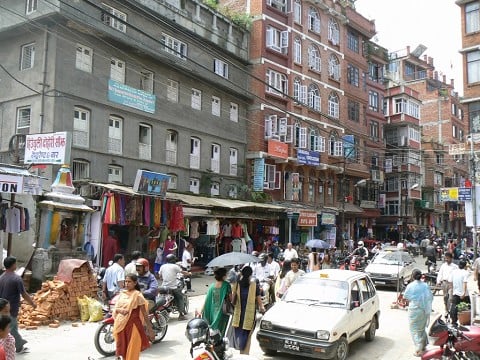
As my “this-is-so-cool-I’m-in-a-totally-new-place” buzz began to wear off, I started to notice them.
Unmistakeable.
Tiny houses, brightly painted with ornately designed roofs. Piled high with flowers, smoking incense laid carefully at the entrance. Often crowned with carvings of a half-beast, half-human figure. A sheltered place inside – just enough space for one person to kneel in devotion. These … are their altars. The knowledge sunk in.
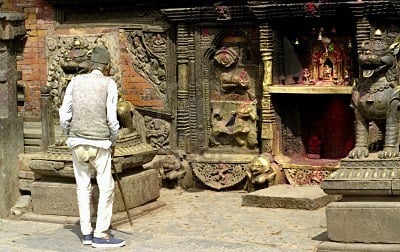
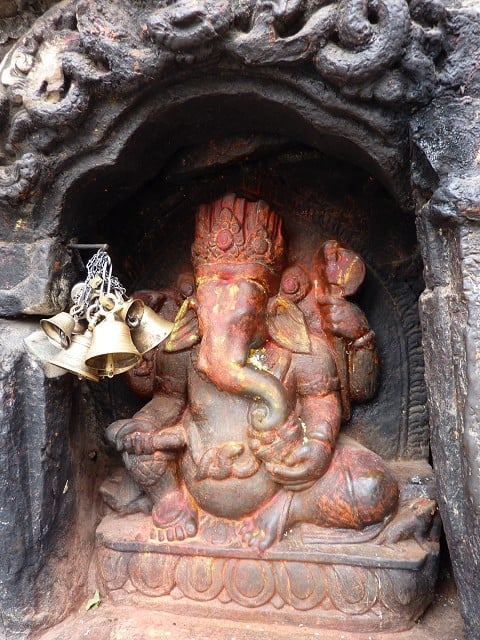
These are not pictures from a history book or relics in a museum.
These are not decorations for someone’s home.
People come to these places, with hopes, dreams, with fears and hurts … and the lay them here, at the base of these altars. They seek solace here. As I approach my church and my Bible … so these precious Nepali people approach the tiny houses, their high places.
They approach the idols their fathers made. It is what they were taught.
I started to count them … I lost count somewhere around 42 … all in the span of a 30-minute drive.
My attention shifted to the beautiful faces on the side of the road, so different from my own. Dark skin, slanted eyes, wide smiles. Colorful, draped clothing. And my heart ached a little.
I began to pray. More than anything, I wanted these people to know Jesus. I wanted them to be part of my spiritual family.
Lord, would they know you?
Will you show yourself to them?
God, that one! That girl with the long dark braid – can I see her in eternity one day?
That little boy giggling as he bathes in the public fountain – will you send him a discipler?
That tired old woman sitting on the side of the road – will you send someone to tell her the truth?
I felt helpless. Before I had begun my first day of ministry in Nepal, I felt defeated, needled by all those tiny little altars.
A whisper in my heart – “How will they believe in him of whom they have never heard? And how are they to hear without someone telling them?” (Romans 10:11-15)
The conviction – He’s sent me to Nepal to tear down high places. With love.
“For everyone who calls on the name of the Lord will be saved.”
And in the flash of an instant, I understood those verses from Kings and Chronicles.
The idols must be destroyed. The high places must be torn down.
So the girl with the long dark braid will have hope.
So the little giggling boy can pray to a God listens.
So the tired old woman can look forward to eternity.
Unlike the action-figure-ninja-Kings of the Old Testament, I don’t have plan to systematically destroy every idol in the land. So I’ll do all I know how to do – love. Love the person in front of me, and then the next person I see, and the next. We’re living and working this week at a home for women and children rescued out of prostitution. Many of them are new Christians … still hardened from their past.
I don’t know what to do, except to love…
With love, tear down the idols and high places.
With love, build up these people – newly declared temples of the Holy Spirit.







