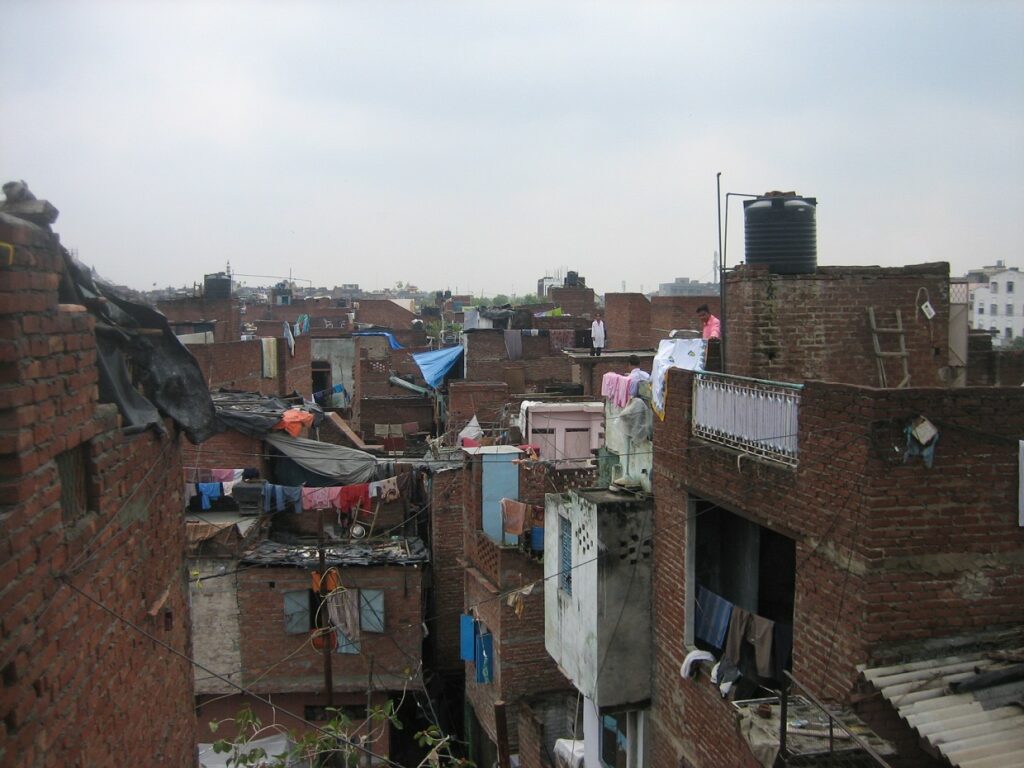
I write to you from an impoverished
community in Delhi, India, where the mosquitoes are plentiful and the
air smells like sewage. I’ve been here for three weeks, though really
it feels much longer. Every morning I wake up, peel my sore body off
the floor, and swear to never again take sleeping in a bed for granted.
I struggle not to step on my roommates as I walk to the bathroom, which
really isn’t a room at all. It’s more of a confined space with three
walls, a curtain, and a hole in the ground. As I attempt to squat by
the hole in the ground, I swear to never again take a toilet for granted.
Moments later I swear to never again take toilet paper for granted.
I’ve spent these three weeks
drenched in sweat, using only a scooper and a bucket of water to cleanse
myself. Sometimes I’ll tell another girl on my trip I’m going to take
a shower. Such a statement causes us both to pause, reflect on what
I just said, and break into hysterical laughter (followed by a solemn
sigh).
I’ve found I don’t laugh much
here. There isn’t much to laugh about when the people around me can’t
afford school supplies or much-needed medical attention, let alone anything
extra they might enjoy. These people are no longer mere statistics (–%
of people live on less than $1 day), they are my neighbors, my friends,
my family.
Toddlers tend to be half dressed
or naked, while the children run around barefoot on the garbage-covered-ground.
I often wonder if a U.S. health inspector would be able to walk through
this colony without having a heart attack. The river outside my door
has a constant flow of trash, and the fruits, vegetables, and chunks
of dangling meat in the market never cease to be covered in flies.
On my second day here I was
talking with my 16-year old neighbor, Goolu. She is one of the few people
who can speak English. We were talking about my glasses, and she said
that Indian people have good eyesight. I told her she was lucky, to
which she responded, “Yes, but you are lucky because you are not
poor. And you have an education…” I didn’t hear the rest of what
she said. I was thinking about how I wanted to do whatever it takes
to get her a college education. But all I could do was sit there.
When I asked the widow of the
house I’m staying in what her hopes and dreams were for the future,
she didn’t have any. She worries more about the bad things that could
happen. Her working sons are her only source of income, and their jobs
aren’t stable. I asked her why she thinks some people have a lot of
money and others don’t. “It’s a bit about luck, hard work, and
budgeting.” She paused. “And corruption.” Her son Shafeek
said, “If you are born rich, you stay rich, and if you are born
poor, you stay poor.” One of her other sons merely sighed and said
it’s in God’s hands.
This overwhelming sense of
hopelessness strongly affected me the first two weeks. My soul felt
empty; my body felt weak. I questioned the meaning of life and wondered
why no one else seemed to care about the injustice taking place before
my eyes.
Then bombs went off in Delhi.
The girls from my trip and I were eating dinner at a market when the
surrounding shops began to close. “Aren’t they supposed to be open
until ten?” I asked. The girls said yes, so we shrugged and continued
to eat our noodles. Pretty soon we were the only ones left in the market,
apart from our waiter and a few other restaurant employees. A message
in Hindi was being projected over the speakers, though none of us knew
what it meant. We sensed that we should leave, so we packaged up our
food and grabbed an auto. Idina, the leader of our trip, received a
phone call from a friend asking if we were okay. We then learned of
the multiple bombs that had gone off that night, some in trash cans,
autos, markets we had recently visited, and one a few miles away from
where we were staying that night. Twenty-three people died and more
than 100 were injured.
The next day I was at church,
using the sermon time to write desolate thoughts in my diary. Afterward
a woman named Eunice came up and asked how I was doing. I responded
honestly, and she gave me some wonderful words of wisdom before asking
to pray for me. When she was done she told me she had forgotten my name
was Hope until she sat down to pray. “It is a special name,”
she told me. “You are meant to bring hope to the hopeless.”
My mind flashed to two years ago when a nearly identical situation took
place.
Since then I’ve found myself
laughing more. I’m leaving tomorrow for Kolkata, and I’m actually sad
to leave this slum. I’m going to miss the children screaming “HI!
HI! HI!” whenever I walk outside. I’m going to miss holding hands
with the girls who live downstairs when we go to visit a friend or buy
vegetables. I’m going to miss hanging out with Aamir and Ateek and Saleem.
Though these people are poor,
they are some of the most giving people I know. I’ve visited many homes,
and every time the hosts stand or sit on the floor and offer their seats
to me. They always bring out Chai tea, Coke, or water. I’ve been advised
to avoid the water, so I’ll decline as politely as possible. Not much
later a bottle of water will be handed to me–someone went out to
buy it. I can only wonder what that money would’ve been used for instead.
I’ve been invited to a number of sleepovers and meals, where I’m treated
much better than I ever deserve.
While I still struggle to believe
in hope and justice for these people, they have helped me believe in
at least one truth: people are the same everywhere. It doesn’t matter
how different the culture is, how light or dark skin color is, how high
or low income is — at the end of the day we all laugh, cry, love, and
die.
There was the time I sat in
a room with a group of teenage girls, feeling helpless as we all stared
at each other, unable to speak the same language. But then they turned
on some music, and we danced. They taught me some Indian moves and I
showed them how to do the running man. Dance parties are fun anywhere.
Another time I was sitting
in a school room with a bunch of children. We started playing a game,
which consisted of me rolling the dice and them moving my piece for
me (as I had no idea how to play and we didn’t speak the same language
— eventually I discovered the game to be much like Trouble). Then one
of the boys farted and we all burst out laughing. Farts are funny anywhere.
When I was walking through
the streets with a woman named Rheanna, we came across a teenage girl
who was crying. Rheanna talked to her for a while, and I later found
out that there had been some sort of fight between her parents. Families
are dysfunctional everywhere.
me with a sense of what it really means to be human. It has left me
with questions of wealth and justice, suffering and salvation. I can
only imagine what Kolkata has in store.