
Kenya Dig It? Scenes from my life – in Kenya
Some moments just can’t be captured by the camera. Let me share with words a few of my highlights so far…
May Day (May 1st) is Labor Day in Kenya. Since it fell on a Sunday, the country decided to take Monday off. The church organized a game day for youth at 10am. We sat in the living room waiting … and waiting … and waiting.
“When are we supposed to start the games?” we ask.
“At 10,” Simon says. “Does someone have a watch? What time is it?”
We answer in unison, “It’s 10:45.”
Sometime after noon we start an intense game of volleyball. Football (soccer) is going on in the next field. The sun shines harshly but a refreshing breeze like a November day in Florida keeps us cool. A couple hours later I know why there are a lot of athletes from Kenya – they’re genetically designed for sports. Within minutes of an approaching thunderhead though, rain starts pelting us and we’re running for cover. The pastor’s daughters are leading the run back to the house when the rain is too hard and we pause under a storefront. The girls are talking to the storeowner and asking if we can go inside from the storm. Minutes later we are all seeking shelter in a feed room with a few chickens and feed bags. Hail pounds the tin roof and the sound is deafening. Later, we run through people’s yards through the rainfall stopping only to poke and play at the clumps of tiny balls of hail.
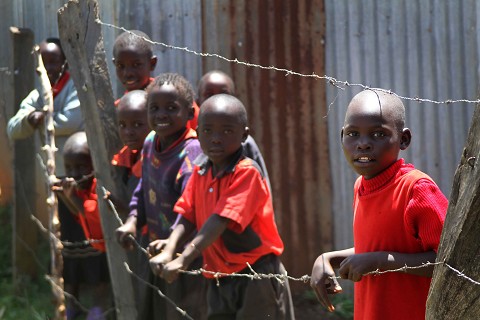
“Mzungo! Mzungo!” White person, white person! I’m pretty sure were the only seven white people in town. All eyes on us.
Who knew volleyball would be so popular in Kenya? A few afternoons we (some Rodeo and some of pastor’s kids) have played the local high school’s men’s volleyball team. One of our new favorite phrases: Kenya dig it?
Not everyone is meant to dig Kenya. Or at least there are times when no one wants to dig it. Times like… bathroom runs in the middle of the night. There are times when you just can’t hold it and you have to go. Amanda’s nudge to accompany her to the bathroom had me up in a flash. Let’s just say she had a dire situation, as new water and food were taking affect. We had not yet attempted to exit the house in the middle of the night (the outhouse is a brick building about ten feet from the mud house where we live under padlock). We approached the red metal door with my headlight beaming, searching for the fastest way out. The whole house had to hear the creak of the lock and metal latch we wiggled open. But then the top and bottom pins were still in place and would not budge! This was more like a trailer door than a front door to a house and an emergency was about to take place! We worked furiously, pulling, tugging, wiggling at the pins until finally they lifted free. We burst forth into the cold night air as the house lights poured on (pastor must have heard our desperate attempt to get out).To the brick house we ran!
The brick outhouse is quite nice; there is a guy side and a girl side. A stall for bucket baths is on the end, and laundry room space at the other end with three stalls in the center for toilets. The toilet stalls have a little concrete pedestal you step up on with a rectangular hole that falls at least 15 feet below. You know how you’re supposed to plug your ears during a scary movie because your mind remembers the sounds so clearly? Well, it’s about the same in a public outhouse. Sound carries, and it can be scary.
When we were finished with business we walked out. I caught my breath. Two men stood in the yard, not far from the house. The guards. I waved, and we walked quickly inside to fumble with closing the door again, then make our way with the headlamp to our room to fight with our mosquito nets in order to return to bed. We repeat the whole process again before morning but with more confidence and less fumbling. But how grateful I am when morning comes!
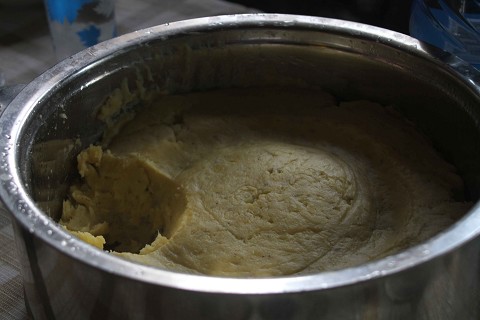
Rafiki’s song in the Lion King, “asante sana Squash Bananas” rings true in Kenya. “Thank you so much, Squash Bananas!” Squashed bananas – like mashed potatoes – are on the menu often.
As we sit in the church for a parenting seminar for the foster guardians, my attention is drawn to the activity at the well outside. We have a perfect view of the scene – banana leaves wave in the breeze under a blue sky and bright sun. The slender post and spigot beckons a seamless flow of attention. All kinds come to draw from it – water is life, a common denominator regardless of class, skin color, gender or age. Here is who comes:
- A man fills 3 yellow buckets and straps them with string to his metal bicycle.
- A young girl washes out two five-gallon sized buckets and fills them. Then heaves them home stoutly.
- A little boy, maybe two, in red pants and a long-sleeve dirtied white t-shirt slumped off one shoulder, the sleeve well-passed his hand, the other finger is raised to his mouth, stumbles by.
- A tall, slim woman in a fitted black dress walks by dragging a wobbly boy behind her.
- An older man in a dark suit with a thin stick for a cane slowly makes his way past.
- A busy boy pushes up a rusty, creaky wheelbarrow with plastic bottles in it. He has a mission. He grabs a plastic cup off a nearby post and fills it. He takes a long sip, then splashes the remaining water to the ground, an action surely mimicking other men he has seen at the well. Then he gets to work filling his bottles. All filled up, he carts them off in his wheelbarrow. Twenty minutes later, he is back.
- The little boy in the red pants walks by again.
Buckets come in a variety of sizes. Some are 5-gallon plastic buckets with metal handles. Some are 5 gallon yellow plastic bins that used to store Crisco (seriously, we saw them on sale in town). Some are small plastic jugs similar to the super-size ketchup and relish containers at Sam’s Club or the oil plastic jugs.
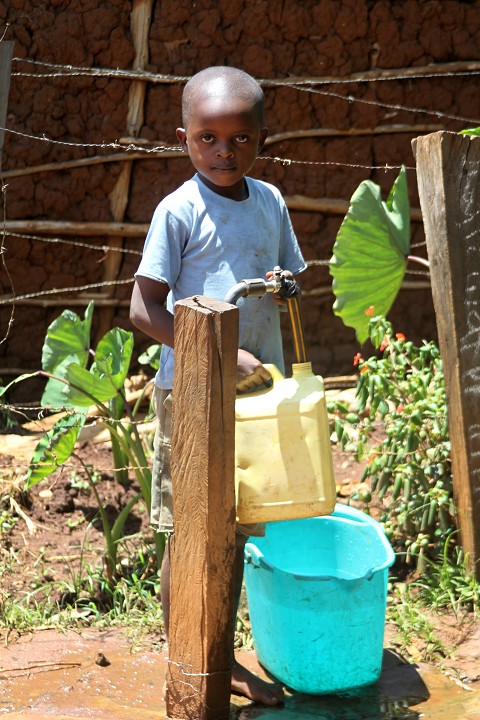
Water well time.
Mish, the pastor’s oldest son and manager of the computer store where I work, asked me to type a document. I pull up a chair, ready my hands, and start typing. Mish, his mother Ann, and two other staff members are gathered behind me and start giggling. I smile at them and continue. Later, I learn what they are laughing at. Ann says in amazement, “you type without looking at the keyboard. You are so fast!” And yet another thing I have taken for granted: typing class.
I have received two new names since arriving in Kenya. One is Swahili – “Sifa,” which means praise. The second is not Swahili but in their mother tongue. It was given to me by Manu (Emanuel) and the family has embraced it: Najaho, (sounds a little like Navaho) meaning the one who likes to laugh. Most Kenyans pronounce my name GINGA! But in Swahili, jinja means to slaughter.
Speaking of slaughtering, I’ve slaughtered a sheep before (during my shepherding experience in New Zealand). Mish had killed a chicken one morning and our team expressed interest in participating in the killing of another meal. Mish, on his lunch break, grabs a long knife. Emmanuel fakes a blow to the sheep’s head with a hatchet for our gasping group. Then he takes hold of the bleating sheep and pulls its head back, ready for Mish to take the honors. I think the hatchet would have been better. Or the Swiss Army in my pocket. The knife blade is dull. I’ll leave it at that.
Kenya dig it?







