
This month in Bulgaria we have had the privilege to work in the Roma villages surrounding Stara Zagora (the city we are staying in). The Roma people (commonly known as gypsies) have had a long, troubled history. They originated from northern India and began migrating west about 1,500 years ago. They first migrated to the Middle East and then into Europe. They have been enslaved and tortured. During the enlightenment period, the Roma people were forced into assimilation—they were beaten for using their native language and forbidden to marry within the Roma population. In some areas they were even sterilized. The Roma in Europe were some of the first victims of the Holocaust—around 500,000 Roma were killed during this time. The Roma survivors of the Holocaust were denied any aid or compensation.
The oppression is still happening in many places in Eastern Europe and around the world. Most Roma people live in extreme poverty, without any electricity or running water. There are many stereotypes about the Roma that people still believe today—that they are unreliable, that they aren’t willing to work, and that they are uneducated, just to name a few. The Roma people seem to be the one exception to the world’s search for justice for all people. Before coming on the race, I knew almost nothing about this incredible group of people. Even before writing this, I didn’t know half of the terrible things that have happened to the Roma people. I write this to give you background on what they have gone through and to encourage you to pray that there would be more people fighting for the Roma people, more people loving, clothing, and feeding them, and living out Matthew 25:35-40, which states:
“For I was hungry and you gave me something to eat, I was thirsty and you gave me something to drink, I was a stranger and you invited me in, I needed clothes and you clothed me, I was sick and you looked after me, I was in prison and you came to visit me.’
“Then the righteous will answer him, ‘Lord, when did we see you hungry and feed you, or thirsty and give you something to drink? When did we see you a stranger and invite you in, or needing clothes and clothe you? When did we see you sick or in prison and go to visit you?’
“The King will reply, ‘Truly I tell you, whatever you did for one of the least of these brothers and sisters of mine, you did for me.’”
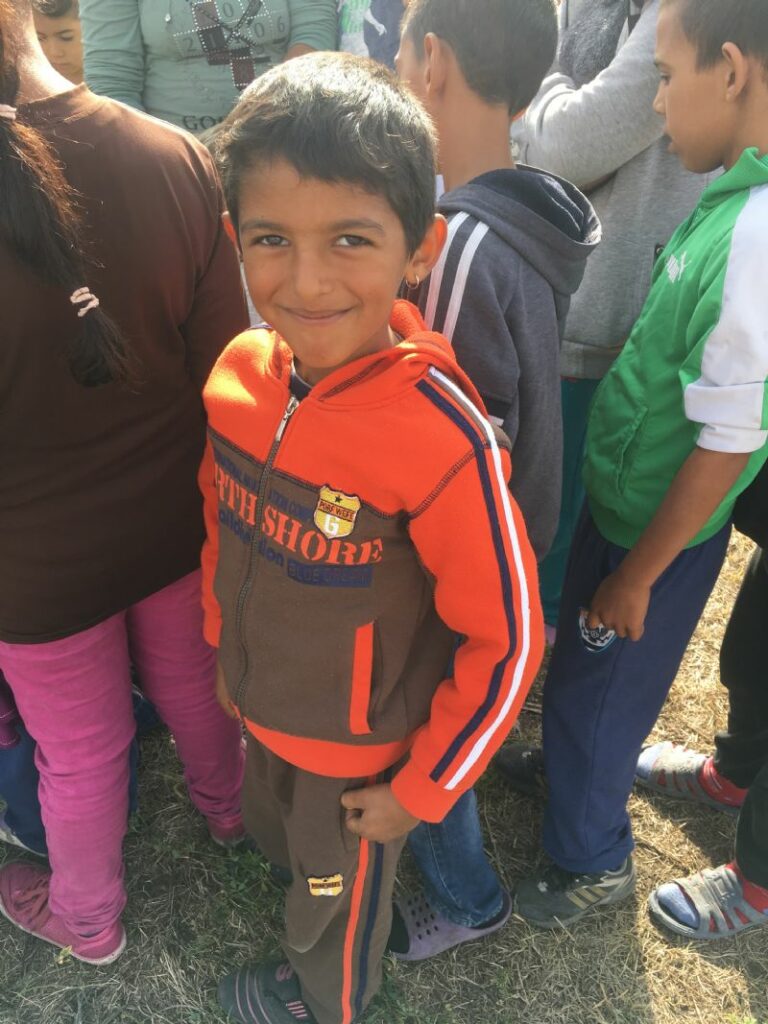
The main Roma community we have visited continuously this month has been victim to the government tearing down many of their homes from a result of them residing there illegally.When our car pulled up, kids immediately ran up ti wait for us. They walk with us to the church, or rather the stationary train car where the church meets, and we go in. If the kids have shoes on, they take them off before coming into the church in order to keep it clean. The church doesn’t have a heating or cooling system, so in the summertime it is swelteringly hot, and in the winter it is freezing inside. All around the village, but especially near the church there are piles of trash all around. Empty soda bottles, candy wrappers, broken glass, old shoes and clothes, pretty much anything you can imagine cover the ground. We decided to go out one Saturday and clean up the trash. When we got there it started pouring down rain, so we all gathered in the church. We got to sing “Father Abraham” and “My God is So Big” with the kids, and play musical chairs. The pastor, Tsetsa, then asked each of us to share about how we met the Lord. We got to share our testimonies and hear her story as well. After about an hour, we looked outside and the rain had stopped. We all put on gloves, grabbed trash bags, and we got to work. The kids paired up with us and helped us pick up the trash. After some time passed, even many of the adults from the community came out and started helping too—they saw that we were making a difference in their community and that we were having fun at the same time, and it was something that they wanted to be a part of.
The joy that these kids bring with them is astounding, allowing us to communicate with them through laughs and smiles.We didn’t pick up all of the trash, but the restoration to that village came from more than just physically cleaning it. We brought hope—hope that there are people that love them and care about them. The unconditional love that these children have for us is a beautiful picture of the Father’s love for us all. The children run and jump into our arms and dance with us, and never leave our sides until our car pulls away. We didn’t do anything to deserve their love except show up and spend time with them. These kids have had so many people tell them that they aren’t worth anything, that they are terrible because they misbehave sometimes, that they aren’t fully loved. That is so far from the truth. They are fully known and fully loved by the God who created them. The kids showed me unconditional love like Jesus has for me, and it was an honor to love them back, and hopefully show them that they are so fearfully and wonderfully made by a father that loves them deeply.
Sources: http://news.bbc.co.uk/2/hi/europe/8136812.stm
https://www.opensocietyfoundations.org/voices/gypsies-roma-travellers-animated-history







