
Confession: I didn’t know very much about Cambodia before coming here. I could point it out to you on the world map. Maybe. But I couldn’t tell you anything about it.
Our first couple weeks here were extremely educational, to say the least. In 1975, a group called the Khmer Rouge took over the country, ending a civil war that had gone on for years. Everyone rejoiced, thinking that there would now be peace in Cambodia. Little did they know that they would lose their friends and neighbors; anywhere between a quarter to a third of the entire population would die during the next several years under the rule of the Khmer Rouge.
While we were in Siem Reap, I picked up a book called, “Stay Alive, My Son.” A man named Pin Yathay shares his story about his experiences during the time of the Khmer Rouge’s regime and how he lost 17 members of his family during the genocide. Our first weekend here, we went to Phnom Penh on our day off and visited the Tuol Seng genocide museum. It was a school that was converted into a prison and interrogation/torture facility by the Khmer Rouge. Reading all these different stories and personal accounts of what occurred I couldn’t help but be struck by how deceived everyone was – whether they were the ones killing or the ones being killed. Families from the city were politely asked to leave their homes with the promise that they would be able to return in 3 days. Months later, they find themselves starving and overworked, at risk of being bludgeoned to death in the forest if they failed to comply with requests that were very politely made of them by the Khmer Rouge. Even the Khmer Rouge themselves were at risk of being tortured and killed if their comrades were suspicious of their loyalty to the regime. In many accounts, there was no basis for those suspicions and people were brutally tortured, forced to confess to hundreds of crimes when they had not committed a single one.
Decades later, what happened during the Khmer Rouge isn’t universal knowledge. Crazier still, men and women responsible for the genocide haven’t been brought to justice.
And this deception has taken on a different form…
According to TransformAsia’s website, of the 3 different kinds of prostitution in Cambodia, it is those who are controlled bysex traffickers that make up the vast majority of the prostitutes in Cambodia. These are young girls and children that are sold by their families, kidnapped or tricked into coming to the city for a job that turns out to be forced imprisonment and become prisoners in the booming Cambodian sex trade.
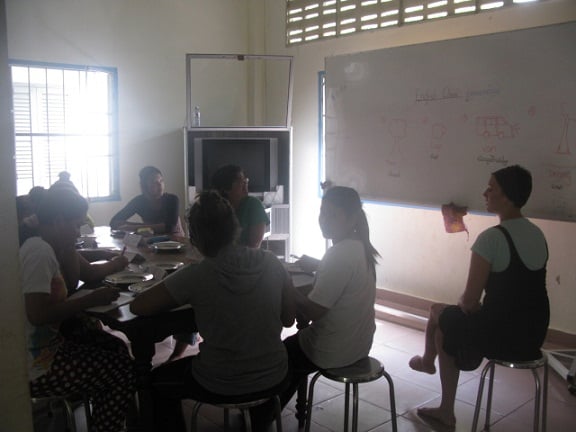
We’ve got one more week here. English and computer lessons are well under way! We can now tell the difference between “this” and “that” and easily type “asdf” and “jkl;” over and over again. 🙂 Not all the babies like us yet but I get a smile every once in a while. At least the other kids will give me hugs (when they’re not trying to poke my side to get me to chase them). And the killer geese in the front yard of the guest house haven’t gotten us yet. What more can I ask for? 🙂







