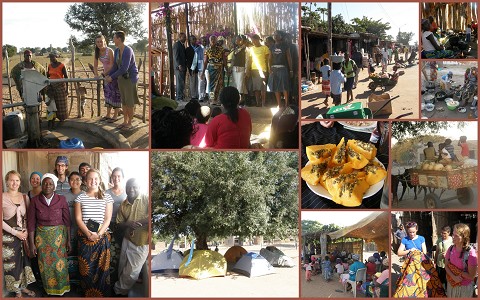
I loved Swaziland. Really. The ministry was great, and we loved our contacts. Our view was sort of straight out of The Lion King, and hiking the local mountains seemed like walking around in Lord of the Rings. But, it was exactly what I was expecting of Africa. We drove on well paved roads and ate Corn Flakes for breakfast.
This coming month we’re off to a major city in South Africa. I’m kind of thinking we’re not going to be living in a mud hut and gathering roots and berries for food.
Okay, actually I know we’re not.
So Mozambique has been a unique experience in that it’s the only taste of ‘real Africa; we’ve seen, or will see.
A few facts about Rivoni Ministries and our month here:
- It is a pastoral training ministry. They train young married couples in the WORD, the WALK, and the WORK of God and then send them to various locations around Mozambique to minister to people in surrounding communities.
- The ministry is headed by Pastor Carlos. He is 41 years old, married to Matilda, and has 4 children, ranging in age from 2 to 15
- The ministry was established in 2006, and since then, they have graduated 25 groups of trainees since then.
- There are currently 3 married couples and their children living here, in addition to Nelson and Tina, who help run the ministry.
- Our ministry site is located in Chiniacanine, in the southern part of Mozambique. We are about an hour and a half from the eastern coast of Africa.
- The ministry was started by Ben and Marty Lubbe, a South African couple who have recently retired and moved back to SA, but are still heavily involved in the ministry.
- In addition to the Bible training program here at the headquarters, Rivoni organizes Bible classes in the nearby communities. They also train the teachers for these classes.
- You can read more about Rivoni at their website: www.rivoni.org. Make sure you check out the article on Team Tandem under “Recent News.
Some of the English phrases used here are interesting and unusual. Some Mozambican/English phrases include:
- hoyo-hoyo – welcome
- buckey – pick-up truck
- that side – somewhere that is not here, as in “We can buy fresh bread that side, but we should take our own water, because they do not have fresh water that side.”
- cold drink – soda
- balungu – Changaan word meaning “white people,” which people yell at us as we pass by in the truck
- mana – Changaan word meaning sister, as in, “We’re going to let Mana Erin pray now.”
- salani kahle – stay well; this is used as a farewell when you are leaving someone
What to Know About Mozambique:
- If you want to say “yes” to someone, simply raise your eyebrows in a quick movement with a slight upward nod of the head. On the same lines, if you’ve asked someone a question, you’d better look at them or you won’t know their response.
- Local transportation is usually in the form of a cumbi, which is basically a sixteen passenger van that acts as a taxi. And don’t be fooled. If the 16-passenger van only has 16 people in it, it isn’t full enough. If it has 20 people in it, it’s still not full. Basically, if any passenger is able to move all four of their limbs, you can still fit more people into the van.
- Likewise, if you get into a cumbi and it starts moving, don’t assume you’re actually getting closer to your destination. The driver may easily spend the first ten minutes of your trip driving around in a big circle looking for more passengers. Or stop to get gas (and leave the engine running. . . that’s living on the edge). So then you might find yourself right back where you started.
- Some words in the Changaan language require a little spit. Like in the phrase “salani kahle,” on the “hle” at the end, it sounds more like you’re getting ready to spit than it does actual phonetic sounds. There are also words that have clicks in the middle of them.
- Singing in church is a very unique thing to hear. One person generally starts it and acts as the lead singer. Everyone else joins in, and automatically you hear 5 or six different harmonies going on. There is often dancing involved as well.
- When visiting a church serve, expect to shake hands with every person in attendance, often while they are singing and dancing.
- The traditional wrap skirt is called a cublana, which is basically just a rectangular piece of cloth that wraps around like a sarong. They’re quite versatile and can be used to carry a baby, a bundle of vegetables, as a blanket, or head wrap.