
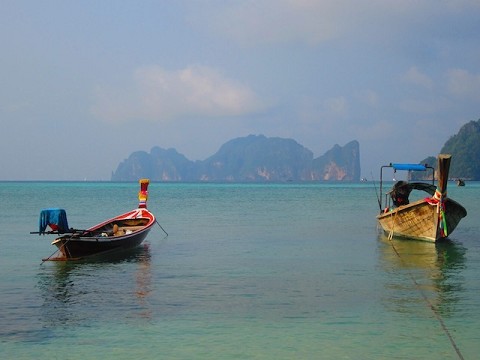
LAKE TITICACA
My last blog ended in Puno, Peru after a 32-hour bus ride from Trujillo. Needless to say, we were in need of a stretch break! We received just that on Tuesday the 13thwhen we had the opportunity to experience Lake Titicaca.
Lake Titicaca (or Titicala in Quechua) is the highest navigable lake in the world. It is 165 km long and stretches 65 km wide, totaling 8,500 square km. It’s deepest point plunges to 280 meters. Though it doesn’t boast a Loch Ness monster, it does have gigantic frogs that average 25 cm long!
With one day to take in all that we could of this mammoth lake, we headed for Los Uros: Islas Flotantes, in English Uros Floating Islands. That’s right, floating islands!
We loaded the tour boat and enjoyed the 40-minute ride to the islands. The sun beamed brightly through a brilliant blue sky; large fluffy clouds and a warm breeze made the view picturesque. As we approached the islands, we were instructed in the native greeting:
“Kamisaraki” (pronounced Kom-ee-sar-ah-key)
That’s how you say hello, good morning, good afternoon and good night. Makes life a little bit easier if you ask me.
We floated up next to one of the islands and anchored the boat, meaning we tied rope to a stake on the island (that’s also just floating). We were greeting by colorfully dressed women as we took our first step onto the land. Except it wasn’t really land…at all.
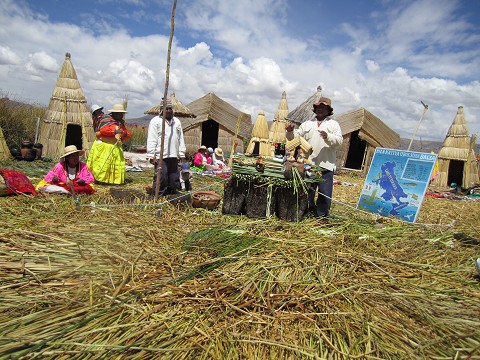
THE PRESIDENT OF THE ISLAND DEMONSTRATING THE TRADITIONAL CONSTRUCTION METHOD.
Each island is made up of large clumps of dirt that hold the roots of bamboo type plant. On top of the dirt, they stack this bamboo-like foliage multiple times in alternating directions. An initial island will have at least 3 stacks of bamboo and a new layer is added every 10-15 days. On top of the island, straw huts are constructed for houses and storage. Typically, 5-6 families will inhabit one island and are governed by a president. They joke that if any family is causing trouble, they will just saw a part of the island off and let them float away!
After a short presentation about the island natives, we were invited into their homes, tried a traditional food (which meant gnawing on some of that lovely bamboo plant) and tried on the native garb. Here, matching is not of the least bit of importance, because all colors match with each other.
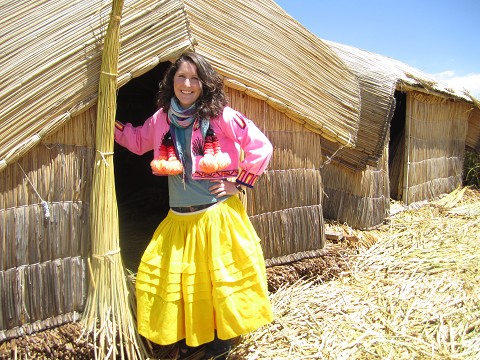
NATIVE DRESS FROM THE FLOATING ISLANDS
It was an absolutely beautiful day, one of my favorites on the Race so far. I thoroughly enjoyed learning about another culture and soaking up some of God’s most beautiful creation. Just floating around for a day on Lake Titicaca was the perfect way to break up all the travel!

IMPROVED TECHNOLOGY…BOATS WITH MOTORS.

TYPICAL HOUSES ON THE FLOATING ISLANDS
Click here to view a 5 minute video of the Floating Islands: http://www.youtube.com/watch?v=ICeNGLEOD80. If you want to see more pictures, visit my Facebook album at http://www.facebook.com/#!/media/set/?set=a.744312731011.2209912.185002477. We´ve made it safely to Cochabamba, Bolivia, where we´ll be doing ministry this month. I´ll be writing a blog for you soon about all the details but lets just say the ministry involves kids and food…it´s going to be a good month! 🙂







