

The scene on a normal travel day…a bunch of gringos walking down the street with their packs.
Crossing the border to Bolivia was the first time I was frustrated to be a US citizen. As we walked up the hill and passed under the archway, we said goodbye to Peru and hello to Bolivia.
And then we waited. And waited.
As all the citizens from around the world walked up and got their passport stamped in a matter of minutes, US citizens had to apply for a visa. When you travel in a group of 55, it takes a substantial amount of time.
Previous to our border crossing, the squad leaders had asked me to help separate our squads passports into different categories- not the easiest task to do on a bumpy bus ride! Though I got a kick out of seeing everyone’s pictures and reading their middle names, it got me thinking…
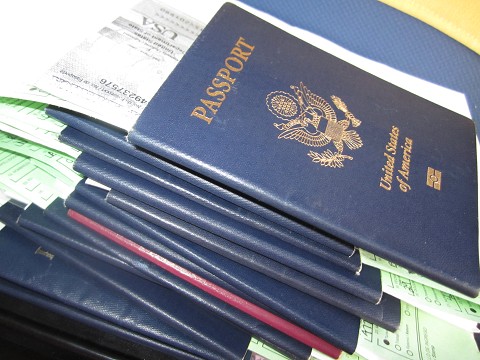
Stack of passports I sorted on the bus.
This little piece of paper gives me rights. It says that I belong to the most powerful country in the world, yet I had no control over this fact. I was simply born there. It also makes me a representative of the US, the good, bad and ugly. If a native loves Obama, I become their best friend; if they loathe him, they are sure to voice their opinion to me. I have no control over this; it’s all because I was born in the US.
It’s my born identity.
I continued to ponder these thoughts as I stood in the boiling lava hot sun, hoping the line would move, even just a little bit. About 2 hours later, we all made it through, even Kelly. During our travel from Lake Titicaca to the border, she had her daypack stolen, which included her passport. Instead of taking the long bus trip back to the embassy in Lima, Kelly opted for a long shot- crossing with just a copy of her passport. It worked!
We loaded the bus back up and I took my seat next to my bus buddy Allison. She was giddy.
“Emily, I got to give my Bible away today!”
“Oh really, tell me more.”
“His name is Daniel. He’s Bolivian. He was the one that helped Kelly get across the border. When her heard that we were missionaries, he inquired about a Bible. He figured missionaries have got to have Bibles. When I heard this, I knew, I just knew I was suppose to give him mine.”
Just then a middle-aged Bolivian man appeared next to us in the aisle. He introduced himself as Daniel and Allison confirmed by her face that “this was the guy!” In his hands he held Allison’s Bible.
I introduced myself and he was pleased that I spoke his language. He asked me to thank Allison for her generosity and was excited to start reading. Except he didn’t know where to start. He had never read the Bible before.
I brought him to the table of contents and briefly explained the difference between the Old Testament and the New. I described the Gospels and Paul’s letters. I suggested he start in the Gospel of John and then realized he probably didn’t know how to find a specific passage. So had him practice.
“Puedes encontrar Juan, capitulo 3, versiculo 16?” (Can you find John, chapter 3, verse 16?)
After a bit of help, Daniel found it. And he read it. I asked him what it meant to him. He was unsure. He asked me to explain it to him.
For God so loved the world that he gave his one and only son, that whoever believes in Him shall not perish by have eternal life. John 3:16
I used the opportunity to explain the Gospel message. He was interested in why we were here. Why would a bunch of gringos from the States travel so far to share this message?
“Because God loves us and he loves you too Daniel.”
I could see the contemplation in his eyes. It had been a long time since someone told him that God loved him. I asked him why he was so interested in learning more about the things of God. He spoke of his grandmother and her prayers for him. He spoke of the religion he used to have as a child. But he wanted more.
I suggested he start with the Gospel of John and then read Romans. He had a Spanish New Testament, so he planned to read in his native language first, then in English. I asked him if he had a local church he could attend or someone he could go to with questions.
That’s when my heart broke.
No.
He said no. To his knowledge, there were no Bible-teaching churches anywhere near his home nor people to answer his questions.
I shared as much as I could with him before he needed to get off the bus. He thanked us profusely and then left.
Allison looked at me with a giant smile.
“There was definitely a reason we were bus buddies today!”
Though I was elated to have shared with Daniel, I was also saddened by the reality that he was a lone ranger. And a lone ranger is a dead ranger.
In the States, I have Bibles galore- many different translations. I have hundreds of people I can go to with questions. I’m surrounded by an incredible church family. I have thousands of sermons, in my native language, at my fingertips. I have the best friends a girl could ask for- the ones that ask you the tough questions and love you despite your response. All because I’m an American and there are abundant resources and I happened to be born there.
After more pondering, I became much more thankful for the blessings of holding a US passport. I am also more aware of the responsibilities it carries. To those who have been given much, much is required. I would gladly stand in another line for 2 hours in the hot sun, just so that I could share with a guy like Daniel.
I think it’s my born identity.
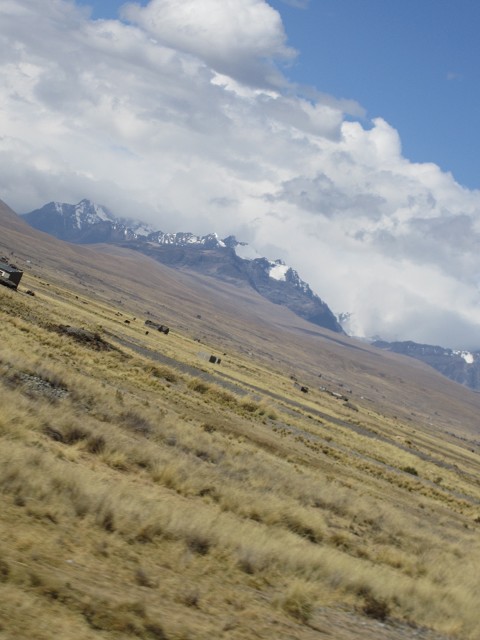
The beautiful Bolivian countryside.







