
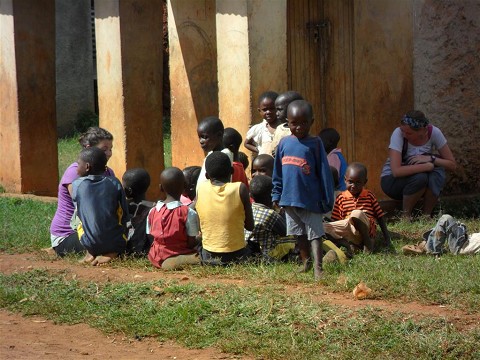
Continuing from my last post, our time at Liberty School segued into recess. As some of us helped prepare lunch (beans and corn) the rest of us played with the kids. One teacher in particular stood out to all of us – her name was Christabel. She played with the kids more than any of the rest of us. The best teachers are the ones who love their students, and it was immediately obvious to all of us that Christabel loves those children. She tells us she finished her high school graduation exam two years ago, and wants to go to college for a teaching degree. Where some people in the States would get some part-time or short term job just to get enough money to get through college, and then go on into their career, Christabel has chosen to put her desire for helping the children of Bikeke first. She’s spent the last two years teaching at Liberty.
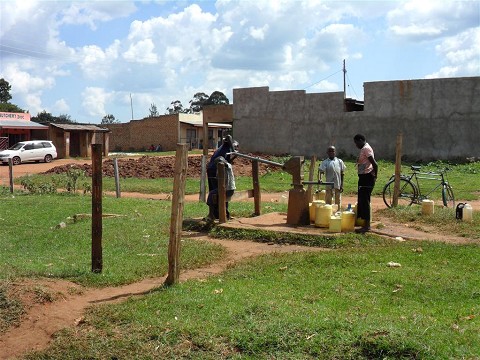
After a quick lunch, we moved out with some of the teachers to evangelize in the neighborhood. This is a critical element of the ministry in Bikeke, as it should be for every ministry. It’s difficult at times for we Americans to be comfortable with going door to door, meeting complete strangers for 15 minutes and trying to figure out if they know Jesus. I don’t have much experience with this, and it’s far from my strong suit, but I’m certainly not going to hold back from ministry! I know God can use anything, even if it’s a strange foreigner wandering into their house and praying over them, so I just trust that God knows what He’s doing.
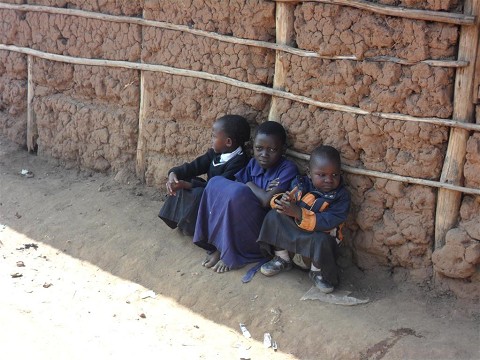
One of the teachers that came with us was Ken. He tells us he was once a street kid, stuck in a cycle of drugs and gangs, and completely hopeless until he was rescued by a white missionary. He was taken out of the street life, given a home and an education, and now he teaches at Liberty. His brother remains in the street life. This is the saddest part of door-to-door evangelism: the hopelessness. So many Kenyans that we meet have no hope that they can do anything to make their lives better. The country is torn by violence in many places, struggling under a massive increase in the cost of basic foodstuffs, and trying to deal with a staggering unemployment rate. We go into homes and ask people what they would like to ask God for, and their response is nearly universal: “Money.” “A job.” “Could you give me some money?” I’ve had a number of Kenyans, from the slums to the streets, ask me to give them some seed money to set up a business. I met one Kenyan who asked first for a better position at his work, then for the opportunity to start his own business. It was so visible in his eyes that he has bigger dreams than his single-room mud hut, but he has so little hope that he can’t even voice those dreams out loud. The belief that there is nothing they can do for themselves is pervasive. Ken hopes to be able to change the lives of Kenyan schoolchildren by teaching in a mission school. Ken’s brother hopes another white person will come by and rescue him. There are so very few Kenyans who believe that Kenyans can help Kenyans – nearly everyone is waiting for a muzungo to wander by like Santa Claus and pull them out of poverty. It gets frightening at times to see how strongly the lies of helplessness have been pulled over the eyes of these people.
Back at the church, we thank God for the day, and drive off. Children wave and chase us down the road. I wave farewell – one more day on the World Race has come to a close. There is no such thing as a normal day on the Race, but today was exceptional even by those standards. I’ve had my eyes opened. Poverty here is more than a problem – it’s a way of life. Everything – schools, houses, meals, even dreams – comes in a diminished form. I’ve seen hope in the midst of nothing in the dumps of Trujillo, Peru, and just owning a mud hut and a vegetable stand sets many of the Kenyans I’ve met farther ahead financially than most of the dump workers. The difference is hope. The Peruvians I met have hope – hope that they can provide a better life for their kids, hope that they can earn more than just three meals each night, hope that God will be faithful to take care of them. The Kenyans we’re encountering, and I realize this is only a small sampling of the population taken mostly from the slums of Kitale, do not have that hope. It would seem pretty much an insurmountable problem if it weren’t for people like Ben and Christine. I’m blessed to live with them and see the ways they’re committed to changing that attitude, one life at a time, by training and mentoring pastors. There are now over 25 churches associated with Shekinah Glory Missions, some that Ben has planted, and some that have been planted by the pastors he’s trained. People like Ben and Christine, training Kenyans to spread the hope of God; or people like Ken and Christabel, using the life they’ve been given to raise up a generation who can look beyond the poverty and hardships in their life to see what could be – there is hope for the hopeless, and it comes from God’s people doing God’s work. I can only see a tiny part of God’s plan for Kenya, but what I do see is exciting. Our time in Kenya is coming to a close, but God remains active. I don’t have the resources to cure poverty, or HIV, or provide jobs for everyone who lives in the slums – but I can share my hope, that God does have those resources, and that His love can provide hope beyond any lie.







