
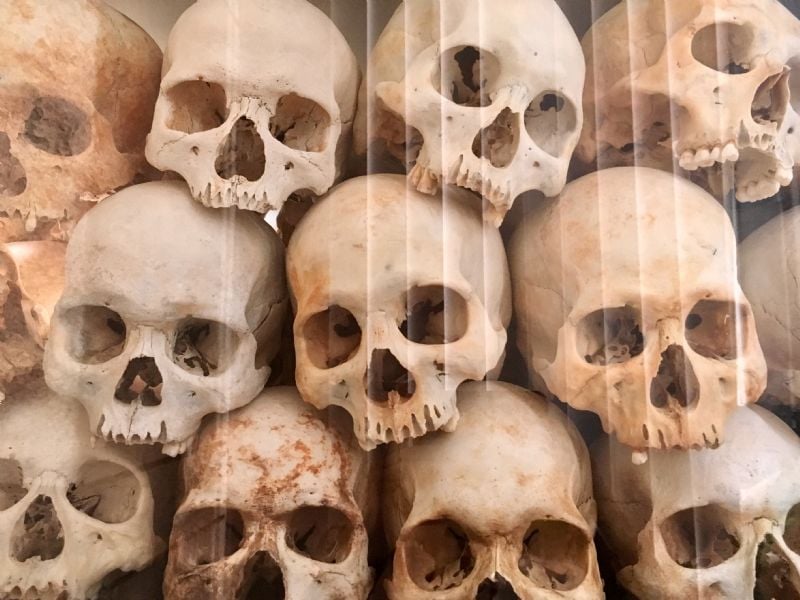
Today I stepped into a room with 9 thousand skulls.
9 thousand of nearly 3 million.
There are some things that you cannot unsee and some feelings that you cannot unfeel.
I have seen sights and heard stories during the past few weeks in Cambodia that will haunt me for the rest of my life.
Perhaps, though, they are stories that deserve to be heard, so in this blog I will impart some of what I have learned to you.
In 1975 Cambodia had been weakened by conflict and civil strife. The United States had dropped more bombs in Cambodia in an attempt to stop North Vietnamese supply lines than it had during the entirety of World War II.
80 percent of the Cambodian population lived in extreme poverty.
It is in this weakness that Pol Pot, a former teacher turned communist leader, took control in an effort to transform Cambodia into a utopian agrarian society known as the Khmer Rouge.
Pol Pot recruited an army of young farmer boys. He placed the blame for Cambodia’s poverty on city dwellers and promised the young boys food, steady jobs, and freedom as a result of his revolution.
On April 17, 1975 Pol Pot’s army marched into Phnom Penh, the capital of Cambodia and my home this month, and evacuated the entire population regardless of age or health.
Residents were forcibly relocated into work camps dispersed throughout Cambodia and separated from their families. At the camps, city people who had no knowledge on farming were forced to toil for more than 12 hours a day in rice fields. Thousands died of starvation, disease, and fatigue.
Religion, education, personal possessions, and laughter were banned. Defiance of these restrictions resulted in death.
Millions, though, died due to no offense at all.
Pol Pot deemed professionals and intellectuals– teachers, doctors, lawyers– enemies of his regime. Anyone who had an esteemed career, spoke a foreign language, had soft hands, or wore glasses was tortured and exterminated.
Moreover, Pol Pot’s regime claimed that “to dig up the grass one must remove the roots.” If one member of a family was sentenced to death, they all were. Women and children were tortured and slaughtered alongside their husbands and fathers.
The most infamous torture and execution center, Security Prison 21, can be found in the center of Phnom Penh. Before 1975 Security Center 21 was a high school, but during the Khmer Rouge’s reign of terror, its classrooms were converted into tiny prison cells and torture chambers for innocent Cambodians.
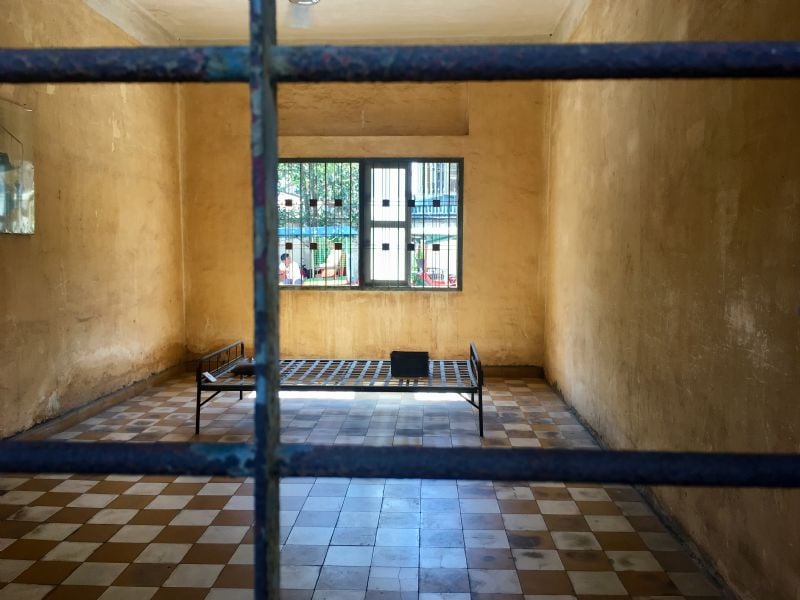
More than 20 thousand Cambodians were forbidden to speak, shackled, beaten, water boarded, electrocuted, raped, and forced to eat human excrement at S-21. These forms of torture were meant to coerce prisoners into confessing supposed treasonous activities.
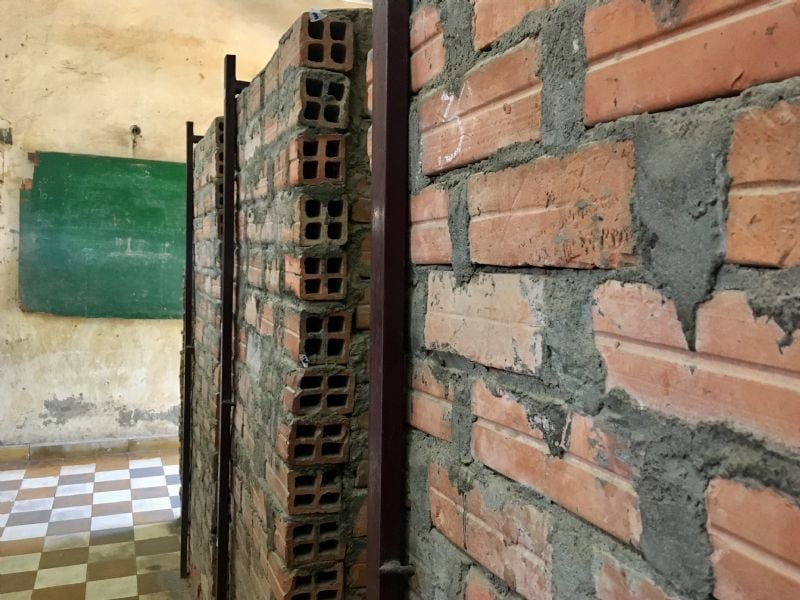
Confessions were almost always fabricated to placate the paranoid Khmer Rouge officials. Prisoners were required to make up elaborate stories about their supposed involvement with the American CIA or Russian KGB.
When S-21 prisoners’ fictitious confessions were deemed satisfactory by prison guards, they were transported by night 15 kilometers outside of Phnom Penh to what is now known as the killing fields.
Prior to 1975 the fields were an orchard, but they are now littered with 129 mass graves.
At the killing fields prisoners were forced to kneel beside large pits that would become their graves. While kneeling and blindfolded, the prisoners were beaten and hacked to death. Small infants were bludgeoned against trees in front of their mothers.
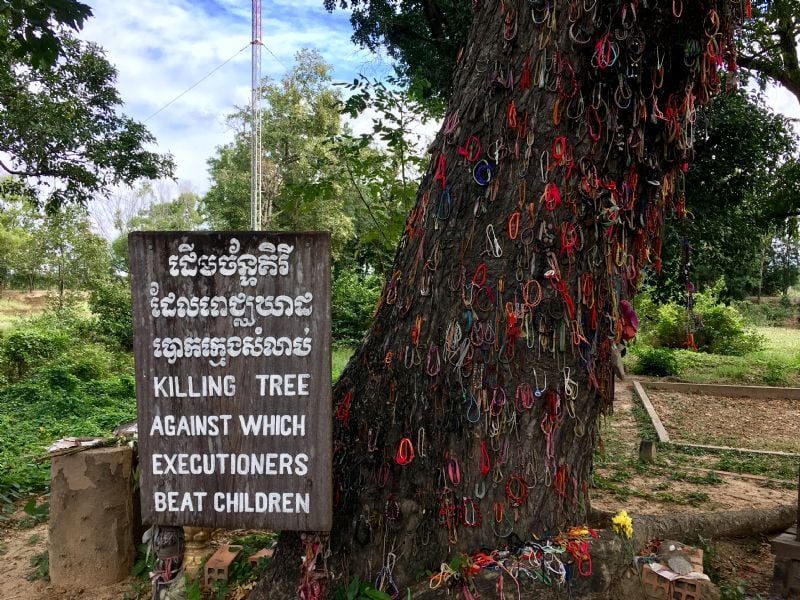
Other killing fields are scattered throughout Cambodia and contain millions of bodies.
The Cambodian Genocide ended less than 40 years ago with liberation by the Vietnamese during the Cambodian-Vietnamese War in 1979.
For many of you, these atrocities occurred during your lifetime. For others, during your parent’s’.
Since arriving to Cambodia, I have stood inside a cell at S-21 and viewed the skulls of 9 thousand victims at the killing fields.
I cannot look at my Cambodian friends without thinking of the genocide.
I teach English classes to high schoolers and wonder how many more students I should have who were never born. I speak to elders at church and wonder if their friends were slaughtered. I see a woman selling fruit on the side of the road and imagine her waking in the night with PTSD-fueled nightmares.
The reality is that 1 in 4 Cambodians died less than one generation ago. Stories of genocide do not reside only in museums and textbooks.
Atrocities like the Cambodian Genocide are still possible. They can occur in high school classrooms and in fruit orchards, and we are told by the Bible not to turn a blind eye.
Speak up for those who cannot speak for themselves, for the rights of all who are destitute. Speak up and judge fairly; defend the rights of the poor and needy.
Proverbs 31:8-9
Let each of you look not only to his own interests, but also to the interests of others.
Philippians 2:4
Give justice to the weak and the fatherless; maintain the right of the afflicted and the destitute. Rescue the weak and the needy; deliver them from the hand of the wicked.
Psalms 82:3-4
We must not only feed and clothe the hungry. We must speak out for the oppressed.
We must be wary of political leaders who offer false promises of economic prosperity, who fear monger, and who maliciously target minority groups and potential opponents.
“First they came for the Socialists, and I did not speak out—
Because I was not a Socialist.
Then they came for the Trade Unionists, and I did not speak out—
Because I was not a Trade Unionist.
Then they came for the Jews, and I did not speak out—
Because I was not a Jew.
Then they came for me—
and there was no one left to speak for me.”







