(You might want to read this one first: http://brittanycox.theworldrace.org/?filename=yesterday-i-rode-a-camel-in-my-front-yard)
We started the day at Blase Medical Clinic, the medical part
of Kenya Relief. They were having day two of their huge open clinic, where
hundreds were lining up to receive cataract surgery, dental care, and general
medical care. We were there to offer hands on this busy day. Within minutes of
arriving, we finally met Steve- the brains and heart behind Kenya Relief. He
gave us a rundown of the day and after talking to nurse Angela, he asked, “Who
is the social worker?� Eager to bombard this man with my questions, I shot my
hand in the air. “Great, we’ve got several home visits going on today for
children we are potentially taking in. You should go along.� I could hardly sit
still. Before I knew it I was on the back of Vitalis’ motorcycle (check that
one off the to-do list) and headed to Brittney’s Home of Grace. I hung out with
Vitalis (one of two social workers at Brittney’s) for a while, asking him about
his work with children, how the process of receiving a child works, Kenyan
laws, etc. I felt my years of social work education flooding my mind. It felt
good to be using the familiar lingo again; I secretly felt pleased that my
education hadn’t been a complete waste. Christine (the second social worker at
Brittney’s), Pat (co-founder of Brittney’s), and Greta (Steve’s wife &
cofounder of Brittney’s) arrived back at the orphanage from their home visit.
Lunch ensued and it was a direct confirmation of the Lord’s love for me… pizza
and fries!! Only missionaries take pictures of food that tastes of home.
Finally, Pat, Christine, Vitalis, and I headed out to our
home visit with our driver Harry. The “short� distance took us through several
towns and then onto a path less traveled. Navigating the treacherous potholes
of the dirt road is a task I’m thankful I don’t have to attempt. Not that the Kenyans
do either- my head is newly misshapen by the hard surface of the truck’s roof.
Forty-five minutes later our trusty driver Harry informs us that the Nissan 4×4
can take us no further. We walked the last several kilometers to our
destination- Christine balancing a hefty box of food atop her well-trained
frame and Vitalis lugging a wheelchair on his shoulders. I was in awe of so
many things at once: the neck and will of the Kenyan, the fields of tea and
banana plants, and shades of green I’m positive I’ve never seen before.
We arrived at Margret’s mud hut just as the afternoon rain
began to pour from the sky. I stepped into my first African home visit, and as
my eyes struggled to adjust to the nearly pitch darkness, they caught sight of
a heart-stopping image. An elderly woman named Margaret was sitting on the dirt
floor. Her frail legs were tucked underneath her, so small I initially thought
they didn’t even exist. My heart felt a new ache as my mind wrestled with the
reality that she probably doesn’t move much from this place on the ground. She
eagerly shakes our hands and offers prayers of thanksgiving as she welcomes us.
What I assume to be neighbors began to pour into the meager space, bringing
buckets to sit on and fervently shaking each of our hands. Within minutes I
counted thirteen children and fourteen adults, and sounds of shuffling tell me
more are hidden by the darkness. We made introductions and then spent about an
hour sifting through the family structure. The interview was done in Luo, the
language of a local tribe, so Christine and Vitalis gave us a quick summary
once they had gathered some understanding of the situation. The one male in the
hut is the Great Grandfather of the boy, Moses, being considered for the
orphanage. The four elderly women, including Margaret curled up on the floor,
are his wives- the fifth wife had recently passed away. The other individuals
present filled out the branches of the family tree- not neighbors after all.
Everyone spoke over each other, offering their part of the
story and explaining Moses’ situation. Margaret, Moses’ actual Great
Grandmother, chimed in whenever there was a break in the chatter. I sat in startled
shock of the situation and tried to hide the tears brimming over and onto my
cheeks. Beautiful Margaret spends her days alone in this dark, damp place-
struggling to care for herself and her orphaned great grandson. She told us she
cooks for herself, though her frail body revealed the scarcity of food. She
spoke earnestly and often about the Lord. She explained the complicated
situation of her great grandson, telling of how his parents have both died in
the last year and a half. He’s currently staying with relatives some distance
off.
“Can we get Moses?� The question traveled through languages.
“Yes, you can have him.� The room was silent as the rain beat down on the tin
roof. In seconds, Margaret handed over her great grandson. She knew that remaining
with her meant a slim possibility for survival, let alone a future. Judgment was
far from anyone’s mind as the hopelessness of that woman cried out for a
chance, for life for her great grandson. The compassion in Margaret’s demeanor
couldn’t put food in Moses’ mouth. Plans were made to meet in the nearest town
the next day.
Christine asked everyone but Margaret to leave the hut. She
showed her the box of food that had been brought for her. Vitalis positioned
the wheelchair for Margaret to pull herself into it. My body was restless with
nothing to do; my mouth opened and closed in silence. I knelt down to shake her
hand and muttered something I can’t even remember, and then I walked out of
Margaret’s dark hut.
We headed out into the rain; we couldn’t wait any longer for
it to stop. On the way out we passed by a house, Moses’ house, which remains
vacant except for the graves of his parents. Soaked through and slipping along
the muddy path, a woman grabbed my hand to guide me, offering more comfort than
the assistance she intended to give. I couldn’t even begin to process what I
had just seen. My eyes and heart had somehow managed to remain guarded, up
until then, against these harsh realities.
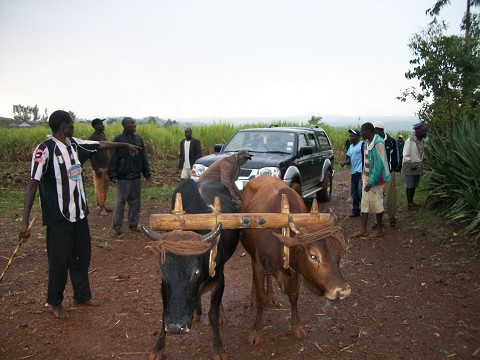
It was another few kilometers back to Harry and the Nissan,
but we were met along the way and told that the two were stuck in the mud. We
made it back to the main road, and took shelter under a friendly stranger’s
roof. A few minutes passed, and my eyes locked onto two large cows coming up
the road. Seconds later my ears caught the sounds of yelling men. The two met
in the most comedic scene I could have asked for; the cows were tied to our
ride and were towing it up the road as about ten Kenyans pushed it along.
Brilliant. We loaded our wet, muddy selves into our vehicle and got back on the
road. My first social work experience in Kenya came to an end.