
Sumba-what?! Sumbawanga. It’s the name of the town where my team has been located for the month of May in Tanzania. The name has something to do with witchcraft, which apparently still runs rampant in the community, but is more or less hush-hush. The predominant religions in the country are Christianity, Catholicism, and Islam. The shallowness of understanding and education in religion is surprising. People here simply subscribe to a religion because their neighbor or friend does, or, as the case is with Islam, because their parents did. (Islam is most often a generational religion.)
It’s been largely an evangelistic month. My team is partnered with another, plus two squad leaders, bringing the total of missionaries to 14. Many of us have battled petty illnesses this month, among other setbacks, but the apparent need of Christ here has been driving us all to perform better in spite of our weakening bodies. We stay in a house, which is actually a mini-compound, the girls taking two bedrooms and the guys sharing one. Most of the housing units here are built like small scale apartments with courtyards. There is one main door to enter the open courtyard, which is where the water spigot is located, with a rectangular building surrounding the courtyard containing on average 3 house-units, one shared bathroom, and sometimes a shop for selling things like soap, eggs, bread, snacks, etc. Our particular unit gives us two neighbors, a chicken house, and a shop at the entrance. Some of the girls set up tents to keep the rats from scurrying over their bodies at night, while the rest of us have just become accustomed to this “World Race Culture”.
Our mornings start about 8:00am with devotionals of some sort, breakfast at 8:30am (cooked over coal fired stoves), and ministry at 9am. We are pretty well balanced between doing house visits, walking to the orphanage to play with an abundance of babies (yes mom, I’ve been holding babies, but no rocking chairs in sight). We also walked a good distance to a blind school to share with the students and staff. Of course we attend the pastor’s church every Sunday, Wednesday, and Friday, delivering on average two messages per session. The house visits are by far the most difficult part of ministry. About half the time we get rejected either because the person is busy, a Roman Catholic leader (they want no Gospel preached in their house, especially by some ‘unqualified youths’), or simply ‘not in need’ of prayer.
I think for the past 9 months I’ve done a fair job of describing what we do on this Race, but I want to give you a better idea of the challenges we face and the objectives we have when we enter someone’s place. We don’t act as Gospel-jamming evangelists trying to convert every poor soul to the way of truth. Rather, we try to encourage and support people in their pursuit of God. Africa has presented the most ideal conditions for this. In Rwanda and Kenya, most people greeted us with enthusiasm and a thirst for the Word. In Tanzania, particularly in Sumbawanga, things are bit more tricky. In Asia, Islamic people made proselytizing unlawful, but in Tanzania, it’s fine because a large portion of the public subscribes to Christianity. Why do I say ‘subscribe’? To them, it’s like a helpful publication, giving them aid when they want it, but they can toss it in the trash when they don’t want it on their coffee table. Scriptural education is minimal here. Religious practices in Sumbawanga and Tanzania as a whole are bound by cultural norms, not scriptural teachings, so this is something that deserves your prayer. Most people have heard of this Jesus guy, but have no idea that it is He who offers Salvation. So what do we do? Here’s an example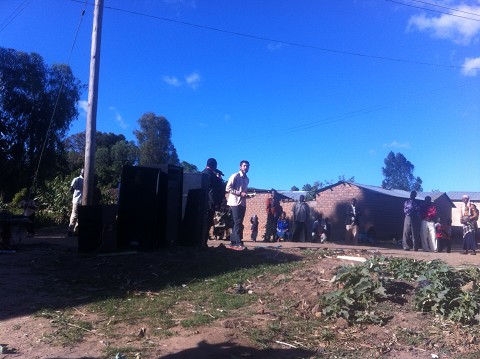 …
…
“Odi!” says our translator as he cracks open the door to the courtyard, checking to see if the people within will respond. After they discuss the reason for the group of muzungus in front of their home, they either reject us or let us in. “You are welcome” is our signal to enter. “They have no chance” means we continue walking. After we enter and look around and get situated, we hear something like “They have agreed to hear you”. So we introduce ourselves and one person takes the lead in initiating conversation, something to the tune of, “Are these your children?” or “Have you ever heard of a guy named Jesus?” One Muslim man responded with laughter and jokes, telling us that he does indeed believe in “God” but that we are fools for following this Jesus. When we attempted to explain the prophecy of the same Old Testament that they are familiar with, or explain how Christianity puts faith in a Gospel, not a religion, we were met with further jokes and laughter. We found an abrupt exit to be the best policy here. If the Holy Spirit hasn’t tempered their hearts enough to even hear a complete sentence, we have no business other than to walk away and shake the dust off our feet (Mark 6:11 says, “And if any place will not receive you and they will not listen to you, when you leave, shake off the dust that is on your feet as a testimony against them.”)
In another instance, a boy asks us about the fruit that Adam and Eve ate. I explain the course of events that take place in Genesis chapter 3. Another young man follows up with questions about the Sabbath. “Some people in my village rest on Friday, others on Saturday, and yet others on Sunday. Which one is right?” I explain that God rested after 6 days of labor. I explained that Jewish culture may mean they practice the Sabbath on one day while it’s different in America of Africa, but that the point is that God wants us to dedicate time away from things of the world to focus on our relationship with Him. He provides all we need, and missing a day of work to grow with God will bless us beyond what that amount of work could bring into our storehouses. Lastly, he asks about clean and unclean meat, wanting to know what’s okay to eat per the Bible, because some people he knows eat only certain foods because they’re considered clean. We point to the original law in Deuteronomy 14, then show the contrast that Jesus brings through the words in Acts 10 concerning Peter’s vision. We try to clarify the parallel between animals and people, pointing out that Jesus makes all believers clean, and that all have a chance to be made clean. The old law of sacrifice and circumcision is no more, and the new law of faith and works into Salvation is fulfilled through Christ.
Lastly, one giant obstacle that has proven very difficult to overcome, if we can at all overcome it, is the idea that we muzungus are walking money bags, only here to feed one's sense of entitlement. It's disheartening to be approached with "Give me money?" instead of 'hello' or 'mambo' (which is a standard greeting in Swahili. This problem is even deeply rooted within the church. My only solution at the moment is to battle it with prayer.
So, my readers, this is a snapshot of what we do in ministry. We educate. We play with children and orphans (James 1:27 tells us, “Religion (Worship) that is pure and undefiled before God, the Father, is this: to visit orphans and widows in their affliction, and to keep oneself unstained from the world.”) We build churches and schools. We teach English, Business, and more. We clean and make repairs on anything from vehicles to household appliances. We travel the globe and serve those in need. One man in Kigale, Rwanda told me he wanted to be saved as a result of us coming to his community and sharing the Good News. Judith, the visionary behind Great Mercy School in Kitale, Kenya told me, “Your entire World Race was made worth it by your coming here and repairing our water well pump that has been broken for almost 2 years.” Thank you readers and supporters for your prayers and contributions. Without you, these peoples’ lives would not have been changed.
2 months, 2 countries to go.







