
There’s a really great couple here living and serving in Mijas at G42, and they go by Kaitlyn and Daniel Thornhill. This morning they shared some great wisdom with us as a class. Daniel specifically shared a great word with us about Luke 15 and the mature body of Christ (that another awesome dude by the name of Gary Black also touched on in class today), and I just wanted to share with you all what was shared with us—it’s too good not to pass it on!
So. In my own slightly-chaotic words, here’s some stuff I learned today.
All of you together are Christ’s body, and each of you is a part of it.—1 Corinthians 12:27

The body of Christ was not always a mature body. We didn’t come together looking like a young Arnold Schwarzenegger.
Just like Jesus himself started out as a baby and grew in “wisdom and stature and favor with God and men,” I think the body of Christ has also grown over the generations.
But, before we get into that, let’s start where all great stories start—at the beginning. Like, the very beginning. In the garden of Eden. Humanity, as we famously like to say, “fell.” The fruit was eaten and eyes were opened and God said, “See! The man has become like one of us, knowing what is good and what is bad!”
And when those eyes were opened, humanity—just two people at that point—looked at each other and just went, sh*t. We’re naked and this whole thing is weird and we have no idea what we’re doing (my paraphrase).
And so, out of the fall of man came the birth of a nation. Israel. Meaning God will prevail.
I don’t think we give this birth enough credit. Sure, sure, we could talk about the fall and the sin and the serpent all day, but what about the rebirth?
Humanity was, as a whole, this brand new thing. There had never been people’s populating the earth before, trying to work the land and provide for themselves and their families. Israel, this great, big, newborn baby of a nation was fresh and needed some serious parenting.
One of the hang-ups people have about God—whether you’re Christian or not—is all of the “rules” laid out in the old testament. Don’t get me wrong, some of us love the rules. We’re the ones out there, scouring our bibles looking for more rules we can folllow.
But, at least for me, I know when I read all of those rules in the old testament—the verses about not mixing the different types of clothing and what to eat and how long to grieve and where to bury your own poop—part of me is just like, “Um… what?”
But I think I always miss the enormous birthing process that just took place.
I mean, a nation was just born! They needed pretty much constant tending. Think about a newborn baby. They’re not exactly ready to make decisions on their own.
Even as a parent—you know the first time you leave your baby with a babysitter, even if that babysitter is your own mom and dad, you’re still giving them a crazy detailed list of when to do what and how hot to warm the milk up and how many songs to sing before trying to put them to sleep and about one-thousand emergency numbers to call should something go wrong.
Well, that’s what God did for his baby nation.
He spoke through his “babysitter’s” and entrusted them with the care instructions for his new nation. It might not make sense to us—all the different laws he decreed and things he asked of this people—but guess what? You’re going to sound just as crazy passing that 10 page print-out on how many counterclockwise stirs the milk needs before it’s ready.
But it’s all out of love. You know your baby best and, as parents, you know how to care for it. I mean, it’s your baby after all. You created it!
Israel was God’s baby. And he knew how to care for it.
But then, as all babies do, the nation started to grow.
It started to crawl. And then crawling turned to walking. And then the old babysitting instructions weren’t going to cut it anymore. It’s a whole lot different having someone watch your 8-day-old compared to your 8-month-old compared to your 8-year-old. They just don’t need the same things. As they get older, you can entrust them with more. They become more independent.
And, speaking of independent, do you ever wonder why Jesus came when he did?
Was it just random? At the beginning of time, did everyone just sit up in heaven and close their eyes and point to the calendar and say, “yes! That’s the day!”
I don’t think so, but hey, you can take that or leave it. I think Jesus came when the world was walking. Israel had been this baby and it had learned to crawl and it was starting to try and walk on it’s own. Heck, maybe they were even ready to start running, they just didn’t know how yet.
In the bible, Jesus is always referenced as a “rabbi” or “teacher” and rabbi actually means teacher, so that’s really just a whole lot of times in the bible that he’s being called a teacher. Basically I’m saying he was a teacher, and so now allow me to draw this possibly life-altering conclusion—
teachers exist to teach us something new.
You don’t bring a teacher in and pay them just so they can teach a bunch of kids something they already know. I’ve done some teaching in my life, and yeah, sometimes you spend some time reviewing the basics, but the goal is always to move onto something new.
In my scenario, Jesus is the teacher. The Jews of that time already knew a lot about God and about the law’s that he’d mandated. They knew what was up. So why did they need a teacher to come in? What new thing did they need to learn? They already knew how to crawl, what else was there?
But Jesus said, no.
Jesus said, “You have heard it said… But I say…”
For the entire law is fulfilled in keeping this one command: “Love your neighbor as yourself.”—Galations 5:14
He said, You have been learning to crawl, but I SAY LET’S LEARN HOW TO RUN.
In the unfortunate But (because there always seems like there has to be a but with things like this), learning to walk is dangerous. Running is dangerous. It’s uncomfortable. Crawling is a whole lot safer, and it’ll still get you from place to place. At least you’re moving, right? Some people aren’t even doing that!
In our personnel spiritual walks, I think we follow this same pattern. We’re born again, and then we have to grow. At first, we have to be fed and changed and told what to do. We’re infants.
Then we get bigger. Stronger. We can crawl and play and babble. We’re having a good time.
But there’s even more. We start to walk. And to talk. And to make decisions for ourselves. And get our own revelation. And teach and preach and pray and play.
We, as generations of God’s children, have also grown up. Maybe we’re not in Young Arnold S shape yet, but we’re definitely not that young babe anymore either.
Then we will no longer be infants, tossed back and forth by the waves, and blown here and there by every wind of teaching and by the cunning and craftiness of people in their deceitful scheming.—Ephesians 4:14
The question that was posed to me today, and the one that I want to pose to you is this—have you grown up?
Luke 15 illustrates this idea of the body of Christ growing into the body of Christ beautifully. Basically, it’s Jesus talking about a bunch of lost stuff.
He mentions the parable of the lost coin, which talks about a woman who loses one silver coin and sweeps the house looking for it. When she finally finds it, she calls her neighbors over to rejoice with her—‘Rejoice with me, for I have found the coin that I had lost.’
He also mentions a lost sheep. The shepherd searches and searches for this sheep that has gotten itself separated from the flock, and when he finds it, he calls together his friends and rejoices, saying—‘Rejoice with me, for I have found my sheep that was lost.’
Then, finally, Jesus tells the story of the lost son. This son asked for his inheritance early, wastes the entire thing and finally ends up broke and starving, sleeping with the pigs. But, the son eventually decided to go back to his father. Even being his father’s servant would be better than the life he’s currently living, so he heads back, head down and hat in hand.
But, while the son was still a long way off down the road walking back home to his father, “his father saw him and felt compassion, and ran and embraced him and kissed him.”
The father ends up putting the best robe and ring on his son and throwing a huge party and declaring—‘this, my son, was dead, and is alive again; he was lost, and is found.’
For I have found the coin that I have lost.
For I have found my sheep that was lost.
He was lost, and is [now] found.
A coin is an inanimate object. It can’t do anything on it’s own. Not a single thing. This is like us as baby Christians. This is like the nation of Israel after the fall. Everything is new. There have to be rules. They can’t really do anything on their own, and when they get lost, they’re not really the ones to blame [For I have found the coin that I have lost.]
Now, a sheep is definitely alive. Sheep are also incredibly stupid—just keeping it real—so yes, they can make “decisions,” but at the same time, they can’t really be expected to keep themselves safe. They can move and eat and reproduce and make noises and what not, but when a sheep wanders away, he’s pretty much doomed because he can’t really fend for himself. This is us. After a while of knowing God, we start to crawl. A kid that crawls can’t really be held responsible for too much, but they’re starting to get it. They’re becoming more autonomous. They’re not as dependent on their parents.
Here, Jesus doesn’t say “For I have found my sheep that I lost.” He says, “For I have found my sheep that was lost.” The sheep got itself lost, but it’s also not very smart, so the sheep still needed the shepherd to find it’s way back again.
Now we get to the good stuff. The son!
He’s an adult! He has access to the full inheritance! Sure, he blows it all and gets himself lost, but I don’t think the ‘getting ourselves lost’ thing is the point. I think the point is that you’re going to get lost. You just will.
But, here, as a full-grown adult and son, he can walk. He can run. He can call his own shots. As adults, we can say we want our inheritance and Dad just gives it to us. And as adults, even if we’re gone a long time, Dad doesn’t just go out searching for us. He knows you can come back whenever you want. He knows you’re mature. He knows you can walk. He knows you can fight. He knows you can find your own way back home.
And so, when he finally sees you coming back, he himself runs out toward you and shouts, “He was lost, and is[now] found.” He doesn’t say I here. He doesn’t claim ownership. He just says that the son is now found. He’s home. He’s not lost anymore.
The Spirit you received does not make you slaves, so that you live in fear again; rather, the Spirit you received brought about your adoption to sonship. And by him we cry, “Abba, Father.”—Romans 8:15
Jesus talks about us as sheep a lot in the bible.
I think that’s because that was what the people were that he came into. They were sheep. They weren’t coins, but they also weren’t yet sons and daughters. They didn’t quite know how to run yet. They could get themselves lost, but they couldn’t yet find their way back home.
I may be talking crazy here, but I don’t know many people who’d want to be sheep instead people. I just don’t. Unicorns, maybe. Birds even, sure. I’d bet someone out there wants to be a bird.
But a sheep?
No. I don’t think so. But, at the same time, I think you’d be missing out on a HUGE opportunity if you were a sheep and you had the chance to be a human and you were like, “Ehhh, better not.”
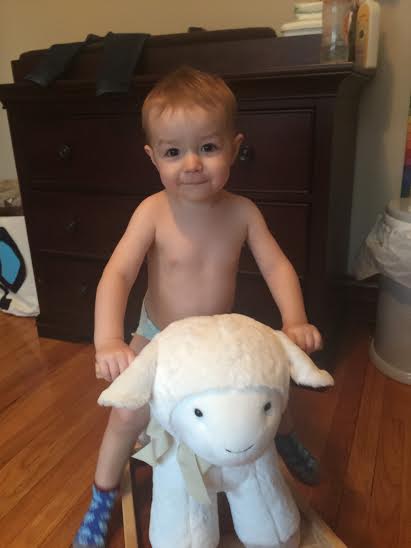
Even if the human is SO CUTE like little Isaiah!
When I was a child, I used to speak like a child, think like a child, reason like a child; when I became a man, I did away with childish things.—1 Corinthians 13:11
In general, in the movement of where we are as the body of Christ, I think we’re maturing. I definitely don’t think we’re coins, and I think we’re shedding our sheeply skin and walking into who we are as sons and daughters. But this has to be something that starts individually—on the cellular level—before it starts to change the DNA of the body as a whole.
So I’ll ask you today—are you still a sheep?
Are you comfortable having just enough to get by, just sitting with all the other sheep and waiting to be told where to go next?
Or are you an adult.
Can you walk and talk and think and run away all on your own. Do you need the Shepherd to lead you back, time after time after time, or can you find the way back on your own. Can you take the risk. Can you call yourself a son, or do you still call yourself a sheep?
Sheep are still God’s. The coin’s are still God’s. It’s all God’s.
But the sons are honored. The sons are trusted to make their own decisions, not matter how freaking royally they’re going to screw it all up. Sons and daughters get the inheritance. The sons are the ones you can entrust with the sheep and the coins and everything else!
**Allow me to draw a possibly offensive conclusion **—if we’re sons and daughters of the age of being able to claim our inheritance, then that also means that we’re grown-a$$ adults, and I think maybe God doesn’t need us checking in with him on every decision, every five seconds. Sometimes, we think we need to pray for 49 hours and check back with him two-hundred times a day about the same things. Praying is great, constant communication with God is how it’s meant to be, but we’re also adults and we can also just do things without asking. If you have kids who’ve moved out of the house, and those same kids called you every time they wanted to make a decision about anything, I think you’d ask yourself what you’d done wrong—
“Mom, can I eat lunch now?”
“Dad, can I paint you this for your birthday?”
“Mom, can I hang out with Jason?”
“Dad, where should I move next?”
“Can I take this class?”
“Should I give that guy a dollar?”
“Can I sing this song?”
“Can I wear this shirt?”
I’m guilty of asking these same kinds of questions, and of course it’s never wrong to ask God questions, I’m just wondering if maybe—maybe—he believes that he’s raised us right, and that maybe—maybe—we can make some decisions on our own. If you love somebody and the only time you have with them, they spend asking you questions the entire time about what they should and shouldn’t do…I’d say that relationship is struggling.
As individuals, and also as the body of Christ as a whole, I think we can say yes or no. We can chose to stay or go. Without fear. Without condemnation. Without paralyzing ourselves by spending all our time waiting for an answer that’s not coming.
So. I don’t know about you, but I’m ready to ask for that inheritance, and start building some kingdom. I’m ready to stop bah-bah-bah-ing and start run-run-running. Who’s with me?
“Because you are precious in my eyes, and honored, and I love you, I give men in return for you, peoples in exchange for your life. Fear not, for I am with you; I will bring your offspring from the east, and from the west I will gather you. I will say to the north, Give up, and to the south, Do not withhold; bring my sons from afar and my daughters from the end of the earth, everyone who is called by my name, whom I created for my glory, whom I formed and made.”—Isaiah 43
Peace! Blessings! All mi amor from spain!
Bree







