Jesus Christ—Liar, Lunatic, or Lord?
Isn’t that a fun (and intriguing) alliteration? Unfortunately for me I didn’t come up with it; but regardless, it rings true.
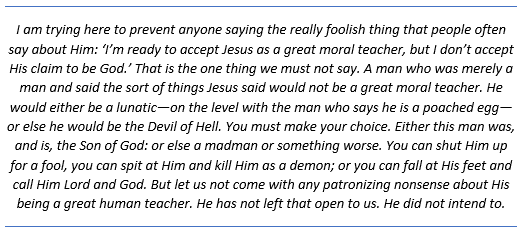
When I first read the above quote by C. S. Lewis it convicted me of the many times throughout my life that I have been unable to defend my Christian faith when people tell me, “I do good works and uphold morality as Jesus says in the bible, why do I need to believe in Him being God’s son to get into heaven? I don’t believe that that is necessary and I think it is cruel of God to not allow ‘good’ people into heaven.”
I never knew how to put into words my response back to that.
Even now, I don’t know what I would say to someone if they said those words to me, but I do know I would say something—I would no longer stand there mute from unknowing how to respond.
So while yes, Jesus did teach good morals, he said and taught so much more than that, and if someone is willing to believe his moral teachings were sound and true, I would love to know why they disregard his other teachings and statements about him being the Son of God.
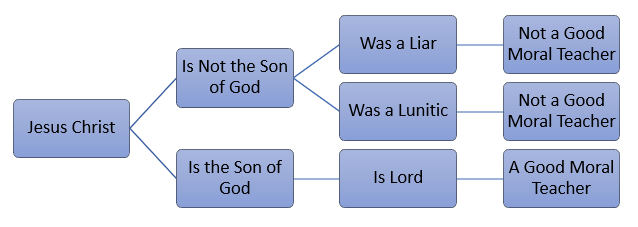
Which leads to the catchy question was Jesus Christ a liar, a lunatic, or was he truly Lord? There are basically two ways people view Jesus—the true Son of God, i.e. Lord, or not the Son of God. If he wasn’t the Son of God than he was either lying when he called himself as such, or he was clinically insane.
If Jesus was a liar and knew that he was not the Son of God, then he was a hypocrite, malicious, and ultimately suicidal. He would have been a hypocrite because he told his followers not to lie (Matthew 19:18). Plus, if he was a liar and thus a hypocrite, why would people consider him a person to look up to for good morals?
Additionally, if Jesus was a liar he would have been malicious because he would have known that he was purposely leading people astray when he claimed, “I am the way the truth and the life. No one comes to the Father except through me” (John 14:6).
Lastly if he was a liar, he would have also been suicidal for ultimately he was charged to death due to his claim to be the Son of God.
Matthew 26:62-66 – 62Then the high priest stood up and said to Jesus, “Are you not going to answer? What is this testimony that these men are bringing against you?” 63But Jesus remained silent.
The high priest said to him, “I charge you under oath buy the living God: Tell us if you are the Christ, the Son of God.”
64“Yes, it is as you say,” Jesus replied. “But I say to all of you: In the future you will see the Son of Man sitting at the right hand of the Mighty One and coming on the clouds of heaven.”
65Then the high priest tore his clothes and said, “He has spoken blasphemy! Why do we need any more witnesses? Look, now you have heard the blasphemy. 66What do you think?”
“He is worthy of death,” they answered.
The significance of his claim to being the Son of God is the fact that he had said that in front of the Jewish Sanhedrin—who whole-heartedly followed the Jewish laws of the Old Testament, who took it very serious when a person were to claim Lordship. This was actually brought up in John 19:7, when Jesus was before Pilate and “the Jews insisted, ‘We have a law, and according to that law he must die, because he claimed to be the Son of God.’” The law that the Jewish leaders were referencing is found in Leviticus 24:16.
Leviticus 24:13-16 – 13Then the Lord said to Moses: 14“Take the blasphemer outside the camp. All those who heard him are to lay their hands on his head, and the entire assembly is to stone him. 15Say to the Israelites: ‘If anyone curses his God, he will be held responsible; 16anyone who blasphemes the name of the Lord must be put to death. The entire assembly must stone him. Whether an alien or native-born, when he blasphemes the Name, he must be put to death.
So, if Jesus Christ was a liar trying to get people to believe he was the Son of God, when he actually was not, it would not have made sense that he went to the Jewish communities and spent his years of ministry teaching primarily to Jews. So much so, that the inscription above him on the cross read “Jesus of Nazareth, the King of the Jews”—something that the Jewish chief priests protested (John 19:21).
Which leads into the next possibility—was Jesus a lunatic? After all, Jesus claimed to be the Son of God sent for the Jewish people, which as stated above would eventually get him sentenced to one of the most horrific ways of death known to man. For maybe he truly believed he was the Son of God, but he was just crazy and “had a couple of bolts loose in the head?”
However, this does not match up with what we know of mental illness today. The people that are closest to me can attest to the fact that studying abnormal psychology has been a hobby of mine for many years—the random collection of close to 20 psychology textbooks in my “library” back at home are prime examples. Although I am no expert of psychology, nor will I claim to be, I do know that mentally disturbed people do not display appropriate emotions—specifically those people who believe they are something that they are not, and suffering from hallucinations, audible and visual, i.e. those who have been diagnosed as schizophrenic.
According to the DSM-5, “schizophrenia is the prototypical psychotic disorder. Not only is it the most common psychosis, but schizophrenia tends to involve abnormalities in all five of the emphasized symptom domains: hallucinations, delusions, disorganized thinking (speech), grossly disorganized or abnormal motor behavior (including catatonia), and negative symptoms… symptoms of schizophrenia tend to reliably develop during late adolescence and early adulthood.” Expanding upon that, research out of the Department of Psychology from the University of California, Berkley touches upon the fact that the longer-lasting symptoms of schizophrenia are the negative symptoms linked to emotions—specifically flat affect, a lack of outward expression of emotion; anhedonia, diminished experience of pleasure; and avolition, diminished motivation. Additionally, out of the same department, later research touches upon the fact that “men with schizophrenia may have more negative symptoms [than women], including flat affect.”
However, throughout the bible there are not instances where Jesus lacks the ability to outwardly display his emotions—in fact, there are many examples of him displaying appropriate emotions, both positive and justly negative.
Examples of Jesus displaying these appropriate emotions include, but are not limited to: while he was at Gethsemane and knew the weight of what God was calling him to do—die, as a sinless man, for all of the sins of the world—he was “deeply distressed and troubled (Mark 14:33) and he told his disciples, “My soul is overwhelmed with sorrw to the point of death” (Matthew 26:38, Mark 14:34). He felt compassion on many occasions, two examples that I know of specifically are when the woman who was bleeding for twelve years touched his robe and he called out asking who it was and then told her “daughter, your faith has healed you. Go in peace and be freed from your suffering” (Mark 5:25-34) and when he had compassion for the multitudes of people who had come to the shore line to merely be around him—despite him trying to find some alone time—and began to teach (Mark 6:30-34). Additionally, while talking to the rich young man, Mark 14:21 states that “Jesus looked at him and loved him”—no it is not the traditional, romantic love that many people think of, but rather a brotherly love for someone that he cared about deeply. Jesus also displayed many appropriate emotions such as righteous anger when the temple was being used for things other than worshiping God (Matthew 21:12-13), sorrow and tears and thus empathy for Mary and Martha when Lazarus had died (John 11:17-37), a troubled spirit when he told his disciples one of them was going to betray him (John 13:21), and joy when he was talking to his Father in heaven and thanking him for revealing his powers to the least of the people at the time—the little children (Luke 10:21).
In the book, A Few Buttons Missing, psychiatrist J. T. Fisher boldly states: “If you were to take the sum total of all authoritative articles ever written by the most qualified of psychologists and psychiatrists on the subject of mental hygiene—if you were to combine them and refine them and cleave out the excess verbiage—if you were to take the whole of the meat and none of the parsley, and if you were to have these unadulterated bits of pure scientific knowledge concisely expressed by the most capable of living poets, you would have an awkward and incomplete summation of the Sermon on the Mount. And it would suffer immeasurably through comparison. For nearly two thousand years the Christian world has been holding in its hands the complete answer to its restless and fruitless yearnings. Here… rests the blueprint for successful human life with optimism, mental health, and contentment.”
So, if one were to claim that Jesus was not the Son of God—fine, that is their opinion (although I do not agree, and I would love to chat with said person). However, that same person cannot, in their right mind, also claim that Jesus was a teacher of morals to look up to, for either he was lying or out of his mind. Either way, neither is a sound basis for someone to claim to follow moral teachings from another.
Following the flowchart of the “options” of who Jesus Christ was, it leaves us with one option: Jesus Christ, who claimed to be the Son of God, was in fact God’s Son, and therefore Lord.
To be honest, there are a lot of reasons why I have this conclusion; however, I would have such a long blog post that no one would want to actually read it, so I am going to try to sum it up rather quickly and if anyone would like clarification, just let me know. (I am already at a 2000+ word count and on the fourth page of a Microsoft Word document, so I will try to keep it simple and to the point.)
There are two main aspects I’m going to touch upon—the first, there are only so many options, and by deductive reasoning, if Jesus is not not the Son of God, then he is, indeed, the Son of God, and therefore Lord.

The second aspect that I want to touch upon, which has more back-up than the deductive reasoning is the logical-historical proof of the bible, which is generally tested in three ways: bibliographical testing, internal evidence testing, and external evidence testing.
Bibliographical Testing – despite not having the original documents, how reliable are the copies we have in regard to the number of manuscripts and the time interval between the original and extant copy:
Here is a comparison chart of trusted and accepted historical documents, their time frames between originals and the known copies, and the known number of copies.

So if these other four works of history are accepted as factual, why is it that the New Testament with the shortest time frame between actual occurrence and the first written copies and the largest number of copies by over ten times, is questioned?
Internal Evidence Testing – to what extent are the words written in the bible credible:
This largely ties into the previous testing and the fact that the time frame between the events recorded and their physical records being written down happened within such a short span that the people that were the eye-witnesses to these events were still alive when it was written originally. Henceforth when these people would have heard an inaccurate statement, they would have corrected the writings—both believers and critics. Examples of the disciples talking to people about their eye-witness accounts are as follows, and in no way exclusive:
Luke 1:1-3; Many have undertaken to draw up an account of the things that have been fulfilled among us…
Acts 2:22; “Men of Israel, listen to this: Jesus of Nazareth was a man accredited by God to you by miracles, wonders and signs, which God did among you through him, as you yourselves know.”
Acts 26:24-27; At this point Festus interrupted Paul’s defense. “You are out of your mind, Paul!” he shouted. “Your great learning is driving you insane.” “I am not insane, most excellent Festus,” Paul replied. “What I am saying is true and reasonable. The King is familiar with these thing…”
Lastly, one more reference for internal evidence is the facts of the time that are clearly laid out for the reader—i.e. Luke 3:1-2, “In the fifteenth year of the reign of Tiberius Caesar—when Pontius Pilate was governor of Judea, Herod tetrarch of Galilee, his brother Philip tetrarch of Iturea and Traconitis, and Lysanias tetrarch of Abilene—during the high priesthood of Annas and Caiaphas….” These are such specific details about the time events that had taken place, that the original readers (who had been alive during Jesus’ lifetime) would have rebuked and corrected them if inaccurate.
External Evidence Testing – does other historical material confirm the internal testimony of the documents themselves:
Two (of many) external confirmations of these internal testimonies found in the New Testament are from the historian Eusebius (A.D. 130) and Irenaeus, Bishop of Lyons (A.D. 180), who was a student of Polycarp, Bishop of Smyrna, who was a disciple of the Apostle John.
Eusebius wrote in his Ecclesiastical History, that “the Elder [Apostle John] used to say this also: ‘Mark, having been the interpreter of Peter, wrote down accurately all that he [Peter] mentioned…. So then Mark made no mistake, writing down in this way some things as he mentioned them; for he paid attention to this one thing, not to omit anything that he had heard, not to include any false statement among them.’”
Additionally, Irenaeus wrote in his Against Heresies, “Matthew published his Gospel among Hebrews [Jews] in their own tongue, when Peter and Paul were preaching the gospel in Rome and founding the church there. After their departure [death], Mark, the disciple and interpreter of Peter, himself handed down to us in writing the substance of Peter’s preaching. Luke the follower of Paul, set down in a book the gospel preached by his teacher. Then John, the disciple of the Lord, who also leaned on his breast [biblical reference to John 13:25 and 21:20], himself produced his Gospel, while he was living at Ephesus in Asia.”
Henceforth, these are two of the many examples of the accuracy of the written New Testament confirmed by an outward source from the same time period.
Over the course of these last two and a half months, I have come to have a passion for apologetics—the defense of your faith. And I find it very contradictory that people will claim to believe that Jesus was a good moral teacher (not that I’m saying he wasn’t) and believe what he says about interpersonal relations, but be so quick to disregard the rest of what he claims—his identity. I do not see how one can occur without the other.
Thanks for listening to my long-winded processing of my thoughts (six pages of a document and just shy of 3000 words), but this is one of my core beliefs and I truly believe that if we (Christians) do not know where our faith is placed, then we will not be successful in fulfilling our one, true calling—to “go and make disciples of all nations,” Matthew 28:19.