
“Hello, how are you? I’m good too, thanks. How old are you? Do you have any children or brothers or sisters? That’s good. Ok, good night!”….
This is, unfortunately, a pretty complete summary of my level of conversational spanish. I may have a small list of useful verbs and very small memory of how to conjugate them, as well as several semi-helpful nouns, all being drawn from somewhere in the depths of my brain where I managed to unearth some of my high school spanish.
I can wrongly form a sentence to get a point across sometimes, usually something to the effect of:
(Talking to the housekeeper, Rosa): “Gracias para desayuna, es muy rico. Tu necessitas ayudar con platos por favor. Yo puedo limpiar los platos si tu querer este? Soy contenta para este. Si?”
Rough translation: “Thank you for breakfast, it is delicious. You need to help with the dishes please. I can to wash the plates if you to want. I am permanently a happy person for this. Yes?”
Intended: “Thank you for breakfast, it was delicious. I know you need to wash the dishes and I would like to help wash them please if thats ok? I am happy to do this, is it ok?”
As you can imagine, poor Rosa just looks at me with a concerned look on her face and says “No, no! Esta bien!” I hope I am not telling her “ you need to go wash the dishes, please.”
Sometimes it is hilarious. There are certain words I tend to confuse…
1) hambre(hungry) and hombre(man). So I sit at the table with an excited look on my face and say “Yo tengo hombre!”, and get a lot of “uh, good for you?” looks, because I am saying “I have a man.
2) juevos(eggs) and jueves(thursday). “Can I some more thursday with my toast please?”
3) perro(dog) and pelo(hair). So you walk up to someone, touch their head, and say “Beautiful dog!”
But beyond these lost “conversations”, I can do little more than smile and nod and probably answer “Si!” to what was actually an open-ended question about my family or career.
In general, I love to talk to people. I like to ask people about their lives and their families and experiences, and my favorite part of being a nurse in the hospital was being able to learn from my patients extensive knowledge of life and family.
I don’t ask people about themselves to be polite or make conversation; I am genuinely interested and fascinated by things people desire and dislike, things they have seen and want to see, lessons they have learned and wish for me to learn.
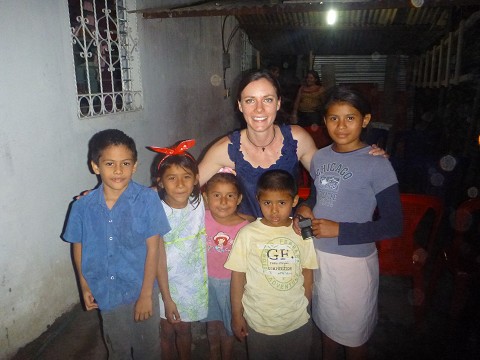
The language barrier has gotten to me more than I expected. I am thankful to have a team mate, Helena, who does very well with conversational spanish and has performed amazingly well translating sermons and testimonies (imagine…she has to hear one of us speak in English, and then in her head to translate it to Portuguese because this is her native language, and then try and say it in Spanish, for a 30-45 minutes every day on stage…God bless her). We also have Oscar, who is incredibly kind and helpful, to translate with us on some days.
But the frustrating thing is that I don’t know how in the world to develop relationships with these people or get to know them if I can’t talk to them! I came on this trip to show love and compassion and embrace people the way Jesus did. But I fear that you can only hug and kiss and smile at someone so many times before the relationship plateaus and goes no where.
I long to stand in the kitchen with Rosa and ask her about her family, her life, her Mayan decent, her desires and dreams. I wish I could ask the pastor how he decided to follow the Lord in this way, and what have been his biggest triumphs and fears. I wish I knew the words to the songs the kids sing with me when we do the little clapping games, and what to say to comfort them when they fall and cry. I wish there were a way to pray with people who need prayer and have them know the words coming from my heart as I say them.
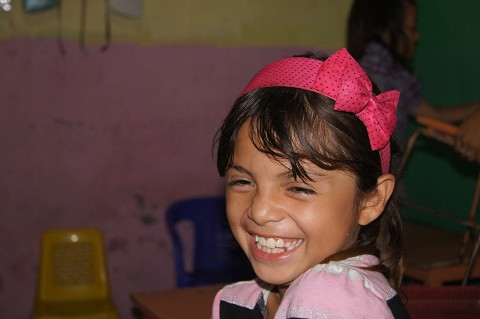
I am afraid that I will leave this place having left no real impression of Christ’s love I was aiming to bring, as I stood around in the background with a stupid grin on my face. This is just another way God is teaching us all to surrender to Him and trust Him.
But in a way, it is teaching me that love goes much beyond just talking: it means taking the sponge out of Rosa’s hands and taking over the dishes (as she smiles and says “Ah! yes, haha!”), and picking children up and spinning them around until they laugh uncontrollably, and braiding little girls hair, and holding elderly peoples hands, and making a point to hug the pastor good morning and good night.
So through it all, I try to just smile and hug and kiss and at least try to speak the language, and hope Jesus inside me makes Himself evident even when my voice is of no use.







