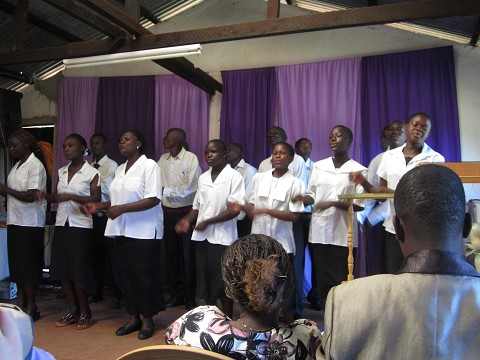
One thing that has continually impressed me about Kenyan churches is the way in which they are outlets for Christian joy. At each one of the four churches we’ve attended so far, people dance, clap, sing, and jump (literally) for joy. People are not afraid to make eye contact and embrace the community aspect of worship. On more than one occasion, we’ve seen church members intentionally move their chairs to the sides of the room to give themselves more room to dance in the middle!
Though displaying this type of joy was a foreign concept to us at first, our team was quick to embrace it. Hannah led the way, a few church services ago, as she left her spot among the six frozen chairs on the stage behind the pulpit and joined with the line of women shaking their hips to the rhythm of God’s goodness. It didn’t take long, either, for the rest of our team to join in the festivities. I think, however, that the reason why we embraced the Kenyan method of expressing joy so quickly was not so much because we desired to fit in, but rather because we are human and inside of every human there exists a desire to express unhindered joy.
We may not all know how to breakdance, but I have yet to meet a soul who doesn’t nod his head to Sweet Home Alabama or tap his pinky finger to Beethoven’s ninth. Despite my vague understanding, however, of the fact that my innate desire to be jovial was not sinful, I still felt, at first, as if the degree to which I expressed that joy was the degree to which I dishonored the glory of God. Even last week, after I found myself in a Christian “rap battle” with a man named Ezekiel at a children’s home, I felt as if needed to “get back to” worshipping God when I was finished.
Finally, though, I have realized that our joy and our glee do not demean God—they celebrate him. God, though one being with one nature, has many different aspects to that nature. For example, God is not a healer or a warrior in the sense that we can pin a finite, describable label to any aspect of his indescribable infinitude, but God simply acts like himself at all times and some of his actions we liken—though a million times greater—to the actions of healers or the actions of warriors. Thus, different sides of God’s cohesive face are appealing to different people.

In the same way that we can recognize different facets of God’s character, I also believe that God has ordained that we experience different those different facets via different emotions. We are called to love all of who God is, though we will use different emotions to do so. For example, I do not believe it would be appropriate to celebrate God’s holiness by shaking our hips and jumping. The holiness of God is something we celebrate with our arms raised towards the heavens or with our faces flat on the ground. Such was the response of the Old Testament believers who truly understood God’s infinite holiness and perfection. His holiness is something we even hesitate to speak of, lest we demean its snow-white perfection with even one misspoken article or conjunction. The emotion I use to celebrate the holiness of God is awe.
Imagine leading a person who has been locked in a dark closet his entire life to the edge of the Grand Canyon and allowing him to look out, for the first time ever, at its breathtaking expanse. There is no way on earth that that person would even think of uttering a syllable, lest it profane his (or your) experience of worship—whether he uses that word to describe it or not—at that moment. The same is true, in my opinion, of the holiness of God. If we are verbose and flighty in our interactions with God’s holiness, it simply means we have yet to grasp the full meaning of the idea that is holiness.
It would not make sense for us, however, to celebrate the justice of God in the same way that we celebrate the holiness of God. We do not raise our hands to the sky when an unbeliever dies and goes to hell. Rather, we mourn and are in anguish for those who perish without knowing the living God. Paul described himself as having “intense sorrow and continual anguish in (his) heart” over his Jewish brothers that we perishing without knowing Jesus Christ (Romans 9:2). We love the justice of God, because as believers, injustice—especially injustice against God—bothers us (Psalm 10), but we don’t love the justice of God with the same emotion as our means and our vehicle. When it comes to the justice of God, the emotion of grief is our vehicle, so to speak.

Where does joy and joviality fit into all of this? It now seems self-evident to me (though it certainly wasn’t always) that joy is the emotional vehicle by which we experience the goodness of God. A.W. Tozer describes the goodness of God, in his book Knowledge of the Holy, as unique from God’s other characteristics in this way:
“When Christian theology says that God is good, it is not the same as saying that He is righteous or holy. The holiness of God is trumpeted from the heavens and re-echoed on earth by saints and sages wherever God has revealed Himself to men; however…the goodness of God is that which disposes Him to be kind, cordial, benevolent, and full of good will toward men.”
When I celebrate the goodness of God— the fact that he provides me with delicious meals, a loving family, enough clothes, warm sunshine, protection, peace, guidance, and whatever else may flow out of his daily benevolence—joy is the emotional vehicle that takes me there. It feels natural and right to jump and sing and dance when the sun is shining and when reminiscing on God’s sweet goodness.
Now that I understand this, I feel free to dance and jump and sing—and rap—when celebrating God’s goodness! I am neither demeaning his holiness nor disregarding his justice, but instead I am celebrating a different side of his face.

It is a self-evident truth that humans experience a wide range of emotions. Also, we are commanded to love, worship, and adore every aspect of God. It seems only fitting, therefore, that our wide ranges of emotions are not evidence of our emotional instability but rather tools and vehicles—both created and ordained by God—to experience, enjoy, adore, and submit to his multi-faceted nature.
Christian joy, here, is not limited to church-services, however! This weekend, we even found our pastor, Moses, dancing to reggae worship videos in our living room as he said to his son, Sammy, “Life is like this, my son!” I couldn’t help but to smile! I love the fact that joy is acceptable and I love the fact that this family knows it!
I would go a step further, however, than saying that joy is appropriate. Rather, I would say that joy is essential. Joy in Christ is so essential because, as the most oft-neglected emotion in our Christian lives, it is the one we are most likely to outsource to worldly means. We must revere the holiness of God and express that reverence with our faces to the ground, but if we do this only and we never celebrate the side of God’s face that is his day-to-day goodness—via joy—we will turn to worldly means as outlets for our joy. This worldly joy is, of course, shallow and short-lived, but our souls will take it—to their own destruction—when it’s their only option.
I’ve heard people say things along the lines of “You can’t pursue God and you can’t do that which is Christian all the time! You need to take a break sometimes and just relax!” and I totally disagree. Call me crazy, but I actually believe that we are called to rid ourselves (to the degree to which our circumstances allow) of all worldliness, and worship, meditate upon, and celebrate God every hour of the day. I’m not there, but I’m trying.
I do believe that we cannot worship God’s holiness, via awe, for twenty-four hours a day until we see the other side of eternity, but we can celebrate his goodness during those times when we are not celebrating his holiness. Both of these actions glorify God, and both of these actions, when added to an even greater range of emotional responses to God—resting in his presence, chuckling at the manifestations of his ridiculous sovereignty, and anguishing over the implications of his wrath—combine to make the literal twenty-four hour, dogged pursuit of God a legitimate possibility.
“Surely God’s not that uptight,” I will also hear. To that, I would simply ask what is meant by “uptight”? God is relaxed in the sense that he rested on the seventh day, despite the fact that he needed no rest (Genesis 2) and he is relaxed in the sense that the human third of his triune greatness—Jesus Christ—drank wine (John 2:1-11) and reclined at tables (Luke 22). He is relaxed in the sense that he is forgiving because he “knows how we were formed and remembers that we are dust (Psalm 103:14). God is not, however, relaxed in the sense that he is anything less than completely zealous for his glory and our obedience.
How am I ever to respond to God’s call for radical, twenty-four-hour-a-day obedience and worship? With joy. Joy is the vehicle by which God has “filled in the gaps”, so to speak—the gaps where our souls cannot express constant awe but desire to express a Godly emotion nonetheless. When we can express our joy through outlets that are of Christ, not apart from him, our faith will only grow, rather than become diluted. So, sometime before your next Chris Tomlin song and after your next Hillsong-infused prayer session, try moving your hips as a way of thanking God for his goodness. Let’s put Shakira out of business.