
Imagine this scenario: twenty Adults—Caretakers—walk into a room, each one holding tightly in his or her arms a newborn baby. Each one is employed by The Maker. Each baby is no older than forty-eight hours old. Each child is placed side by side on a lengthy wooden table. An Attendant picks, at random, a number, one through twenty, from a clear bin and tapes it on the first baby’s forehead. She continues this process with the other nineteen babies until each baby is tagged with his or her own randomly chosen number.
Then, flouting all conventional ideas of fairness, the Attendant explains the meaning of the numbers to each Adult. “Your assigned children are too young to comprehend this,” she says, “But each of their numbers corresponds to your child’s Lot in life. Some will soon be given to white, middle class families in Europe and North America. They will live in ease. Others will be given lower class families. They will struggle, but have a chance. Some will live on the streets and will have little to no chance.”
The Adults, as they begin to become enraged with the seemingly inherent unfairness of it all, start to protest The Maker. “Have you not the power,” they ask, “to distribute The Lots equally?”.
“I do,” responds The Maker, “But I have chosen to share it with you.” The Maker looks out at a sea of bewildered faces. After a few minutes of silence—The Maker always leaves time for introspection—The Maker turns to The Adults, pounds his fist on the hard, wooden table, and says, with righteous conviction in his voice, “Let not blindness cover your minds.”
At that, The Adults’ eyes are opened and they realize that they are standing in a large warehouse. Stacked ceiling-high are resources—keys to apartments and houses, crisp stacks of bills to pay for future college educations, crates of food, textbooks, Bibles, and clothes. From behind the warehouse supplies emerge People—teachers, pastors, parents, doctors—all of them cornerstones of their communities and brilliant role models.
The Adults rejoice, finally understanding what The Maker is on to. Clearly, The Maker had provided the Supplies and the People to close the gap between those babies that had been tagged, on the forehead, with the Good Lots and those that had been tagged with the Bad Lots. They wait eagerly for instructions regarding distribution.
But, to their surprise, and in an egregious breach of logic, The Maker begins to call forward the Adults charged with caring for the babies tagged with the Best Lots. To them, he gives the Supplies. Their Lots amounted to much in and of themselves—so much that the Supplies were mere excess.
The Adults cried in protest, “This is a travesty unspeakable!”
“You have seen injustice today!” declared some of the more prominent voices among them. “The Maker is out of his mind!”
“Your quickness of tongue has dampened your wisdom!” retorts one voice among The Adults. “Regain your composure. The Maker never established guidelines. The babies haven’t even left the room yet and The Maker is all but silent on the restrictions as to what can be done with the Supplies.” The Maker remains silent throughout the goings-on. “We can give the Supplies and the People to the babies with Bad Lots and walk out of here with a collectively innocent conscience’.”
A smile curls on The Maker’s face as the Adults begin to understand. “I have ordained that community and love among Adults be brought about by ideas such as the one your ears have just heard.” At that, the Maker walks slowly out of the room.
“You’ve heard it then!” exclaims another one of The Adults charged with caring for a baby with a Bad Lot. Her voice echoes off of the cold warehouse floor. Only ten of her counterparts are around to hear it. Three blocks away, the nine other Adults—caretakers of the Good Lot babies—speed down the middle lane of a three lane highway in U-Haul trucks full of their own Supplies, front seats packed with People and Role Models. The Good Lot babies themselves are in the trucks as well, asleep and unaware of what they are involved in.
Though the Supplies legally belong to them—The Maker has made it so—It is a heist that will go down in history.
God has answered a lot of questions for me on The World Race. I’ve wanted insight into my future and God has answered in promising ways. I’ve wanted to know answers to theological questions, and God has provided answers in this area too. I’ve wanted to know how to be a better part of a community and God has answered that as well. Of course, these answers are unfolded over a long period of time—and are still being unfolded—but I have some pretty tangible stuff to meditate on.
There are a few areas, however, in which God has remained silent as a stone. One such area is the inherent unfairness of the gap between those who were born with much (me) and those who were born with little. I’ve written on this before, but my blogs have always been about how it’s affected me personally and what I think I feel convicted to do about it—but never about the why behind it all. I haven’t written about the why precisely because God has remained silent to me about the why.
Starting here, I could write a long blog on what the Bible says about giving to the poor, throw in some convicting stats, and edit it for two hours, but honestly, it’s month eleven and I don’t have the energy. Nothing will happen anyway apart from the work of the Holy Spirit. The best I can do is to tell a brief story.
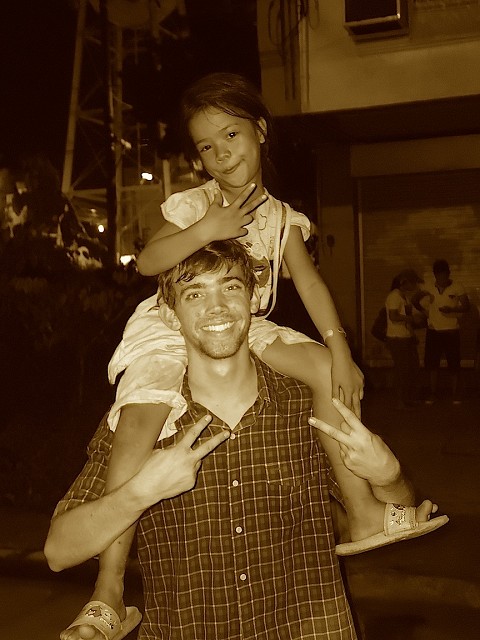
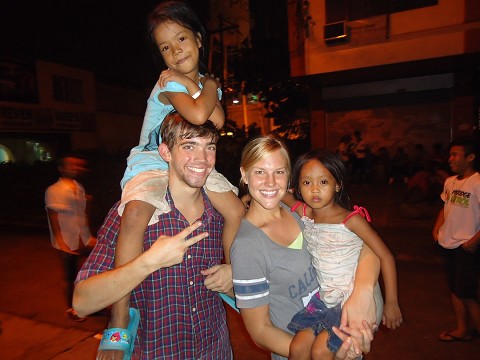
We did ministry to the street children again last night and one little girl in specific, Princess, broke my heart. After giving her a ride on my shoulders and laughing for a bit, she asked to go home. Confused, I asked her where her home was.
“There,” she said, pointing to a sidewalk across the street. We walked across the street and she sat down on the sidewalk under an overhang. “So, this is home?” I asked, in a fairly emotionless voice, not wanting to depress her, but also not wanting to glitz over a grim reality she may have already come to realize.
“Yeah,” she said, her voice replete with exhaustion as she looked up at the overhang, making eye contact with me before looking up at the overhang, as if to direct my eyes towards it and said, “I know, right.” It was a facial expression I had only ever seen on people much older than her. She had received a Bad Lot.

I wish, of course, that this story had a happy ending. Princess surely still fell asleep on the sidewalk that night and will likely do the same tonight—and the next night. I don’t have an answer as to why injustice exists and I have no motivation or inclination to clutter the already messy debates that exist around such issues. I only know that in these situations, God has given all of us the opportunity to glorify his name.
I feel that the parable is applicable to Princess’ situation, though in no way is it representative of all of God’s character, all of man’s potential, or the state of the world today. Similarly, I don’t want to promote a grim scarcity philosophy (because I believe in an abundance philosophy), but merely want to challenge you and myself: Why participate in The Heist when God has given us the opportunity—not the burden, or even the command (which he has), but the opportunity—to pour out our lives in service of the poor?







