
Last Sunday, we learned that a church member’s mother had died. We heard that she had developed a brain tumor and had been in a coma for six months. We can rest assured that she is in heaven right now, as she was a faithful follower of Christ, yet her death was nevertheless a sad occurrence in that she left behind many family members.
I haven’t been to very many funerals in my life. In fact, I’m incredibly lucky in the sense that I’ve only been to two funerals in my life and neither funeral was for an immediate family member or a close friend. I openly admit, therefore, that I am not the best person to talk to about death and dying. For me to discuss death—or even funerals—with a tone of experience or authority would be incredibly out of line and might even slander both the dead and the experiences of the living who are well-acquainted with death. In the same way as it’s best to let my reverence be high and my words be few (if any at all) when discussing the holiness of Yahweh—lest I let a single misplaced word sully His snow-white reputation with the comparative triviality of the English language, I also find it best to let my reverence be high and my words be few when discussing the dead—lest I fail to pay proper homage to the sudden blaze we call life on earth and to the irreversible eternity that follows. “In Uganda, we respect our dead,” our contact Frieda told us.
What I do feel qualified to discuss, however—though even this must be done carefully, like a man maneuvering his way through a loaded minefield where every mine represents a breach—some egregious, some subtle, of the sanctity of the topic—is my own testimony of how I have pondered my own death and how my attitude has changed in the past two years.
After church on Sunday, we piled into the van and drove to the house where the first part of the funeral service would take place. To my surprise, we found a crowd, over one hundred strong, there already. We huddled together in plastic chairs, on the grass, and borrowed wooden benches as our pastor, Joseph, another local pastor, Barnabas, and our church’s elder, James preached the Gospel with vigor. The wooden coffin, draped in a white and purple tapestry stitched with the cross of Christ, sat towards the front of the mass of people in brightly colored traditional African clothing sitting under the rented blue and white striped tent, which leaned lazily on rusty metal poles.
As James spoke on the sacrifice of Christ, and how that related to this woman’s death, my surroundings faded into near meaninglessness as my mind turned to thoughts of my own inevitable death. This Bible does not find this timely introspection surprising. “It is better to go to a house of mourning than to go to a house of feasting, since that is the end of all mankind, and the living should take it to heart,” said King Solomon (Ecclesiastes 7:2).
The worship team sang a trio of Ugandan worship songs, and though I couldn’t understand what they were singing, their ethnic rhythms seemed fit to frame, musically, the rhythm that God has written into life itself—“naked I come, naked I return…” As I spread my Bible open on my lap to follow along with the message James and Pastor Barnabas were giving, I flashed back, unintentionally, to my junior and senior years of high school.
All throughout my life, before I knew Christ, my biggest fear had always been the fear of my own death. It is not that I was afraid of the act of dying itself, for that would likely happen quickly and was a long way away as it was, but that I was terrified of the results of death—the way that death seemed to nullify the meaning of life, to be specific. It was an absolutely harrowing thought.
The two things that I desired were eternal existence and eternal significance and the reality of unavoidable physical death slaughtered any hope I had of attaining either. I had given up on the hope of eternal existence—for the unbreakable laws of nature themselves predestined that I, like every other carbon-based organism would die and rot in the ground—long before I ever gave up on the hope of attaining eternal significance. I tried to help myself forget about my first lost hope by charging deep into romanticized illogicality and trying to convince the shallow parts of my brain—though the deep recesses always knew better—that though my consciousness would not live on, perhaps my name would live on. I was, in essence, trying to muscle my way into eternity.
I knew I was fooling myself, though. Anything I did that would prolong my own name would eventually be replaced or forgotten about, as well. As much as I wanted to make it onto the Moorestown High School record boards for track and field, as my dad and uncles had been, it irked me to picture the fact that someday, sixty years later, some kid that hasn’t even been born yet would come along and replace my name. Very few people’s names stand the test of time. I don’t know the name of my own great, great-grandfather’s name. Do you?
The only reason why these hopeless realizations didn’t depress me as much as they could have—for anyone who knew me in high school would happily admit that I was a good-natured and cheerful person—was simply because the cares and concerns of day to day life removed them from the front of my mind. Yes, I was happy, and happy most often too, but what a shallow happiness it is, that happiness which hinges upon not remembering the central truths of one’s worldview!
If we are not as concerned with the prolonging of our own name, we may still live for the purpose of knowing that we made a legitimate impact on the world, even if nobody knows that it was us, in specific, who made that impact. But what do we mean by knowing? We won’t know it when we’re dead. It won’t give us warm, fuzzy feelings—there will be no feelings. Or perhaps it will be the case that we don’t need our name to carry on (because it won’t), nor do we need to experience the satisfaction that comes from knowing that we made a difference (because we won’t know anything), but we just want others to live a better life, even if it has no effect on our own name or our own satisfaction. Even that view, however, is seriously flawed. In what way do we want others to live a better life? Better in terms of their own ability to find meaning? They will run into the same problems you just ran into. It’s one big, maddening circle. Better in terms of their hedonistic satisfaction? That too is temporary and will be absolutely dwarfed and rendered meaningless by an eternity of nothingness.
Let there be no talk of finding meaning if life is temporary. I’m not cynical, simply because I don’t actually believe that this life represents all that there is. We need to recognize that our attempts to find true meaning in this life—if, of course, it is all that there is—are mere coping mechanisms—distractions and diversions we create to numb death’s sting. They are all diversions. It will not do to brand the meaninglessness of the un-eternal life as cynical and act as if we somehow refuted its logic. No, that will not do. Emotions don’t refute logic.
If funerals represent the quintessence of all things morbid, then weddings, it seems, represent the quintessence of all things joyous. There’s a reason why “Four Weddings and a Funeral” is a catchy movie title—weddings and funerals are seen as opposites. People will pour over dusty photo albums of weddings and recount, over late-night cups of coffee, the classiness of their relatives’ funerals. They are momentous occasions, though momentous for different—opposite—reasons.
Christians, however, cheat death. Christ cheated death first. It would be enough for God to have made a way—through Jesus Christ—to nullify the effects of death: the nothingness and the tragic futility. God, however, in his dogged attempt to display the grandeur of his own name, goes one step further than nullifying the effects of death. He does not just prove his detractors wrong; he turns them on their heads and humiliates them with the cross of Christ. “And, having disarmed the powers and authorities, (Jesus) made a public spectacle of them, triumphing over them by the cross.” (Colossians 2:15). God, in an absolutely egregious breach of the rules of nature, turns funerals into weddings.
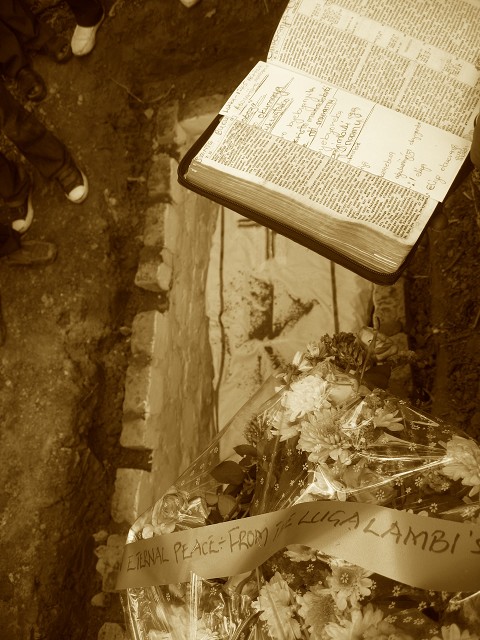
When a Christian dies, he or she is reunited with Jesus Christ and a wedding ushers in eternity. And, though it could be argued that the belief in eternal life is merely Christians’ own version of a diversion created to numb death’s sting, we believe that the hope for our eternal resurrection is based on a very real, historical event: the resurrection of Jesus of Nazareth himself. The apostle Paul makes this same connection in 1 Corinthians 15. “Now if Christ is proclaimed as raised from the dead, how can some of you say, ‘There is no resurrection of the dead’”. (1 Corinthians 15:12). He was writing this a mere 21 years after Jesus’ death and resurrection. To put things in perspective, that same amount of time ago the Berlin Wall fell. Imagine trying to propogate a major world religion today that included rock-solid claims that the Berlin Wall fell if it hadn’t! You would be a laughingstock! You certainly wouldn’t become the official religion of the Roman Empire a mere 250 years later. Our wedding is a real one:
“Then, I heard something like the voice of a vast multitude, like the sound of cascading waters, and like the rumbling of loud thunder, saying:
Hallelujah, because our Lord God, the Almighty, has begun to reign. Let us be glad, rejoice, and give Him glory, because the marriage of the Lamb has come, and his wife has prepared herself. She was given fine linen to wear, bright and pure. For the fine linen represents the righteous acts of the saints.” (Revelation 19:6-8)
The Bible describes us as the bride of Christ. For Christians, it is beautiful to think of the fact that, when we die, and our funerals are being conducted on earth, we will simultaneously be involved in a wedding in heaven.
It took a while for me to realize the beauty of these truths, however, but now that I have, I can joyously report that I am no longer afraid of death. I am ready for my wedding. I guess there is no way to guarantee you that I am not faking it. There is no way of guaranteeing you that is not a false display of heroism. But, I hope you will believe me.
“Where, O death, is your victory? Where, O death, is your sting?” (1 Corinthians 15:55).







