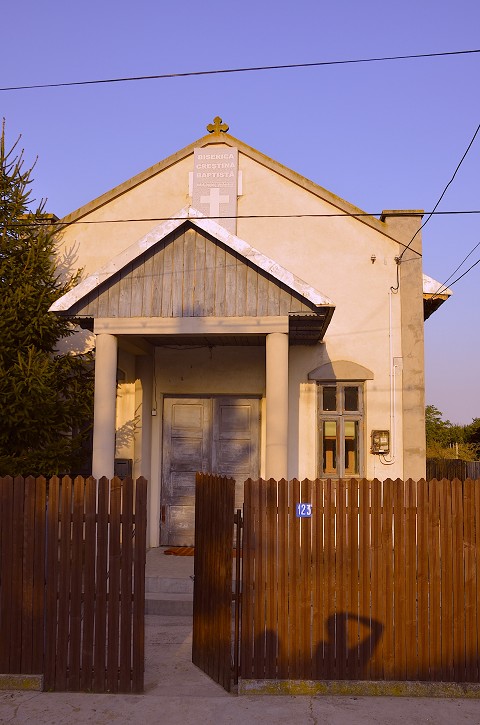
I have often found that God needs to isolate us to grow us. We live in such a busy, interconnected world, especially as our social networking capabilities expand yearly, that it becomes nearly impossible to grow spiritually. Even Jesus would frequently isolate himself to have fellowship with his father. Though spiritual growth and sustained periods of pondering life’s important questions are almost always checklist items of ours, the daily lifestyles we choose are rarely conducive to their accomplishment.
This past week, God gave our team the blessing of isolation. By isolation, I do not mean that we were not busy—it was actually our busiest week on the World Race so far—I simply mean that we enjoyed being isolated in the small, rural, agricultural village of Stoborasti, about an hour’s drive from Draganesti, far from the distractions of internet access and daily news. On Wednesday morning, we left to spend the week working with pastor Raul’s friend and fellow pastor, Alex Ghita.
We were able to do manual labor every morning, help with children’s and youth ministry every afternoon, teach Bible lessons, lead worship, and be a part of two different church services in our short time there. There are dozens of lessons God taught me during my time in Stoborasti, and I am already realizing that this sense of having so much more to say than a blog can do justice to will be a reoccurring theme these next nine and a half months. As anyone who has been on a mission trip can attest to (or even anyone with a memorable experience of any sort)—there is something about seeing, touching, tasting, smelling, and feeling the events about which you write that will always give you an infinitely deeper appreciation of them than you could ever hope to convey to those reading about them. Either way, here are three short, but impactful things I learned in Stoborasti:
Truth #1 – Manual labor is good for the soul. Until recently, I had always liked the idea of manual labor, but never liked the manual labor itself. Though it was obviously not the most important reason why I decided to go on the World Race, the thought of manual labor certainly did appeal to my inner man, especially on the days I felt trapped within the four walls of the university classroom. There seemed to be something almost honorable, as crazy as this sounds, to having a talented mind, but putting it on hold for some more “manly” manual labor task—a sort of Will Hunting syndrome. Again, though, I always liked the idea of manual labor more than I liked the manual labor itself! When I was actually doing the work, I’d complain to myself and hope to be done as quickly as possible.
Though I feel like God has been teaching me these first two months that my gifting and my calling ismy brain and my academic love of the Word of God (and there’s nothing un-manly about that), rather than manual labor, I do still cherish the moments when I get to do manual labor. I have started to cherish the manual labor itself primarily because there is a new type of joy that comes from knowing you are working for Christ (Colossians 3:17). Back in Draganesti, at the beginning of the week, we worked hard to clear out a plot of land that will later be used for a soccer field for the youth of Hope Church. In Stoborasti, we cleared out a protestant graveyard some days and moved firewood the other day.
Both the sweaty reward that comes from looking at the fruit of your manual labor and the process itself are deeply satisfying, though Biblically, this should be no surprise. After all, the sole task of man in the Garden of Eden was purely to cultivate the land (Genesis 2)! It was only after the fall of man in Genesis 3, that this manual labor became toilsome and joyless. When we are working for Christ, we get a glimpse back into the Garden of Eden, and a glimpse of what manual labor was created to feel like.

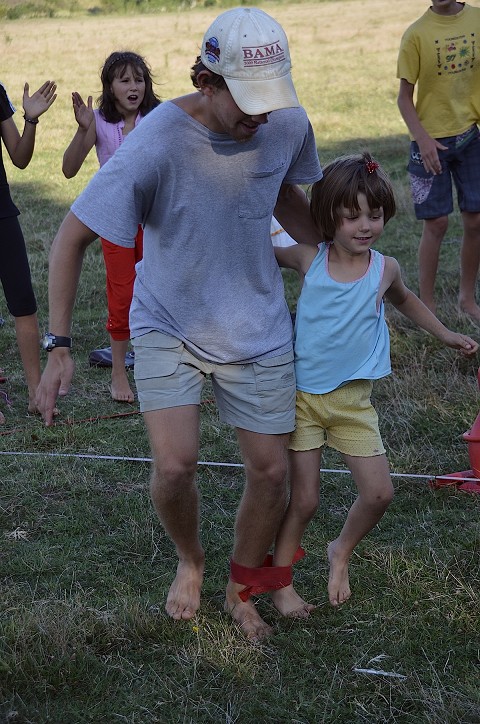
Truth #2 – Children are created to remind us of what child-like faith should look like. This sounds obvious, but the more I think about it, the more profound it is. In the time we spent doing children’s ministry, it was incredible to see their heartfelt prayers and the unquestioning rawness of their faith. They constantly seemed to have a better grasp on the true meaning of Biblical principles than we did. The more I pondered this, though, the more I realized how I had effectively reversed God’s use of children and child-like faith. Here is what I mean by that:
I often imagined that God, early on, noticed the type of faith that young children have and then instructed us, as adults, to be more like them. It’s as if God saw that children would be useful in explaining principles of his Kingdom and thus made the executive decision to include them in his divinely compiled narrative for that reason. This view, however, cheapens the beautiful reality of how God uses children. It presupposes that children came before Child-like faith, and that God, in witnessing the random characteristics of children (as if He didn’t create them anyway), decided that they would be the best analogy to use for the abstract, previously unexplainable type of faith we should approach His throne with.
We are told in John 1:1, however, that “in the beginning there was the word…”. God’s word, principles, and concepts came first! Child-like faith came before the child—God created the child for the very purpose of exhibiting child-like faith! What does this all matter, though? Isn’t it just semantics and wordplay? I think that when we realize the difference between God merely noticing the characteristics of children and God creating them in the womb to fulfill His desired characteristics for the transcendent purpose of His glory, we appreciate children a hundred times more! Thank God for children!
The Lie – Our circumstances determine our happiness. We are often told, even from secular speakers, that our circumstances (especially financial and material) don’t have to determine our happiness– and I totally agree! What I don’t agree with, however, is the almost universally accepted secular remedy—namely, that we can simply choose to be happy and we will be. I tried it constantly and it only seemed to work for a season or a short period of time. Maybe I just wasn’t apt enough in the practice of emotion-control, but my dang circumstances would always creep back in and rain on my parade of self-constructed happiness just hours after it started. I propose that the only panacea able to render our physical circumstances useless in determining our happiness is Christ.
This is precisely because the reality of what Christ did for us, the beauty of his story, and the excited anticipation of someday returning to our true home absolutely dwarves our circumstances! Fake happiness, the kind created out of thin air, lasts for such a short season before it needs to be mustered-up again and refocused on because it offers us nothing tangible behind which we can place our happiness! It is like paper money without gold bars to back it up. Surpassing Christ-happiness is backed by a solid historical event (the crucifixion), a solid hope for the future, and a solid God.
It was so evident that Alex and his family rejoiced daily in this solid happiness. The fact that they live in a modest, two-room house (one kitchen, with a bathroom attached and a bedroom for him, his wife, and his two young children) above the church he pastors had no effect on his happiness. Neither did the fact that there hadn’t been any hot water at the house for the past two months, nor did the fact that they lacked a car (this meant an hour and fifteen minute walk to the next village for children’s ministry!) seem to affect it either. They knew the love of Christ that surpasses all understanding (Ephesians 3:19).
So where does this leave us? Rejoice in Christ, because it dwarves our circumstances, do manual labor on occasion, because it feeds the soul, and have the type of child-like faith that children were created for! It will give us lasting happiness—trust me!