As our squad’s old, rickety bus crossed the Indian-Nepali border, I knew that this would be an incredible month. Kathmandu, Nepal’s capital, is considerably cooler than anywhere we’d been in India as it sits at 4,600 feet above sea level in a valley surrounded by the foothills that comprise the base of the Himalayas, just six hours south of Mt. Everest. After 31 hours of bus-riding, we were more than ready to get off and get situated.
In typical World Race fashion, we got off the bus at Kathmandu’s main bus station without a cell phone sim-card, without a map, and with no idea of how to get to our contact’s house. Luckily, we figured it out, one step
at a time.
God has presented our team with a unique challenge this month and this challenge has certainly been thought-provoking. The children’s home and school where we are working, Happy Home Nepal, is a secular organization. As Christians, it is understood that improving people’s physical circumstances without improving their standings before a holy and perfect God (via the Gospel of Jesus Christ) is the equivalent of trying to cure cancer with a Band-Aid. On the other hand, as Christians, it is absolutely imperative to care for the broken physical circumstances around us as the Bible commands us and as the indwelling spirit of God compels us. The entire parable of The Good Samaritan (Luke 10:25-37) is about just that—not neglecting one’s neighbor when he or she is in need. Similarly, when the Bible offers us litmus tests for measuring the sincerity of our salvation, the criteria with which we are to measure ourselves is almost always our commitment to social justice (think Luke 3:7-3:14 or all of 1 John).

St. Francis once famously said, “Preach the Gospel at all times; if necessary use words.” People have taken this famous quote, however (which isn’t inspired scripture), and obscured it to mean that words are not necessary whatsoever in the salvation process. I’m not sure that this idea squares with the full weight of scripture, however, which clearly teaches that though loving actions are vital in bolstering the Gospel, salvation cannot occur without one hearing the Gospel in the spoken word. After all, we must not separate loving actions and the spoken-word Gospel as two separate ideas, because as Christians, we understand that speaking the Gospel is not only a loving action in and of itself, but the most loving action that exists.
We must believe that the best thing that can possibly happen to Happy Home Nepal is that it would be radically changed by the Gospel. It certainly looks as if Happy Home Nepal is seeking God—not that this is grounds for salvation, because it is not, but it is prompting for God to send missionaries. Consider Cornelius in the book of Acts. He is a vaguely righteous man, but he is not saved. His righteous seeking, however, is what prompts God to send Peter directly to his doorstep to share the Gospel with him. Happy Home Nepal does not, of course, show what we would consider to be saving faith (full trust in Jesus Christ as man’s only hope for salvation), but they absolutely show (especially in the conversations we’ve had with them in the first 48 hours) seeking faith—the type of faith that stirs God’s heart to send floods of missionaries.
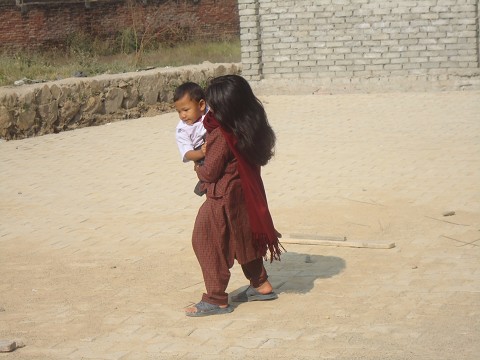
Happy Home Nepal is a children’s home for children who have been rescued off of the streets of Nepal. Most of the children come from extreme cases of abuse and neglect. Many were given names and birth dates only upon arrival at the home as they were found literally unidentified, abandoned, and lying on the streets. For the females especially, Happy Home Nepal provides an escape from what would have likely turned into human sex trafficking down the road. The employees here have huge hearts and they love incredibly well. My prayer is that their hearts would submit to the God who loves them even more than they love others.
To be perfectly honest, I did initially question our alignment with a secular organization. “Why are we even going there?” I asked my teammates, bluntly, “Is this even missions?” As my teammates encouraged me, however, and as God simultaneously changed my heart on the issue, I realized that not only did this month “count” as missions, but rather that this month demonstrates the very essence of missions. For these next four weeks, we will not enjoy the luxury—or experience the curse—of being recognized as Christians by the organization whose label we bear and whose acronym we can clearly rattle off. Instead, it will be an amazing challenge to see if people will “know we are Christians by our love”—in both word and deed.